

If you’re just stepping into the world of fiber optics, all the technical terms and abbreviations can feel overwhelming. That’s why I created this fiber glossary series — to help you understand what these terms really mean, in the simplest way possible.
I’ll explain everything from an industry insider’s point of view, using real photos whenever I can (not just fancy renders). I also avoid overly complex explanations, keeping the language clear and direct, so you can be confident you’ll understand the real meaning of these terms after reading.
Today, we’re going to talk about: Numerical Aperture (NA)
TABLE OF CONTENTS
What Is Numerical Aperture (NA)?
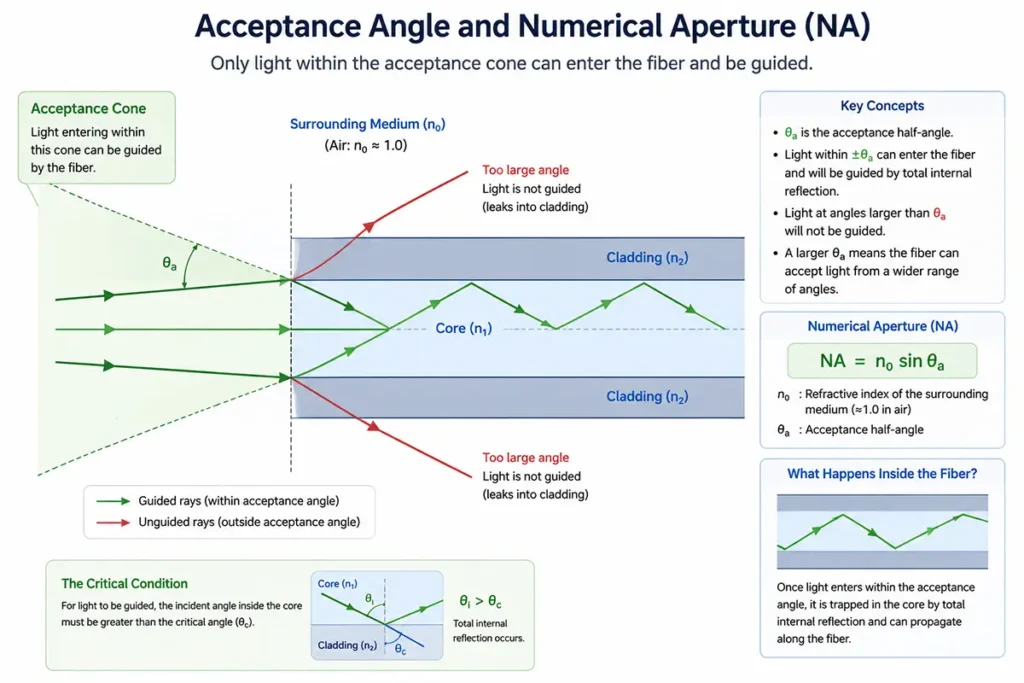
Numerical Aperture (NA) is a dimensionless parameter that describes an optical fiber’s ability to collect and guide light. It determines the maximum range of angles at which light can enter the fiber and still remain confined within the core through total internal reflection.
In simple terms, NA indicates how easy it is for light to enter a fiber. A larger NA allows the fiber to accept light from a wider range of angles, while a smaller NA requires more precise alignment but provides better control of light propagation. As a result, NA plays an important role in fiber coupling efficiency, mode propagation, and overall optical system design.
What Does Numerical Aperture Actually Mean?
For beginners, the easiest way to understand Numerical Aperture is to think of it as a fiber’s “light acceptance ability.”
Imagine two funnels placed outside during a rainstorm.
One funnel has a wide opening, while the other has a narrow opening. The wider funnel can collect rainwater more easily because it accepts water from a larger range of directions.
Optical fibers behave in a similar way.
A fiber with a larger Numerical Aperture can accept light over a wider range of input angles, making it easier to couple light into the fiber. A fiber with a smaller Numerical Aperture accepts light only within a narrower angle range and therefore requires more precise alignment.
This is why Numerical Aperture is often considered one of the most important parameters when designing fiber optic communication systems.
Understanding the Acceptance Angle
Not every light ray that reaches the end face of a fiber can successfully travel through it.
For light to remain guided inside the core, it must enter the fiber within a specific range of angles. If the angle is too large, the light will not satisfy the conditions for total internal reflection and will escape into the cladding.
The maximum angle at which light can enter the fiber and still propagate through the core is called the Acceptance Angle.
Numerical Aperture is essentially a measurement of this acceptance capability.
A larger Acceptance Angle means the fiber can collect light more easily. A smaller Acceptance Angle means the incoming light must be aligned more precisely.
This relationship is one of the primary reasons why Numerical Aperture is widely used when evaluating fiber coupling performance.
How Is Numerical Aperture Calculated?
Numerical Aperture can be expressed using the Acceptance Angle:
NA = n₀ sin θₐ
Where:
- n₀ is the refractive index of the surrounding medium (approximately 1 in air)
- θₐ is the Acceptance Angle (half-angle)
For optical fibers, Numerical Aperture can also be calculated using the refractive indices of the core and cladding:
NA = √(n₁² − n₂²)
Where:
- n₁ is the refractive index of the fiber core
- n₂ is the refractive index of the cladding
This equation shows that Numerical Aperture is directly related to the refractive index difference between the core and cladding.
In other words, a larger refractive index difference generally results in a larger Numerical Aperture.
Why Is Numerical Aperture Important?
Although Numerical Aperture is a simple parameter, it affects several important aspects of fiber performance.
1. It Determines How Easily Light Enters the Fiber
The most direct effect of Numerical Aperture is on light coupling.
A fiber with a large NA can accept light from a wider range of angles, making it easier to launch optical power into the fiber.
This is particularly useful when using light sources such as LEDs, which emit light over relatively broad angles.
In contrast, fibers with smaller NA values require more precise alignment between the light source and the fiber.
2. It Affects Coupling Efficiency
Coupling efficiency describes how much optical power successfully enters the fiber.
A larger Numerical Aperture generally improves coupling efficiency because the fiber can capture a greater portion of the incoming light.
This is one reason why multimode fibers are often easier to connect and align than single-mode fibers.
In practical applications, coupling efficiency directly influences insertion loss and overall system performance.
3. It Influences Supported Modes
Numerical Aperture also affects how light propagates inside the fiber.
Fibers with larger NA values can support a greater number of propagation modes. This is one reason why multimode fibers typically have larger Numerical Apertures.
Fibers with smaller NA values support fewer modes and provide better control over light propagation.
As a result:
- Multimode fibers generally have higher NA values.
- Single-mode fibers generally have lower NA values.
This relationship helps explain why single-mode fibers are preferred for long-distance, high-bandwidth communication systems.
Numerical Aperture and Relative Refractive Index Difference
Numerical Aperture is closely related to Relative Refractive Index Difference (Δ).
The relationship can be simplified as:
Larger Δ → Larger NA → Larger Acceptance Angle
When the refractive index difference between the core and cladding increases, the fiber can confine light more strongly. This allows the fiber to accept light over a wider range of angles, resulting in a higher Numerical Aperture.
Conversely, a smaller Δ generally produces a smaller NA and a narrower Acceptance Angle.
This is why single-mode fibers typically use smaller values of Δ, while multimode fibers often use larger values.

Typical Numerical Aperture Values
Different types of optical fibers use different Numerical Aperture values depending on their design goals.
| Fiber Type | Typical NA |
|---|---|
| Single-Mode Fiber | 0.10 – 0.14 |
| OM1 Multimode Fiber | 0.20 – 0.29 |
| OM2 Multimode Fiber | 0.20 – 0.29 |
| OM3 Multimode Fiber | ~0.20 |
| OM4 Multimode Fiber | ~0.20 |
| OM5 Multimode Fiber | ~0.20 |
In general, multimode fibers have larger Numerical Apertures because they are designed to collect light more easily and support multiple propagation modes.
A Simple Analogy to Understand Numerical Aperture
Imagine trying to throw a ball into a bucket.
A bucket with a large opening is easier to hit because it can accept the ball from a wider range of directions.
A bucket with a small opening requires much more precise aim.
Numerical Aperture works in a similar way.
A higher NA creates a larger optical “target,” making it easier for light to enter the fiber.
A lower NA creates a smaller target, requiring more precise alignment but providing greater control over light propagation.
Frequently Asked Questions
Is a higher Numerical Aperture always better?
No. A higher NA improves light collection and coupling efficiency, but it can also support more propagation modes. The optimal value depends on the application.
What is the typical NA of single-mode fiber?
Most standard single-mode fibers have a Numerical Aperture between approximately 0.10 and 0.14.
What is the relationship between NA and Acceptance Angle?
A larger Numerical Aperture corresponds to a larger Acceptance Angle, allowing the fiber to collect light from a wider range of directions.
What is the relationship between NA and Relative Refractive Index Difference?
In general, a larger Relative Refractive Index Difference (Δ) results in a larger Numerical Aperture.
Conclusion
Numerical Aperture (NA) is one of the most important parameters in fiber optics because it describes how effectively a fiber can collect and guide light. It directly influences Acceptance Angle, coupling efficiency, supported propagation modes, and overall fiber performance.
Although NA is a simple dimensionless value, it plays a critical role in the design and operation of optical communication systems, making it an essential concept for anyone working with fiber optics.
Still Have Questions?
If you’re still unsure about something, feel free to reach out.
Want to explore more fiber optic terms? Head over to our blog section.
If the term you’re looking for isn’t covered yet, let me know — I’ll add it to the priority list!
And lastly — if you’re a telecom provider, network operator, or involved in fiber infrastructure development and looking for a reliable partner in fiber optic components — feel free to contact to us.