

Si vous venez d'entrer dans le monde de la fibre optique, tous les termes techniques et les abréviations peuvent vous sembler insurmontables. C'est pourquoi j'ai créé ce série de glossaires sur les fibres - pour vous aider à comprendre ce que ces termes signifient réellement, de la manière la plus simple possible.
Je vous expliquerai tout du point de vue d'un connaisseur du secteur, en utilisant de vraies photos chaque fois que je le peux (et pas seulement des rendus fantaisistes). J'évite également les explications trop complexes, en gardant un langage clair et direct, afin que vous puissiez être sûr de comprendre la véritable signification de ces termes après la lecture.
Aujourd'hui, nous allons parler de.. : Ouverture numérique (NA)
TABLE DES MATIÈRES
Qu'est-ce que l'ouverture numérique (NA) ?
L'ouverture numérique (NA) est un paramètre sans dimension qui décrit la capacité d'une fibre optique à collecter et à guider la lumière. Elle détermine la plage maximale d'angles à laquelle la lumière peut pénétrer dans la fibre tout en restant confinée à l'intérieur du cœur par réflexion interne totale.
En termes simples, la NA indique la facilité avec laquelle la lumière pénètre dans une fibre. Une NA plus grande permet à la fibre d'accepter la lumière sous une plus grande variété d'angles, tandis qu'une NA plus petite nécessite un alignement plus précis mais permet un meilleur contrôle de la propagation de la lumière. Par conséquent, la NA joue un rôle important dans l'efficacité du couplage des fibres, propagation du mode, et la conception globale du système optique.
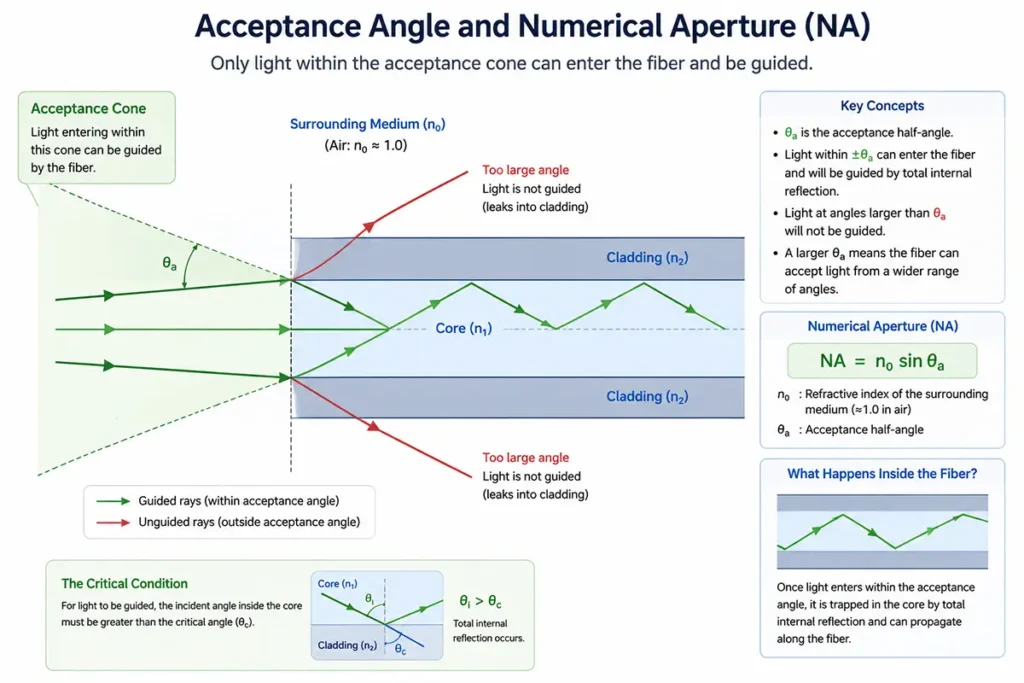
Que signifie l'ouverture numérique ?
Pour les débutants, la façon la plus simple de comprendre l'ouverture numérique est de la considérer comme la “capacité d'acceptation de la lumière” d'une fibre.”
Imaginez deux entonnoirs placés à l'extérieur pendant une tempête de pluie.
Un entonnoir a une large ouverture, tandis que l'autre a une ouverture étroite. L'entonnoir le plus large peut recueillir l'eau de pluie plus facilement car il accepte l'eau provenant d'un plus grand nombre de directions.
Les fibres optiques se comportent de la même manière.
Une fibre avec une ouverture numérique plus grande peut accepter la lumière sur une plus large gamme d'angles d'entrée, ce qui facilite le couplage de la lumière dans la fibre. Une fibre avec une ouverture numérique plus petite n'accepte la lumière que dans une plage d'angles plus étroite et nécessite donc un alignement plus précis.
C'est pourquoi l'ouverture numérique est souvent considérée comme l'un des paramètres les plus importants lors de la conception de systèmes de communication par fibre optique.
Comprendre l'angle d'acceptation
Tous les rayons lumineux qui atteignent l'extrémité d'une fibre ne peuvent pas la traverser avec succès.
Pour que la lumière reste guidée à l'intérieur du cœur, elle doit entrer dans la fibre dans une plage d'angles spécifique. Si l'angle est trop grand, la lumière ne remplit pas les conditions de réflexion interne totale et s'échappe dans la gaine.
L'angle maximal auquel la lumière peut pénétrer dans la fibre tout en se propageant à travers le cœur est appelé l'angle d'ouverture. Angle d'acceptation.
L'ouverture numérique est essentiellement une mesure de cette capacité d'acceptation.
Un angle d'acceptation plus grand signifie que la fibre peut collecter la lumière plus facilement. Un angle d'acceptation plus petit signifie que la lumière entrante doit être alignée plus précisément.
Cette relation est l'une des principales raisons pour lesquelles l'ouverture numérique est largement utilisée lors de l'évaluation des performances de couplage des fibres.
Comment l'ouverture numérique est-elle calculée ?
L'ouverture numérique peut être exprimée à l'aide de l'angle d'acceptation :
NA = n₀ sin θₐ
Où ?
- n₀ est l'indice de réfraction du milieu environnant (environ 1 dans l'air)
- θₐ est l'angle d'acceptation (demi-angle)
Pour les fibres optiques, l'ouverture numérique peut également être calculée en utilisant les indices de réfraction du cœur et de la gaine :
NA = √(n₁² - n₂²)
Où ?
- n₁ est l'indice de réfraction du cœur de la fibre
- n₂ est l'indice de réfraction de la gaine
Cette équation montre que l'ouverture numérique est directement liée à la différence d'indice de réfraction entre le cœur et la gaine.
En d'autres termes, une plus grande différence d'indice de réfraction se traduit généralement par une plus grande ouverture numérique.
Pourquoi l'ouverture numérique est-elle importante ?
Bien que l'ouverture numérique soit un paramètre simple, elle affecte plusieurs aspects importants de la performance de la fibre.
1. Il détermine la facilité avec laquelle la lumière pénètre dans la fibre.
L'effet le plus direct de l'ouverture numérique est le couplage de la lumière.
Une fibre avec une grande NA peut accepter de la lumière à partir d'une plus grande gamme d'angles, ce qui facilite le lancement de la puissance optique dans la fibre.
Ceci est particulièrement utile lors de l'utilisation de sources lumineuses telles que les LED, qui émettent de la lumière sur des angles relativement larges.
En revanche, les fibres ayant des valeurs NA plus faibles nécessitent un alignement plus précis entre la source lumineuse et la fibre.
2. Il affecte l'efficacité de l'accouplement
L'efficacité du couplage décrit la quantité de puissance optique qui pénètre avec succès dans la fibre.
Une ouverture numérique plus grande améliore généralement l'efficacité du couplage car la fibre peut capter une plus grande partie de la lumière entrante.
C'est l'une des raisons pour lesquelles les fibres multimodes sont souvent plus faciles à connecter et à aligner que les fibres monomodes.
Dans les applications pratiques, l'efficacité du couplage influence directement la perte d'insertion et la performance globale du système.
3. Il influence les modes de soutien
L'ouverture numérique affecte également la façon dont la lumière se propage à l'intérieur de la fibre.
Les fibres ayant des valeurs NA plus élevées peuvent supporter un plus grand nombre de modes de propagation. C'est l'une des raisons pour lesquelles les fibres multimodes ont généralement des ouvertures numériques plus grandes.
Les fibres ayant des valeurs NA plus faibles supportent moins de modes et permettent un meilleur contrôle de la propagation de la lumière.
En conséquence :
- Les fibres multimodes ont généralement des valeurs NA plus élevées.
- Les fibres monomodes ont généralement des valeurs NA plus faibles.
Cette relation explique pourquoi les fibres monomodes sont préférées pour les systèmes de communication à longue distance et à large bande passante.
Ouverture numérique et différence d'indice de réfraction relatif
L'ouverture numérique est étroitement liée à la différence d'indice de réfraction relatif (Δ).
La relation peut être simplifiée comme suit :
Plus grand Δ → Plus grand NA → Plus grand angle d'acceptation
Lorsque la différence d'indice de réfraction entre le cœur et la gaine augmente, la fibre peut confiner la lumière plus fortement. Cela permet à la fibre d'accepter la lumière sur une plus grande plage d'angles, ce qui se traduit par une ouverture numérique plus élevée.
Inversement, un Δ plus petit produit généralement un NA plus petit et un angle d'acceptation plus étroit.
C'est pourquoi fibres monomodes utilisent généralement des valeurs plus petites de Δ, tandis que les fibres multimodes utilisent souvent des valeurs plus grandes.

Valeurs d'ouverture numérique typiques
Les différents types de fibres optiques utilisent des valeurs d'ouverture numérique différentes en fonction de leurs objectifs de conception.
| Type de fibre | Typique NA |
|---|---|
| Fibre monomode | 0.10 – 0.14 |
| Fibre multimode OM1 | 0.20 – 0.29 |
| Fibre multimode OM2 | 0.20 – 0.29 |
| Fibre multimode OM3 | ~0.20 |
| Fibre multimode OM4 | ~0.20 |
| Fibre multimode OM5 | ~0.20 |
En général, les fibres multimodes ont des ouvertures numériques plus grandes parce qu'elles sont conçues pour collecter la lumière plus facilement et prendre en charge plusieurs modes de propagation.
Une analogie simple pour comprendre l'ouverture numérique
Imaginez que vous essayez de lancer une balle dans un seau.
Un seau avec une grande ouverture est plus facile à frapper parce qu'il peut accepter la balle dans un plus grand nombre de directions.
Un seau avec une petite ouverture nécessite une visée beaucoup plus précise.
L'ouverture numérique fonctionne de la même manière.
Une NA plus élevée crée une “cible” optique plus grande, ce qui facilite l'entrée de la lumière dans la fibre.
Une NA plus faible crée une cible plus petite, ce qui nécessite un alignement plus précis mais permet de mieux contrôler la propagation de la lumière.
Questions fréquemment posées
Une ouverture numérique plus élevée est-elle toujours préférable ?
Non. Une NA plus élevée améliore la collecte de la lumière et l'efficacité du couplage, mais elle peut également prendre en charge davantage de modes de propagation. La valeur optimale dépend de l'application.
Quelle est la NA typique d'une fibre monomode ?
La plupart des fibres monomodes standard ont une ouverture numérique comprise entre 0,10 et 0,14 environ.
Quelle est la relation entre NA et l'angle d'acceptation ?
Une ouverture numérique plus grande correspond à un angle d'acceptation plus grand, ce qui permet à la fibre de capter la lumière dans un plus grand nombre de directions.
Quelle est la relation entre l'indice de réfraction relatif et la différence d'indice de réfraction relatif ?
En général, une plus grande différence d'indice de réfraction relatif (Δ) se traduit par une plus grande ouverture numérique.
Conclusion
L'ouverture numérique (NA) est l'un des paramètres les plus importants dans le domaine des fibres optiques, car elle décrit l'efficacité avec laquelle une fibre peut collecter et guider la lumière. Elle influence directement l'angle d'acceptation, l'efficacité du couplage, les modes de propagation pris en charge et les performances globales de la fibre.
Bien que la NA soit une simple valeur sans dimension, elle joue un rôle essentiel dans la conception et le fonctionnement des systèmes de communication optique, ce qui en fait un concept essentiel pour toute personne travaillant dans le domaine des fibres optiques.
Vous avez encore des questions ?
Si vous avez encore des doutes, n'hésitez pas à nous contacter.
Vous souhaitez découvrir d'autres termes relatifs à la fibre optique ? Consultez notre section blog.
Si le terme que vous recherchez n'est pas encore couvert, faites-le moi savoir - je l'ajouterai à la liste des priorités !
Enfin, si vous êtes un fournisseur de télécommunications, un opérateur de réseau, ou si vous êtes impliqué dans le développement d'une infrastructure de fibre optique et que vous recherchez un partenaire fiable pour les composants de fibre optique, n'hésitez pas à nous contacter.