
Se você está começando a entrar no mundo da fibra óptica, todos os termos técnicos e abreviações podem parecer esmagadores. Por isso, criei este série glossário de fibras - para ajudá-lo a entender o que esses termos realmente significam, da maneira mais simples possível.
Explicarei tudo do ponto de vista de um especialista do setor, usando fotos reais sempre que possível (não apenas renderizações sofisticadas). Também evito explicações excessivamente complexas, mantendo a linguagem clara e direta, para que você possa ter certeza de que entenderá o real significado desses termos após a leitura.
Hoje, vamos falar sobre: Abertura numérica (NA)
ÍNDICE DE CONTEÚDO
O que é abertura numérica (NA)?
A abertura numérica (NA) é um parâmetro sem dimensão que descreve a capacidade de uma fibra óptica de coletar e guiar a luz. Ele determina a faixa máxima de ângulos em que a luz pode entrar na fibra e ainda permanecer confinada dentro do núcleo por meio da reflexão interna total.
Em termos simples, o NA indica a facilidade com que a luz entra em uma fibra. Um NA maior permite que a fibra aceite luz de uma gama mais ampla de ângulos, enquanto um NA menor exige um alinhamento mais preciso, mas oferece melhor controle da propagação da luz. Como resultado, o NA desempenha um papel importante na eficiência do acoplamento da fibra, propagação de modo, e o projeto geral do sistema óptico.
O que realmente significa abertura numérica?
Para os iniciantes, a maneira mais fácil de entender a abertura numérica é pensar nela como a “capacidade de aceitação de luz” de uma fibra.”
Imagine dois funis colocados do lado de fora durante uma tempestade.
Um funil tem uma abertura larga, enquanto o outro tem uma abertura estreita. O funil mais largo pode coletar a água da chuva com mais facilidade porque aceita a água de uma gama maior de direções.
As fibras ópticas se comportam de maneira semelhante.
Uma fibra com uma abertura numérica maior pode aceitar luz em uma faixa mais ampla de ângulos de entrada, facilitando o acoplamento da luz na fibra. Uma fibra com uma abertura numérica menor aceita luz somente em uma faixa de ângulo mais estreita e, portanto, exige um alinhamento mais preciso.
É por isso que a abertura numérica é frequentemente considerada um dos parâmetros mais importantes no projeto de sistemas de comunicação por fibra óptica.
Entendendo o ângulo de aceitação
Nem todo raio de luz que chega à extremidade de uma fibra pode atravessá-la com sucesso.
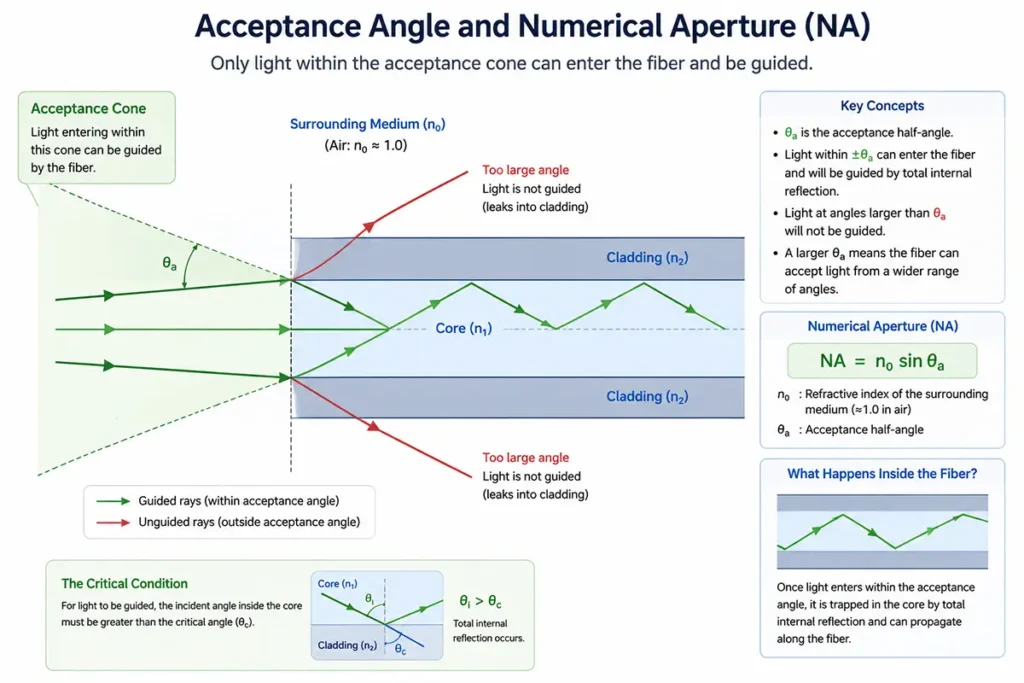
Para que a luz permaneça guiada dentro do núcleo, ela deve entrar na fibra dentro de uma faixa específica de ângulos. Se o ângulo for muito grande, a luz não satisfará as condições para a reflexão interna total e escapará para o revestimento.
O ângulo máximo em que a luz pode entrar na fibra e ainda se propagar pelo núcleo é chamado de Ângulo de aceitação.
A abertura numérica é essencialmente uma medida dessa capacidade de aceitação.
Um ângulo de aceitação maior significa que a fibra pode coletar a luz com mais facilidade. Um ângulo de aceitação menor significa que a luz de entrada deve ser alinhada com mais precisão.
Essa relação é um dos principais motivos pelos quais a abertura numérica é amplamente usada na avaliação do desempenho do acoplamento da fibra.
Como a abertura numérica é calculada?
A abertura numérica pode ser expressa usando o ângulo de aceitação:
NA = n₀ sin θₐ
Onde:
- n₀ é o índice de refração do meio circundante (aproximadamente 1 no ar)
- θₐ é o ângulo de aceitação (meio-ângulo)
Para fibras ópticas, a abertura numérica também pode ser calculada usando os índices de refração do núcleo e do revestimento:
NA = √(n₁² - n₂²)
Onde:
- n₁ é o índice de refração do núcleo da fibra
- n₂ é o índice de refração do revestimento
Essa equação mostra que a abertura numérica está diretamente relacionada à diferença de índice de refração entre o núcleo e o revestimento.
Em outras palavras, uma diferença maior de índice de refração geralmente resulta em uma abertura numérica maior.
Por que a abertura numérica é importante?
Embora a abertura numérica seja um parâmetro simples, ela afeta vários aspectos importantes do desempenho da fibra.
1. Determina a facilidade com que a luz entra na fibra
O efeito mais direto da abertura numérica é o acoplamento de luz.
Uma fibra com um NA grande pode aceitar luz de uma variedade maior de ângulos, facilitando o lançamento de potência óptica na fibra.
Isso é particularmente útil ao usar fontes de luz, como LEDs, que emitem luz em ângulos relativamente amplos.
Em contrapartida, as fibras com valores menores de NA exigem um alinhamento mais preciso entre a fonte de luz e a fibra.
2. Afeta a eficiência do acoplamento
A eficiência do acoplamento descreve a quantidade de potência óptica que entra com sucesso na fibra.
Uma abertura numérica maior geralmente melhora a eficiência do acoplamento porque a fibra pode capturar uma parte maior da luz de entrada.
Esse é um dos motivos pelos quais as fibras multimodo costumam ser mais fáceis de conectar e alinhar do que as fibras monomodo.
Em aplicações práticas, a eficiência do acoplamento influencia diretamente a perda de inserção e o desempenho geral do sistema.
3. Influencia os modos suportados
A abertura numérica também afeta a forma como a luz se propaga dentro da fibra.
As fibras com valores de NA maiores podem suportar um número maior de modos de propagação. Esse é um dos motivos pelos quais as fibras multimodo geralmente têm aberturas numéricas maiores.
As fibras com valores menores de NA suportam menos modos e oferecem melhor controle sobre a propagação da luz.
Como resultado:
- As fibras multimodo geralmente têm valores de NA mais altos.
- As fibras monomodo geralmente têm valores de NA mais baixos.
Essa relação ajuda a explicar por que as fibras monomodo são preferidas para sistemas de comunicação de longa distância e alta largura de banda.
Abertura numérica e diferença de índice de refração relativo
A abertura numérica está intimamente relacionada à diferença do índice de refração relativo (Δ).
A relação pode ser simplificada como:
Maior Δ → Maior NA → Maior ângulo de aceitação
Quando a diferença de índice de refração entre o núcleo e o revestimento aumenta, a fibra pode confinar a luz com mais força. Isso permite que a fibra aceite luz em uma faixa mais ampla de ângulos, resultando em uma abertura numérica maior.
Por outro lado, um Δ menor geralmente produz um NA menor e um ângulo de aceitação mais estreito.
É por isso que fibras monomodo normalmente usam valores menores de Δ, enquanto as fibras multimodo geralmente usam valores maiores.

Valores típicos de abertura numérica
Diferentes tipos de fibras ópticas usam diferentes valores de abertura numérica, dependendo de seus objetivos de projeto.
| Tipo de fibra | Típico NA |
|---|---|
| Fibra monomodo | 0.10 – 0.14 |
| Fibra multimodo OM1 | 0.20 – 0.29 |
| Fibra multimodo OM2 | 0.20 – 0.29 |
| Fibra multimodo OM3 | ~0.20 |
| Fibra multimodo OM4 | ~0.20 |
| Fibra multimodo OM5 | ~0.20 |
Em geral, as fibras multimodo têm aberturas numéricas maiores porque são projetadas para coletar luz com mais facilidade e suportar vários modos de propagação.
Uma analogia simples para entender a abertura numérica
Imagine tentar jogar uma bola em um balde.
Um balde com uma abertura grande é mais fácil de acertar porque pode receber a bola de uma variedade maior de direções.
Um balde com uma abertura pequena exige uma mira muito mais precisa.
A abertura numérica funciona de maneira semelhante.
Um NA mais alto cria um “alvo” óptico maior, facilitando a entrada da luz na fibra.
Um NA menor cria um alvo menor, exigindo um alinhamento mais preciso, mas proporcionando maior controle sobre a propagação da luz.
Perguntas frequentes
Uma abertura numérica maior é sempre melhor?
Um NA mais alto melhora a coleta de luz e a eficiência do acoplamento, mas também pode suportar mais modos de propagação. O valor ideal depende do aplicativo.
Qual é o NA típico da fibra monomodo?
A maioria das fibras monomodo padrão tem uma abertura numérica entre aproximadamente 0,10 e 0,14.
Qual é a relação entre NA e o ângulo de aceitação?
Uma abertura numérica maior corresponde a um ângulo de aceitação maior, permitindo que a fibra colete luz de uma gama mais ampla de direções.
Qual é a relação entre NA e a diferença do índice de refração relativo?
Em geral, uma diferença maior de índice de refração relativo (Δ) resulta em uma abertura numérica maior.
Conclusão
A abertura numérica (NA) é um dos parâmetros mais importantes na fibra óptica, pois descreve a eficácia com que uma fibra pode coletar e guiar a luz. Ela influencia diretamente o ângulo de aceitação, a eficiência do acoplamento, os modos de propagação suportados e o desempenho geral da fibra.
Embora o NA seja um valor simples e sem dimensão, ele desempenha um papel fundamental no projeto e na operação de sistemas de comunicação óptica, tornando-o um conceito essencial para qualquer pessoa que trabalhe com fibra óptica.
Ainda tem dúvidas?
Se ainda não tiver certeza sobre algo, sinta-se à vontade para entrar em contato.
Deseja explorar mais termos de fibra óptica? Vá para a seção do nosso blog.
Se o termo que você está procurando ainda não estiver coberto, informe-me - eu o adicionarei à lista de prioridades!
E, por fim, se você for um provedor de telecomunicações, operador de rede ou estiver envolvido no desenvolvimento de infraestrutura de fibra e estiver procurando um parceiro confiável em componentes de fibra óptica, sinta-se à vontade para entrar em contato conosco.