
Si acabas de adentrarte en el mundo de la fibra óptica, todos los términos técnicos y abreviaturas pueden resultarte abrumadores. Por eso he creado este serie de glosarios sobre fibra - para ayudarle a entender lo que significan realmente estos términos, de la forma más sencilla posible.
Te lo explicaré todo desde el punto de vista de un experto del sector, utilizando fotos reales siempre que pueda (no sólo renders extravagantes). También evito las explicaciones demasiado complejas, manteniendo un lenguaje claro y directo, para que puedas estar seguro de que entenderás el significado real de estos términos después de leerlos.
Hoy vamos a hablar de: Apertura numérica (NA)
ÍNDICE
¿Qué es la apertura numérica (NA)?
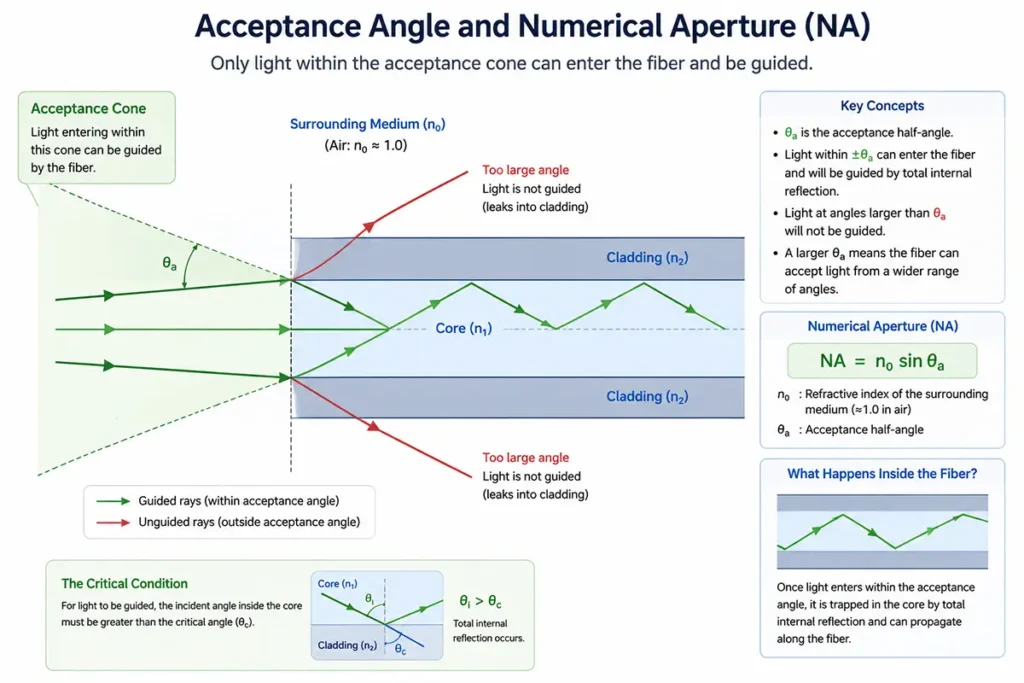
La apertura numérica (NA) es un parámetro adimensional que describe la capacidad de una fibra óptica para recoger y guiar la luz. Determina el rango máximo de ángulos en los que la luz puede entrar en la fibra y permanecer confinada en el núcleo a través de la reflexión interna total.
En términos sencillos, la NA indica la facilidad con la que la luz entra en una fibra. Una NA mayor permite que la fibra acepte luz desde una gama más amplia de ángulos, mientras que una NA menor requiere una alineación más precisa pero proporciona un mejor control de la propagación de la luz. Como resultado, la NA desempeña un papel importante en la eficacia de acoplamiento de la fibra, modo de propagación, y el diseño general del sistema óptico.
¿Qué significa realmente apertura numérica?
Para los principiantes, la forma más fácil de entender la Apertura Numérica es pensar en ella como la “capacidad de aceptación de la luz” de una fibra.”
Imagina dos embudos colocados en el exterior durante una tormenta.
Un embudo tiene una abertura ancha, mientras que el otro tiene una abertura estrecha. El embudo más ancho puede recoger el agua de lluvia con más facilidad porque acepta agua procedente de un mayor rango de direcciones.
Las fibras ópticas se comportan de manera similar.
Una fibra con una apertura numérica mayor puede aceptar luz en una gama más amplia de ángulos de entrada, lo que facilita el acoplamiento de la luz a la fibra. Una fibra con una apertura numérica menor solo acepta luz dentro de un rango de ángulos más estrecho y, por tanto, requiere una alineación más precisa.
Por eso, la apertura numérica suele considerarse uno de los parámetros más importantes a la hora de diseñar sistemas de comunicación por fibra óptica.
Comprender el ángulo de aceptación
No todos los rayos de luz que llegan a la cara final de una fibra pueden atravesarla con éxito.
Para que la luz permanezca guiada dentro del núcleo, debe entrar en la fibra dentro de un rango específico de ángulos. Si el ángulo es demasiado grande, la luz no cumplirá las condiciones para la reflexión interna total y escapará hacia el revestimiento.
El ángulo máximo con el que la luz puede entrar en la fibra y seguir propagándose a través del núcleo se denomina Ángulo de aceptación.
La apertura numérica es esencialmente una medida de esta capacidad de aceptación.
Un ángulo de aceptación mayor significa que la fibra puede recoger la luz con más facilidad. Un ángulo de aceptación menor significa que la luz entrante debe alinearse con mayor precisión.
Esta relación es una de las principales razones por las que la apertura numérica se utiliza ampliamente a la hora de evaluar el rendimiento del acoplamiento de fibras.
¿Cómo se calcula la apertura numérica?
La apertura numérica puede expresarse mediante el ángulo de aceptación:
NA = n₀ sin θₐ
Dónde:
- n₀ es el índice de refracción del medio circundante (aproximadamente 1 en el aire)
- θₐ es el ángulo de aceptación (semiángulo)
En el caso de las fibras ópticas, la apertura numérica también puede calcularse a partir de los índices de refracción del núcleo y el revestimiento:
NA = √(n₁² - n₂²)
Dónde:
- n₁ es el índice de refracción del núcleo de la fibra
- n₂ es el índice de refracción del revestimiento
Esta ecuación muestra que la apertura numérica está directamente relacionada con la diferencia de índice de refracción entre el núcleo y el revestimiento.
En otras palabras, una mayor diferencia de índice de refracción suele traducirse en una mayor apertura numérica.
¿Por qué es importante la apertura numérica?
Aunque la apertura numérica es un parámetro sencillo, afecta a varios aspectos importantes del rendimiento de la fibra.
1. Determina la facilidad con que la luz entra en la fibra
El efecto más directo de la apertura numérica es el acoplamiento de la luz.
Una fibra con una NA grande puede aceptar luz desde una gama más amplia de ángulos, lo que facilita el lanzamiento de potencia óptica a la fibra.
Esto resulta especialmente útil cuando se utilizan fuentes de luz como los LED, que emiten luz en ángulos relativamente amplios.
Por el contrario, las fibras con valores de NA más pequeños requieren una alineación más precisa entre la fuente de luz y la fibra.
2. Afecta a la eficacia del acoplamiento
La eficiencia de acoplamiento describe cuánta potencia óptica entra con éxito en la fibra.
Una apertura numérica mayor suele mejorar la eficacia del acoplamiento porque la fibra puede capturar una mayor parte de la luz entrante.
Ésta es una de las razones por las que las fibras multimodo suelen ser más fáciles de conectar y alinear que las monomodo.
En aplicaciones prácticas, la eficacia de acoplamiento influye directamente en la pérdida de inserción y en el rendimiento global del sistema.
3. Influye en los modos de apoyo
La apertura numérica también afecta a cómo se propaga la luz dentro de la fibra.
Las fibras con valores de AN mayores admiten un mayor número de modos de propagación. Este es uno de los motivos por los que las fibras multimodo suelen tener aperturas numéricas mayores.
Las fibras con valores de NA más pequeños admiten menos modos y proporcionan un mejor control de la propagación de la luz.
Como resultado:
- Las fibras multimodo suelen tener valores de NA más elevados.
- Las fibras monomodo suelen tener valores de NA más bajos.
Esta relación ayuda a explicar por qué se prefieren las fibras monomodo para los sistemas de comunicación de larga distancia y gran ancho de banda.
Apertura numérica y diferencia de índice de refracción relativo
La apertura numérica está estrechamente relacionada con la diferencia de índice de refracción relativo (Δ).
La relación puede simplificarse como
Mayor Δ → Mayor NA → Mayor ángulo de aceptación
Cuando aumenta la diferencia de índice de refracción entre el núcleo y el revestimiento, la fibra puede confinar la luz con más fuerza. Esto permite que la fibra acepte luz en una gama más amplia de ángulos, lo que se traduce en una mayor apertura numérica.
A la inversa, un Δ más pequeño generalmente produce un NA más pequeño y un Ángulo de Aceptación más estrecho.
Por eso fibras monomodo suelen utilizar valores menores de Δ, mientras que las fibras multimodo suelen utilizar valores mayores.

Valores típicos de apertura numérica
Los distintos tipos de fibras ópticas utilizan diferentes valores de apertura numérica en función de sus objetivos de diseño.
| Tipo de fibra | Típico NA |
|---|---|
| Fibra monomodo | 0.10 – 0.14 |
| Fibra multimodo OM1 | 0.20 – 0.29 |
| Fibra multimodo OM2 | 0.20 – 0.29 |
| Fibra multimodo OM3 | ~0.20 |
| Fibra multimodo OM4 | ~0.20 |
| Fibra multimodo OM5 | ~0.20 |
En general, las fibras multimodo tienen aperturas numéricas mayores porque están diseñadas para recoger la luz con mayor facilidad y admiten múltiples modos de propagación.
Una analogía sencilla para entender la apertura numérica
Imagina que intentas lanzar una pelota a un cubo.
Un cubo con una gran abertura es más fácil de golpear porque puede aceptar la pelota desde una gama más amplia de direcciones.
Un cubo con una abertura pequeña requiere una puntería mucho más precisa.
La apertura numérica funciona de forma similar.
Un NA más alto crea un “objetivo” óptico más grande, lo que facilita la entrada de luz en la fibra.
Un NA más bajo crea un objetivo más pequeño, lo que requiere una alineación más precisa pero proporciona un mayor control sobre la propagación de la luz.
Preguntas frecuentes
¿Es siempre mejor una mayor apertura numérica?
No. Una NA más alta mejora la captación de luz y la eficacia de acoplamiento, pero también puede admitir más modos de propagación. El valor óptimo depende de la aplicación.
¿Cuál es la NA típica de la fibra monomodo?
La mayoría de las fibras monomodo estándar tienen una apertura numérica de entre 0,10 y 0,14 aproximadamente.
¿Cuál es la relación entre NA y el Ángulo de Aceptación?
Una apertura numérica mayor corresponde a un ángulo de aceptación mayor, lo que permite a la fibra captar la luz procedente de una gama más amplia de direcciones.
¿Cuál es la relación entre NA y diferencia de índice de refracción relativo?
En general, una mayor diferencia de índice de refracción relativo (Δ) se traduce en una mayor apertura numérica.
Conclusión
La apertura numérica (NA) es uno de los parámetros más importantes en fibra óptica porque describe la eficacia con la que una fibra puede recoger y guiar la luz. Influye directamente en el ángulo de aceptación, la eficacia de acoplamiento, los modos de propagación admitidos y el rendimiento general de la fibra.
Aunque la AN es un simple valor adimensional, desempeña un papel fundamental en el diseño y el funcionamiento de los sistemas de comunicación óptica, por lo que es un concepto esencial para cualquiera que trabaje con fibra óptica.
¿Aún tiene preguntas?
Si aún tienes dudas, no dudes en ponerte en contacto con nosotros.
¿Quieres conocer más términos sobre fibra óptica? Visite nuestra sección de blog.
Si el término que busca aún no está cubierto, hágamelo saber y lo añadiré a la lista de prioridades.
Por último, si es usted proveedor de telecomunicaciones, operador de redes o participa en el desarrollo de infraestructuras de fibra y busca un socio fiable en componentes de fibra óptica, no dude en ponerse en contacto con nosotros.