
TABLE OF CONTENTS
What Is a Fiber Pigtail?
Quick Definition
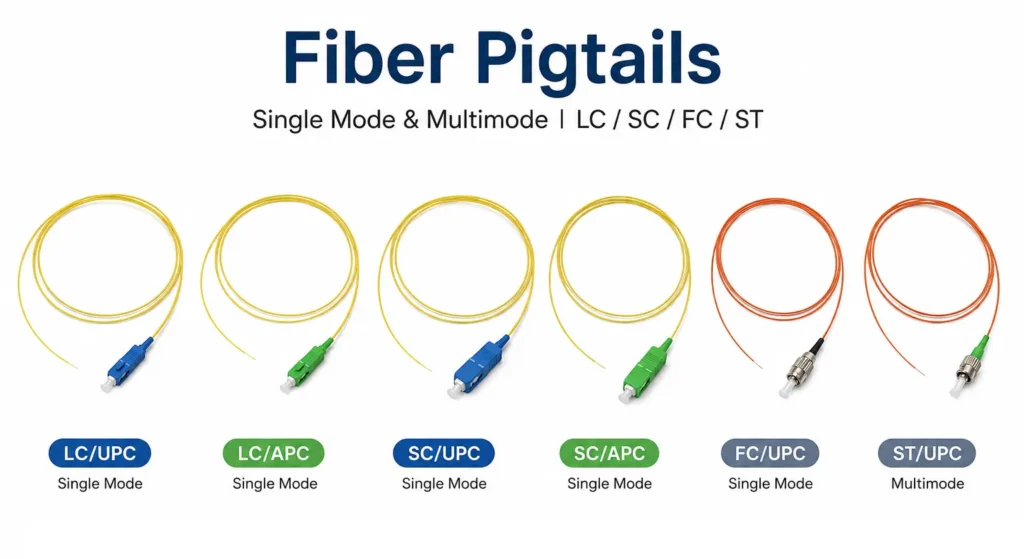
A fiber pigtail, also called a fiber optic pigtail, is a short optical fiber cable with a factory-terminated connector on one end and a bare fiber on the other end. The connector end plugs into an adapter, patch panel, ODF, terminal box, splitter, or optical module. The bare fiber end is normally fusion spliced or mechanically spliced to another optical fiber cable inside a splice tray or termination box. [1]
In simple terms, a fiber pigtail turns a bare optical fiber into a connectorized port. This is useful because outdoor cables, backbone cables, and distribution cables often arrive as bare fibers, while equipment usually needs LC, SC, FC, ST, or other connector interfaces.

Why It Is Used
Fiber pigtails are widely used because factory-terminated connectors are more consistent than field-polished connectors. A connector can be polished, inspected, cleaned, and tested under controlled production conditions, then spliced to the field cable on site. [2]
This is why pigtails are common in telecom networks, FTTH projects, fiber distribution boxes, ODFs, splice closures, data centers, and enterprise cabling systems.
What Is a Fiber Pigtail Used For?
Creating a Connector Interface
The main purpose of a fiber pigtail is to terminate a fiber cable and create a connector interface. Without a connector, a bare fiber cannot be plugged into an adapter, optical module, patch panel, splitter, or test device. With a pigtail, the connector end stays ready for patching, testing, and maintenance.

Common Installation Scenarios
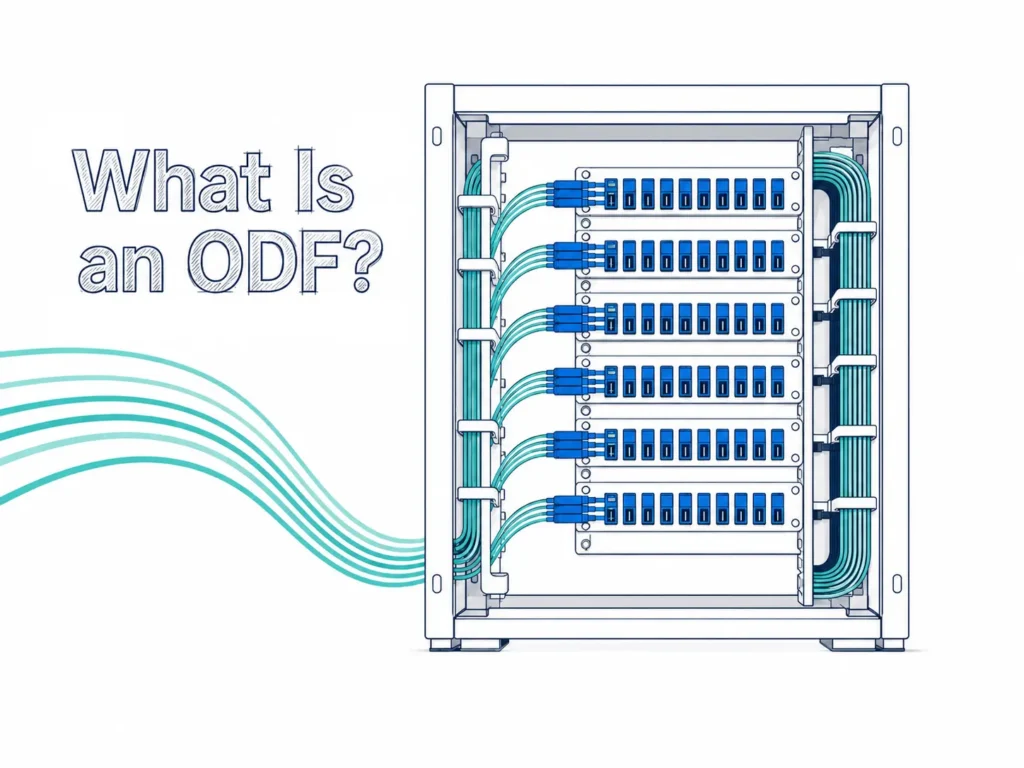
In an optical distribution frame, pigtails are spliced to backbone fibers and routed to adapter panels. In a terminal box or distribution box, they connect feeder or distribution fibers to subscriber-side ports. In splice closures, waterproof or ruggedized pigtails help outdoor cables transition into connectorized links.
SC/APC pigtails are common in FTTH and PON networks because angled connectors help reduce back reflection. LC/UPC pigtails are common in high-density panels and data centers.
Fiber Pigtail vs Fiber Patch Cord
The Core Difference
Fiber pigtails and fiber patch cords may look similar, but they are used for different tasks. A patch cord has connectors on both ends and connects two existing ports. A pigtail has one connector end and one bare fiber end, so it is used for cable termination. [8]
| Item | Fiber Pigtail | Fiber Patch Cord |
|---|---|---|
| Connector ends | One connector, one bare fiber | Connectors on both ends |
| Main purpose | Terminate a bare fiber cable | Connect two ready-made ports |
| Installation | Requires splicing | Plug-and-play |
Which One Do You Need?
If your cable is already terminated and you only need to connect equipment, you usually need a patch cord. If your cable is an unterminated outdoor, distribution, or backbone cable that must be spliced into a patch panel or terminal box, you usually need a pigtail.
For professional projects, use proper pigtails with the correct fiber type, polish, cable diameter, labeling, and test data.
Main Types of Fiber Optic Pigtails
By Fiber Type
Single mode pigtails are usually based on 9/125um OS2 fiber and are used for long-distance telecom, FTTH, metro, backbone, and PON applications. Multimode pigtails are usually based on OM1, OM2, OM3, OM4, or OM5 fiber and are used for shorter-distance links in buildings, campuses, and data centers.
The fiber type must match the cable and transmission system. Mixing single mode and multimode fiber can cause serious loss or link failure.
By Connector Type
LC pigtails are popular in high-density panels and data centers because the LC connector is compact. SC pigtails are widely used in FTTH, telecom, CATV, and distribution systems. FC pigtails are still used in some test equipment and legacy systems. ST pigtails may appear in older multimode networks.
By Polish Type
UPC connectors use an ultra physical contact polish and are common in data communication systems. APC connectors use an angled physical contact polish, normally with an 8-degree angle, and are often selected where lower back reflection is required, such as FTTH, CATV, and PON links. [2]
APC and UPC connectors should not be mixed. Even if the housing looks similar, the end-face geometry is different, and mixing them can cause high loss or connector damage.
Need custom LC, SC, APC, UPC or multi-core fiber pigtails for your project?
By Fiber Count and Environment
Multi-core pigtails are used when many fibers must be terminated in a compact closure, box, or ODF. A 12-fiber pigtail set is often color-coded so technicians can match each pigtail during splicing and documentation. Larger counts such as 24, 48, or 72 fibers require careful labeling and tray routing. [3]
For indoor panels, 0.9mm pigtails are common because they are flexible in splice trays. For stronger handling, 2.0mm or 3.0mm pigtails may be used. Outdoor or harsh environments may require waterproof or armored pigtails.
How Does Fiber Pigtail Splicing Work?
Basic Splicing Process
Fiber pigtail splicing joins the bare fiber end of the pigtail to another optical fiber. In most professional installations, this is done with a fusion splicer, which aligns the fibers and permanently joins them with an electric arc. [4]
The process starts with preparing the field cable, removing the jacket and buffer materials, cleaning the fiber, and cleaving it to create a precise end face. The pigtail is prepared in the same way. The two fibers are fused together, protected with a heat-shrink sleeve, placed into a splice tray, and routed to the adapter panel.

Fusion Splicing or Mechanical Splicing?
Fusion splicing is usually preferred for long-term telecom, FTTH, data center, and B2B infrastructure. Mechanical splicing can be useful for temporary repair or small jobs, but it is less attractive for high-volume or long-service-life projects.
How to Choose the Right Fiber Pigtail
Match the System Interface
Start with the port or adapter that the pigtail will connect to. The connector type, polish type, and fiber type must match the system. For example, an SC/APC FTTH distribution box should use SC/APC single mode pigtails, while a high-density LC/UPC patch panel may require LC/UPC multimode or single mode pigtails.
Check Cable Diameter and Jacket
Cable diameter affects handling and space. A 0.9mm pigtail suits splice trays and compact boxes. A 2.0mm or 3.0mm pigtail is stronger but takes more space. LSZH jackets are often preferred indoors, while PE, armored, or waterproof designs may be needed outdoors.
Confirm Optical Performance
For commercial projects, buyers should ask for insertion loss and return loss specifications, not only connector type and price. Connector performance depends on ferrule quality, polishing, end-face geometry, cleanliness, and inspection. [2] [5]
For large orders, confirm test reports, labels, packing method, color sequence, and OEM requirements before production.
Common Mistakes When Using Fiber Pigtails
Common Mistakes When Using Fiber Pigtails
APC and UPC connectors are not interchangeable. An SC/APC connector and an SC/UPC connector may both use SC housings, but their end faces are different.
Ignoring Connector Cleanliness
Dust, oil, or tiny particles on the connector end face can increase loss and damage the mating connector. Even new pigtails should stay capped and be cleaned when possible before connection. [6] [7]
Poor Routing and Labeling
Sharp bends can create macrobending loss, especially with 0.9mm pigtails in crowded boxes. In multi-core projects, poor labeling or wrong color matching can create hidden faults that are difficult to troubleshoot later.
Fiber Pigtail Specification Checklist for Buyers
What to Include in an Inquiry
A clear quotation request should include connector type, polish type, fiber mode, fiber grade, length, cable diameter, jacket material, color, fiber count, and packing requirement. For larger projects, also confirm insertion loss, return loss, labeling, and test reports.
For example: “SC/APC single mode OS2 fiber pigtail, 0.9mm LSZH, 1.5m length, 12-color set, zirconia ferrule, individually packed with test report.”
Why Application Details Matter
A pigtail for an indoor ODF may not need the same structure as one for an outdoor FTTH closure. Sharing the target application helps the manufacturer recommend a more suitable product.
FAQ About Fiber Pigtails
What is the difference between a fiber pigtail and a patch cord?
A pigtail has one connector end and one bare fiber end for termination. A patch cord has connectors on both ends for connecting existing ports.
Are fiber pigtails single mode or multimode?
They can be either. Single mode pigtails are common in telecom and FTTH. Multimode pigtails are common in short-distance enterprise and data center links.
What is an SC/APC fiber pigtail used for?
SC/APC pigtails are used in FTTH, PON, CATV, and optical distribution networks where angled connectors help reduce back reflection.
Do fiber pigtails need to be fusion spliced?
Most professional installations use fusion splicing because it provides a permanent and stable connection. Mechanical splicing is usually for temporary work or repair.
FAQ About Fiber Pigtails
A fiber pigtail is a small component, but it plays an important role in fiber optic termination. It connects factory-terminated connector quality with field splicing flexibility, making it useful in ODFs, terminal boxes, splice closures, FTTH systems, telecom networks, and data centers.
For a reliable installation, choose the correct connector, fiber type, polish type, cable diameter, jacket, fiber count, color code, and performance grade for the actual network.
Sources
[1] Fiber Cable Termination: https://en.wikipedia.org/wiki/Fiber_cable_termination
[2] Optical Fiber Connector: https://en.wikipedia.org/wiki/Optical_fiber_connector
[3] TIA-598-C: https://en.wikipedia.org/wiki/TIA-598-C
[4] The Fiber Optic Association, Splices: https://www.thefoa.org/tech/ref/termination/splices.html
[5] IEC 61753 series: https://webstore.iec.ch/searchform&q=IEC%2061753
[6] EXFO, Connector Inspection and Cleaning: https://www.exfo.com/en/resources/blog/fiber-connector-inspection-cleaning/
[7] VIAVI, Fiber Inspection and Cleaning: https://www.viavisolutions.com/en-us/resources/learning-center/fiber-inspection-and-cleaning
[8] Patch Cable: https://en.wikipedia.org/wiki/Patch_cable