

If you’re just stepping into the world of fiber optics, all the technical terms and abbreviations can feel overwhelming. That’s why I created this fiber glossary series — to help you understand what these terms really mean, in the simplest way possible.
I’ll explain everything from an industry insider’s point of view, using real photos whenever I can (not just fancy renders). I also avoid overly complex explanations, keeping the language clear and direct, so you can be confident you’ll understand the real meaning of these terms after reading.
Today, we’re going to talk about: Relative Refractive Index Difference
TABLE OF CONTENTS
What Is Relative Refractive Index Difference (Δ)?
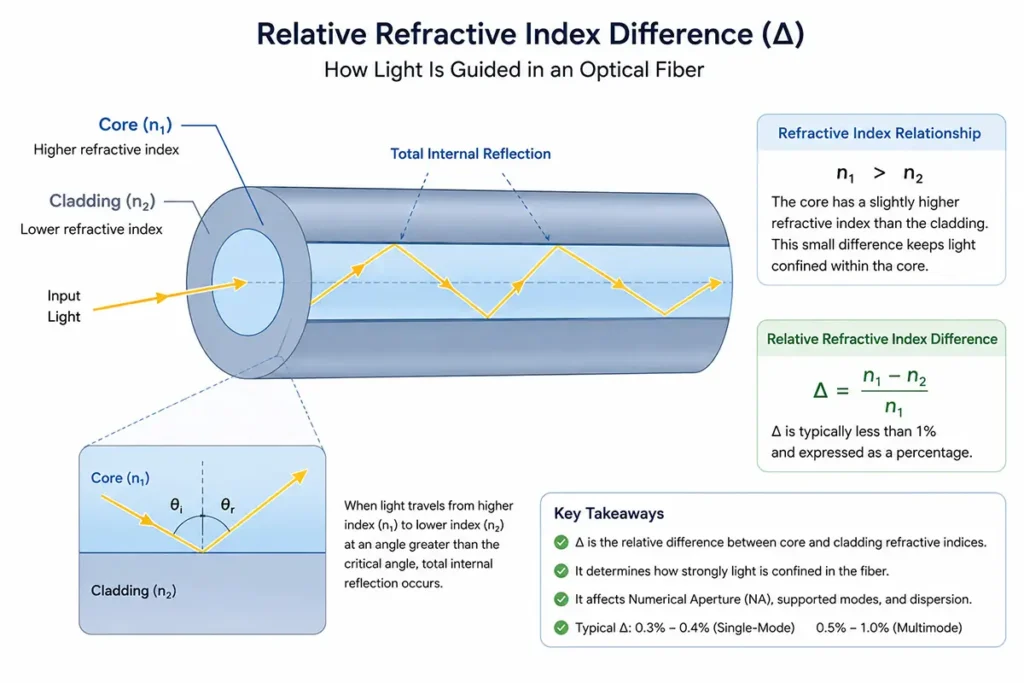
Relative Refractive Index Difference (Δ) is a dimensionless parameter that expresses the difference between the refractive index of the fiber core and the cladding relative to the core refractive index. In optical fibers, Δ is typically less than 1%, yet this small difference is essential for guiding light through total internal reflection.
Despite its small value, Δ has a major influence on fiber performance. It affects how tightly light is confined within the core, the numerical aperture (NA) of the fiber, the number of supported propagation modes, and dispersion behavior. Larger values of Δ generally provide stronger light confinement and higher NA, while smaller values are commonly used in single-mode fibers to achieve better mode control and lower dispersion.
What Does Relative Refractive Index Difference Actually Mean?
At first glance, Relative Refractive Index Difference may sound like a complicated optical term. In reality, it simply describes how different the refractive indices of the fiber core and cladding are.
A standard optical fiber consists of two layers:
- Core – the central region where light travels
- Cladding – the outer layer surrounding the core
For light to remain trapped inside the core, the core must have a slightly higher refractive index than the cladding.
For example:
- Core refractive index (n₁): 1.468
- Cladding refractive index (n₂): 1.462
Although the difference appears extremely small, it is enough to create total internal reflection, which keeps light confined within the fiber.
Relative Refractive Index Difference is simply a convenient way to express this small difference as a percentage.
Relative Refractive Index vs. Refractive Index: What's the Difference?
Many beginners confuse these two terms because they sound very similar.
A refractive index describes the optical property of a material. It indicates how much light slows down when traveling through that material.
Relative Refractive Index Difference, however, does not describe a material directly. Instead, it describes the relationship between two materials—the fiber core and the cladding.
Think of it this way:
- Refractive Index = Property of a material
- Relative Refractive Index Difference = Difference between two materials
In fiber optics, both values are important. The refractive indices determine how light behaves inside each layer, while Δ describes how effectively the fiber can guide that light.
How Is Δ Calculated?
The Relative Refractive Index Difference is commonly calculated using the following equation:
Δ = (n₁ − n₂) / n₁
Where:
- n₁ = Core refractive index
- n₂ = Cladding refractive index
Because the difference between n₁ and n₂ is extremely small, Δ is usually expressed as a percentage.
For most commercial optical fibers, the value typically falls between 0.3% and 1%.
Why Is Δ Important in Optical Fibers?
Although Δ is usually less than 1%, it influences several key fiber characteristics.
1. It Determines How Well Light Is Confined
The primary purpose of having different refractive indices is to keep light inside the core.
A larger Δ means a greater refractive index difference between the core and cladding. This creates stronger light confinement and makes total internal reflection easier to achieve.
As a result, light remains more tightly guided within the fiber core.
2. It Affects Numerical Aperture (NA)
A higher Δ value results in a higher NA.
A higher numerical aperture allows an optical fiber to accept light over a wider range of incident angles, making optical coupling easier.
This is one reason why multimode fibers typically have a higher Δ value than single-mode fibers.
To learn more about this relationship, please refer to our guide on fiber numerical aperture (NA).
3. It Influences Single-Mode and Multimode Fiber Design
The value of Δ plays an important role in determining how light propagates through the fiber.
Multimode fibers typically use a larger Δ because they are designed to support multiple propagation modes and benefit from a larger Numerical Aperture.
Single-mode fibers generally use a smaller Δ. This helps maintain tighter control over light propagation, reduces modal effects, and supports long-distance, high-bandwidth transmission.
For this reason, fiber designers carefully select Δ according to the intended application.
Typical Δ Values in Optical Fibers
Different fiber types use different Relative Refractive Index Differences.
| Fiber Type | Typical Δ |
|---|---|
| Single-Mode Fiber | 0.3% – 0.4% |
| Multimode Fiber | 0.5% – 1.0% |
While these numbers appear extremely small, even slight changes can significantly affect fiber performance.
A Simple Analogy to Understand Δ
Imagine a highway surrounded by guardrails.
The cars represent light signals, while the guardrails represent the refractive index difference between the core and cladding.
If the guardrails are strong and clearly defined, it becomes easier to keep vehicles moving in the correct direction.
Similarly, a larger Δ creates stronger optical confinement, helping guide light through the fiber.
Of course, stronger confinement is not always better. Fiber designers must balance light confinement, Numerical Aperture, dispersion performance, and transmission requirements when selecting the appropriate Δ value.
Frequently Asked Questions
Is a larger Δ always better?
No. A larger Δ provides stronger light confinement and higher Numerical Aperture, but it may not be suitable for every application. Single-mode fibers often require smaller Δ values for better mode control.
Is Δ measured in dB?
No. Relative Refractive Index Difference is a dimensionless parameter and is typically expressed as a percentage.
What is the typical Δ of single-mode fiber?
Most standard single-mode fibers have a Δ value between approximately 0.3% and 0.4%.
What is the relationship between Δ and Numerical Aperture?
In general, a larger Δ results in a larger Numerical Aperture (NA), allowing the fiber to accept light over a wider range of input angles.
Conclusion
Relative Refractive Index Difference (Δ) is one of the most fundamental parameters in optical fiber design. Although it is typically less than 1%, it directly influences light confinement, Numerical Aperture, propagation modes, and dispersion behavior.
By controlling the refractive index difference between the core and cladding, fiber manufacturers can optimize optical fibers for different applications, from short-range multimode networks to long-distance single-mode transmission systems.
Still Have Questions?
If you’re still unsure about something, feel free to reach out.
Want to explore more fiber optic terms? Head over to our blog section.
If the term you’re looking for isn’t covered yet, let me know — I’ll add it to the priority list!
And lastly — if you’re a telecom provider, network operator, or involved in fiber infrastructure development and looking for a reliable partner in fiber optic components — feel free to contact to us.