
If you’re just stepping into the world of fiber optics, all the technical terms and abbreviations can feel overwhelming. That’s why I created this fiber glossary series — to help you understand what these terms really mean, in the simplest way possible.
I’ll explain everything from an industry insider’s point of view, using real photos whenever I can (not just fancy renders). I also avoid overly complex explanations, keeping the language clear and direct, so you can be confident you’ll understand the real meaning of these terms after reading.
Today, we’re going to talk about: V-Number
TABLE OF CONTENTS
What Does V-Number Actually Mean?
When people first see the term “V-number,” they often think it must be some complicated mathematical parameter used only by optical engineers. And honestly, many explanations online make it look far more difficult than it really is.
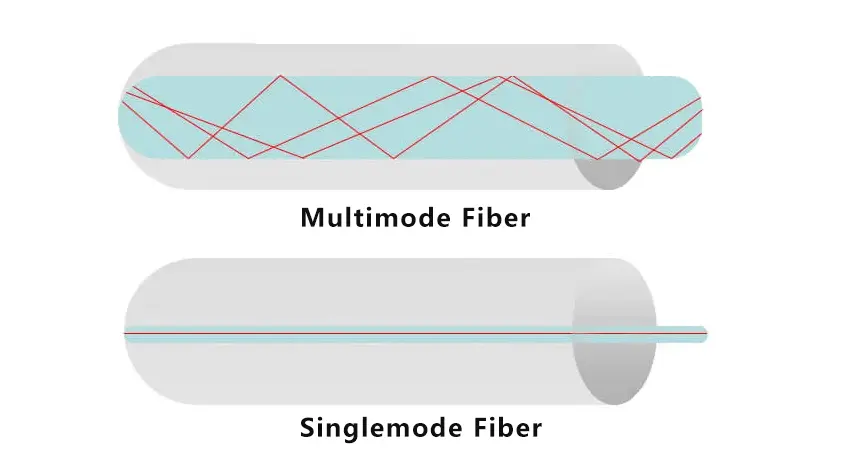
But in simple terms, the V-number is mainly used to describe how many different light paths can exist inside a fiber optic cable.
You can imagine the fiber core as a tunnel for light. If the tunnel is very small and narrow, light can only travel in one main path. But if the tunnel becomes larger, light suddenly has more room and can travel in multiple paths at the same time.
That is essentially what the V-number controls.
A lower V-number means the fiber only allows one main propagation mode, which is why single-mode fiber has a low V-number. A higher V-number means the fiber can support many different modes, which is why multimode fiber has a much higher V-number.
This is also why engineers care so much about the V-number when designing fiber optic systems. It directly affects how light behaves inside the cable.
Why Does V-Number Matter?
The reason the V-number is important is because different light paths do not always arrive at the same time.
In a multimode fiber, some light rays travel almost straight through the core, while others bounce around at different angles. Even though the difference is extremely small, those paths are not exactly the same length. Over short distances this usually does not matter much, but over longer distances the signal can begin to spread out and become less clear.
This effect is called modal dispersion.
That is one of the biggest reasons why multimode fiber is usually used for short-distance communication, such as inside buildings or data centers, while single-mode fiber is preferred for telecom networks, FTTH deployment, and long-distance transmission.
Single-mode fiber keeps the light traveling in a much more controlled way. Since there is basically only one main propagation path, the signal remains cleaner and more stable over long distances.
So while the V-number may sound like a theoretical term, it actually has a direct impact on real-world network performance.
The Famous “2.405” Rule
One number appears again and again whenever people talk about V-number:
V=2.405
This value is extremely important in fiber optics because it acts like a boundary line between single-mode and multimode operation.
If the V-number is lower than 2.405, the fiber can only support one mode, which means it behaves as a single-mode fiber.
If the V-number becomes larger than 2.405, additional modes begin to appear, and the fiber starts behaving like a multimode fiber.
You do not need to understand complicated wave equations to remember this rule. The easiest way to think about it is:
- Below 2.405 → single-mode
- Above 2.405 → multimode
That simple idea already explains a huge part of fiber optic design.
What Affects the V-Number?
The V-number is calculated using this formula:

At first glance the formula may look intimidating, but the basic idea is actually straightforward.
The V-number becomes larger when the fiber core gets bigger. A larger core gives light more room to travel in different ways, making multimode operation easier.
The V-number also increases when the numerical aperture (NA) becomes larger. In simple terms, a higher NA means the fiber can accept light from wider angles, which again allows more propagation modes to exist.
Wavelength matters too. Shorter wavelengths increase the V-number, while longer wavelengths reduce it. This is one reason why the same fiber can sometimes behave differently at different wavelengths.
In fact, under certain conditions, a fiber that normally operates as single-mode can begin supporting additional modes if the wavelength becomes short enough.
Real Examples in Fiber Networks
This becomes much easier to understand when looking at real fiber types used in actual networks.
A standard single-mode fiber, such as G.652D fiber, typically has a very small core around 9 microns. Because the core is so small, the V-number stays relatively low, helping the fiber maintain single-mode transmission over very long distances.
That is why single-mode fiber is widely used in telecom backbones, FTTH networks, and long-haul communication systems.
Multimode fiber is completely different. Common multimode fibers like OM2 or OM3 usually have much larger cores, often 50 microns or even 62.5 microns. These larger cores naturally create a higher V-number, allowing many propagation modes to exist inside the fiber.
This makes multimode fiber easier for light coupling and lower-cost optical systems, which is why it is commonly used in data centers and short-distance communication links.
So in many ways, the V-number helps explain why single-mode and multimode fibers behave so differently, even though both are carrying light signals.
Why Many V-Number Explanations Feel Confusing
A lot of technical articles explain the V-number using highly mathematical language. You may see terms like LP modes, normalized frequency, cutoff wavelength, refractive index profiles, or Bessel functions almost immediately.
Those concepts are important in advanced optical engineering, but they are not necessary for understanding the basic meaning of the V-number.
For beginners, the most important thing to remember is much simpler:
The V-number mainly describes how tightly light is controlled inside the fiber core.
A small V-number means light is strongly confined and forced into a simpler propagation pattern. A larger V-number means light has more freedom to travel in multiple ways.
Once you understand that idea, most discussions about single-mode and multimode fiber suddenly become much easier to follow.
A Simple Way to Remember V-Number
If you only want to remember one thing from this article, remember this:
- Low V-number → fewer light paths
- High V-number → more light paths
Or even more simply:
- Small V → single-mode
- Large V → multimode
That is the core idea behind the V-number in fiber optics.
Still Have Questions?
If you’re still unsure about something, feel free to reach out.
Want to explore more fiber optic terms? Head over to our blog section.
If the term you’re looking for isn’t covered yet, let me know — I’ll add it to the priority list!
And lastly — if you’re a telecom provider, network operator, or involved in fiber infrastructure development and looking for a reliable partner in fiber optic components — feel free to contact to us.