

Si vous venez d'entrer dans le monde de la fibre optique, tous les termes techniques et les abréviations peuvent vous sembler insurmontables. C'est pourquoi j'ai créé ce série de glossaires sur les fibres - pour vous aider à comprendre ce que ces termes signifient réellement, de la manière la plus simple possible.
Je vous expliquerai tout du point de vue d'un connaisseur du secteur, en utilisant de vraies photos chaque fois que je le peux (et pas seulement des rendus fantaisistes). J'évite également les explications trop complexes, en gardant un langage clair et direct, afin que vous puissiez être sûr de comprendre la véritable signification de ces termes après la lecture.
Aujourd'hui, nous allons parler de.. : Différence d'indice de réfraction relatif
TABLE DES MATIÈRES
Qu'est-ce que la différence d'indice de réfraction relatif (Δ) ?
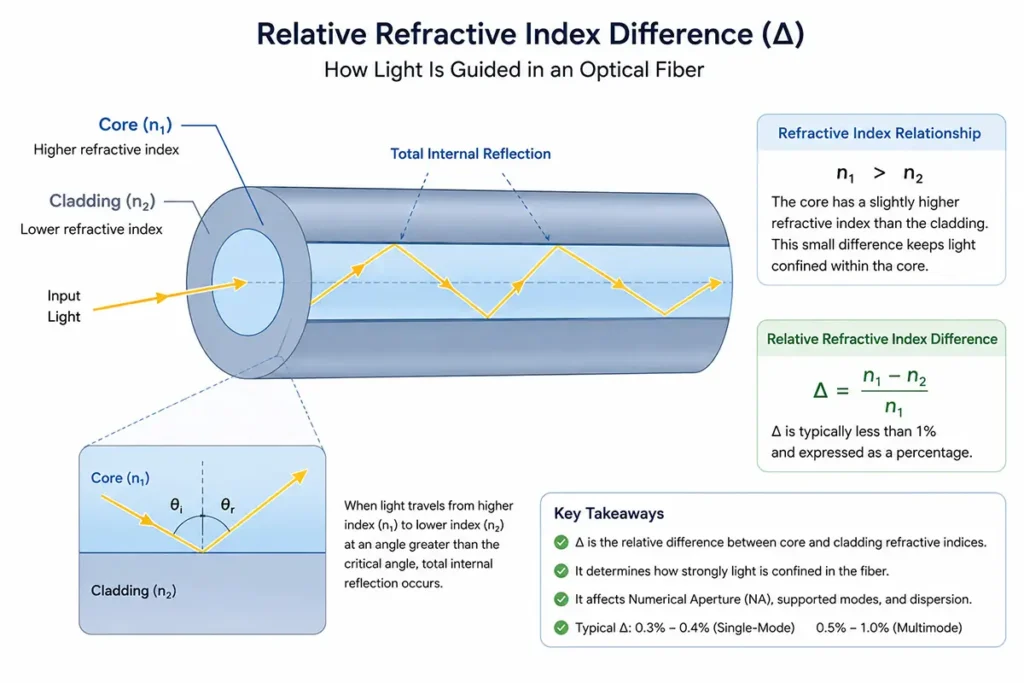
La différence d'indice de réfraction relatif (Δ) est un paramètre sans dimension qui exprime la différence entre l'indice de réfraction du cœur de la fibre et celui de la gaine par rapport à l'indice de réfraction du cœur. Dans les fibres optiques, Δ est généralement inférieur à 1%, mais cette petite différence est essentielle pour guider la lumière par réflexion interne totale.
Malgré sa faible valeur, Δ a une influence majeure sur les performances de la fibre. Il influe sur le degré de confinement de la lumière à l'intérieur du cœur, sur l'intensité de la lumière et sur la durée de vie de la fibre. ouverture numérique (NA) de la fibre, le nombre de modes de propagation pris en charge, et le comportement de dispersion. Des valeurs plus élevées de Δ permettent généralement d'obtenir un confinement plus important de la lumière et une NA plus élevée, tandis que des valeurs plus faibles sont couramment utilisées dans les applications de la fibres monomodes afin d'obtenir un meilleur contrôle des modes et une plus faible dispersion.
Que signifie la différence d'indice de réfraction relatif ?
À première vue, la différence relative d'indice de réfraction peut sembler un terme optique compliqué. En réalité, il décrit simplement la différence entre les indices de réfraction du cœur de la fibre et de la gaine.
Une fibre optique standard se compose de deux couches :
- Noyau - région centrale où la lumière se propage
- Revêtement - la couche extérieure qui entoure le noyau
Pour que la lumière reste piégée à l'intérieur du noyau, celui-ci doit avoir un indice de réfraction légèrement supérieur à celui de la gaine.
Par exemple :
- Indice de réfraction du noyau (n₁) : 1.468
- Indice de réfraction de la gaine (n₂) : 1.462
Bien que la différence semble extrêmement faible, elle est suffisante pour créer une réflexion interne totale, qui maintient la lumière confinée à l'intérieur de la fibre.
La différence relative d'indice de réfraction est simplement un moyen pratique d'exprimer cette petite différence en pourcentage.
Indice de réfraction relatif ou indice de réfraction : Quelle est la différence ?
De nombreux débutants confondent ces deux termes car ils se ressemblent beaucoup.
L'indice de réfraction décrit la propriété optique d'un matériau. Il indique dans quelle mesure la lumière est ralentie lorsqu'elle traverse ce matériau.
La différence d'indice de réfraction relative ne décrit cependant pas directement un matériau. Elle décrit plutôt la relation entre deux matériaux, le cœur de la fibre et la gaine.
Pensez-y de la manière suivante :
- Indice de réfraction = Propriété d'un matériau
- Différence d'indice de réfraction relatif = différence entre deux matériaux
Dans les fibres optiques, ces deux valeurs sont importantes. Les indices de réfraction déterminent comment la lumière se comporte à l'intérieur de chaque couche, tandis que Δ décrit l'efficacité avec laquelle la fibre peut guider cette lumière.
Comment calcule-t-on Δ ?
La différence d'indice de réfraction relatif est généralement calculée à l'aide de l'équation suivante :
Δ = (n₁ - n₂) / n₁
Où ?
- n₁ = indice de réfraction du noyau
- n₂ = indice de réfraction de la gaine
La différence entre n₁ et n₂ étant extrêmement faible, Δ est généralement exprimé en pourcentage.
Pour la plupart des fibres optiques commerciales, la valeur se situe généralement entre 0,3% et 1%.
Pourquoi Δ est-il important dans les fibres optiques ?
Bien que Δ soit généralement inférieur à 1%, il influence plusieurs caractéristiques clés de la fibre.
1. Il détermine le degré de confinement de la lumière
L'objectif principal des différents indices de réfraction est de maintenir la lumière à l'intérieur du noyau.
Un Δ plus grand signifie une plus grande différence d'indice de réfraction entre le cœur et la gaine. Cela renforce le confinement de la lumière et facilite la réflexion interne totale.
Par conséquent, la lumière reste guidée plus étroitement dans le cœur de la fibre.
2. Elle affecte l'ouverture numérique (NA)
Une valeur Δ plus élevée entraîne une NA plus élevée.
Une ouverture numérique plus élevée permet à une fibre optique d'accepter la lumière sur une plage d'angles d'incidence plus large, ce qui facilite le couplage optique.
C'est l'une des raisons pour lesquelles les fibres multimodes présentent généralement une valeur Δ supérieure à celle des fibres monomodes.
Pour en savoir plus sur cette relation, veuillez consulter notre guide sur ouverture numérique (NA) de la fibre.
3. Influence sur la conception des fibres monomodes et multimodes
La valeur de Δ joue un rôle important dans la façon dont la lumière se propage dans la fibre.
Les fibres multimodes utilisent généralement un Δ plus grand car elles sont conçues pour supporter plusieurs modes de propagation et bénéficient d'une ouverture numérique plus grande.
Les fibres monomodes utilisent généralement un Δ plus petit, ce qui permet de mieux contrôler la propagation de la lumière, de réduire les effets modaux et de prendre en charge les transmissions à longue distance et à large bande passante.
C'est pourquoi les concepteurs de fibres choisissent soigneusement Δ en fonction de l'application prévue.
Valeurs typiques de Δ dans les fibres optiques
Les différents types de fibres présentent des différences d'indice de réfraction relatif différentes.
| Type de fibre | Typique Δ |
|---|---|
| Fibre monomode | 0.3% – 0.4% |
| Fibre multimode | 0.5% – 1.0% |
Bien que ces chiffres paraissent extrêmement faibles, même de légères modifications peuvent affecter de manière significative les performances de la fibre.
Une analogie simple pour comprendre Δ
Imaginez une autoroute entourée de glissières de sécurité.
Les voitures représentent les signaux lumineux, tandis que les glissières de sécurité représentent la différence d'indice de réfraction entre le cœur et la gaine.
Si les glissières de sécurité sont solides et clairement définies, il est plus facile de maintenir les véhicules dans la bonne direction.
De même, un Δ plus grand crée un confinement optique plus fort, aidant à guider la lumière à travers la fibre.
Bien entendu, un confinement plus important n'est pas toujours meilleur. Les concepteurs de fibres doivent trouver un équilibre entre le confinement de la lumière, l'ouverture numérique, les performances de dispersion et les exigences de transmission lorsqu'ils choisissent la valeur Δ appropriée.
Questions fréquemment posées
Un Δ plus grand est-il toujours préférable ?
Non. Un Δ plus grand permet un meilleur confinement de la lumière et une ouverture numérique plus élevée, mais il n'est pas forcément adapté à toutes les applications. Les fibres monomodes nécessitent souvent des valeurs Δ plus petites pour un meilleur contrôle des modes.
Le Δ est-il mesuré en dB ?
Non. La différence d'indice de réfraction relatif est un paramètre sans dimension et est généralement exprimée en pourcentage.
Quel est le Δ typique d'une fibre monomode ?
La plupart des fibres monomodes standard ont une valeur Δ comprise approximativement entre 0,3% et 0,4%.
Quelle est la relation entre Δ et l'ouverture numérique ?
En général, un Δ plus grand se traduit par une ouverture numérique (NA) plus grande, ce qui permet à la fibre d'accepter la lumière sur une plus grande plage d'angles d'entrée.
Conclusion
La différence d'indice de réfraction relatif (Δ) est l'un des paramètres les plus fondamentaux dans la conception des fibres optiques. Bien qu'elle soit généralement inférieure à 1%, elle influence directement le confinement de la lumière, l'ouverture numérique, les modes de propagation et le comportement de dispersion.
En contrôlant la différence d'indice de réfraction entre le cœur et la gaine, les fabricants de fibres peuvent optimiser les fibres optiques pour différentes applications, des réseaux multimodes à courte portée aux systèmes de transmission monomodes à longue distance.
Vous avez encore des questions ?
Si vous avez encore des doutes, n'hésitez pas à nous contacter.
Vous souhaitez découvrir d'autres termes relatifs à la fibre optique ? Consultez notre section blog.
Si le terme que vous recherchez n'est pas encore couvert, faites-le moi savoir - je l'ajouterai à la liste des priorités !
Enfin, si vous êtes un fournisseur de télécommunications, un opérateur de réseau, ou si vous êtes impliqué dans le développement d'une infrastructure de fibre optique et que vous recherchez un partenaire fiable pour les composants de fibre optique, n'hésitez pas à nous contacter.