
TABLE OF CONTENTS
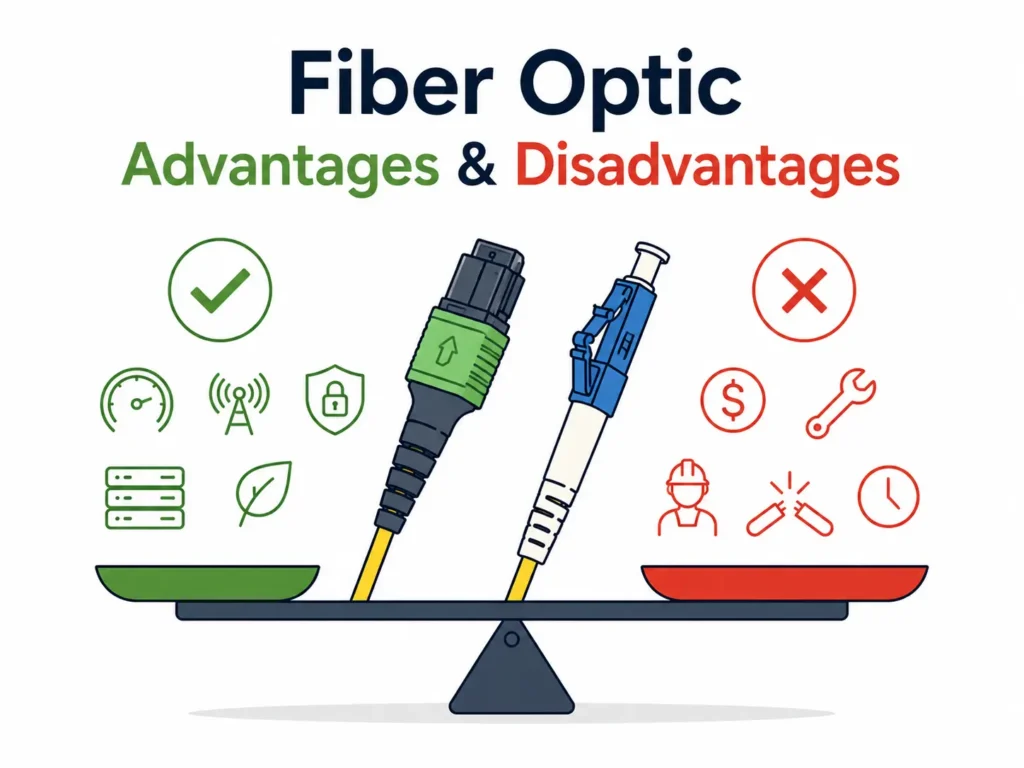
Fiber optic cable is used in data centers, telecom networks, industrial systems, and building backbones. Its main strengths are high bandwidth, long transmission distance, electrical isolation, and compact size. However, an objective comparison must also consider the real fiber optic disadvantages: higher initial system costs, stricter handling and cleaning requirements, specialized repair work, and the inability to deliver electrical power.
Fiber is an excellent transmission medium, but it is not automatically the best cable for every connection. The right choice depends on distance, data rate, environment, equipment, power requirements, maintenance capability, and future expansion plans.
What Is Fiber Optic Cable—and What Are We Comparing?

A fiber optic cable carries data as pulses of light through thin strands of glass or plastic. Copper network cable carries electrical signals through metal conductors. This difference gives fiber many of its performance and safety advantages, but it also creates different installation requirements.
A fair comparison must consider the link, including cable, connectors, adapters, transceivers, patch panels, and active equipment. “Fiber internet” describes a service, while Ethernet is a networking technology that can operate over fiber or copper. Cable price alone therefore does not represent total system cost or performance.
Fiber Optic Advantages and Disadvantages at a Glance
| Factor | Fiber optic advantage | Disadvantage or trade-off | Most relevant when |
|---|---|---|---|
| Capacity | High bandwidth and upgrade potential | Requires compatible optics and equipment | Data centers and expanding networks |
| Distance | Low attenuation over long runs | Very long links still need loss-budget planning | Telecom, campus, and inter-building links |
| Interference | Immune to EMI and electrically isolated | Cannot deliver Power over Ethernet | Industrial sites and building links |
| Size | Thin, light, and suitable for dense cabling | Connectors need protection and cleaning | Conduits, racks, and high fiber counts |
| Cost | Potentially lower long-term cost per bit | Equipment, testing, and labor raise initial cost | New construction and network upgrades |
| Maintenance | No corrosion in the glass path | Bends, contamination, and repairs need fiber-specific practices | Installation and network operations |
The importance of each trade-off changes with the application. A drawback that matters in a small office may be relatively minor in a long-distance backbone where copper cannot provide the required reach or capacity.
The Main Fiber Optic Advantages
More Bandwidth and Room to Scale
High bandwidth is one of the most important fiber optic advantages. Optical systems can carry large volumes of data, making fiber suitable for cloud services, video, AI infrastructure, storage networks, and other demanding applications. Wavelength-division multiplexing can also carry multiple optical channels through one fiber.
An installed fiber can often support higher speeds after the transceivers and equipment at each end are upgraded. This does not mean every old fiber supports every new standard: fiber type, distance, connector loss, and component quality still matter. Even so, a properly designed fiber plant can remain useful through several equipment generations.
Longer Reach with Lower Signal Loss
Optical fiber has much lower attenuation than typical copper network cabling, allowing high-speed signals to travel farther before regeneration or amplification is required. This is valuable for telecom access networks, campuses, factories, and links between buildings.
Actual reach depends on fiber mode, wavelength, data rate, transceivers, connectors, splices, and total optical loss. Designers should calculate a link-loss budget instead of relying on one universal maximum-distance claim.
EMI Immunity, Electrical Isolation, and Better Security
Because fiber does not carry electrical signals, motors, transformers, power cables, and other sources of electromagnetic interference do not disrupt its data transmission. Its dielectric nature also prevents ground loops and helps isolate equipment in separate buildings.
Fiber does not radiate an electromagnetic signal and is harder to tap without disturbing the link. It is more difficult—not impossible—to intercept, so encryption and physical security are still required.
Smaller, Lighter, and Suitable for Dense Cabling
Fiber can deliver substantial capacity in a smaller, lighter cable than an equivalent group of copper links. This reduces congestion in conduits, cable trays, and server racks. With the correct construction and protection, it can also provide a long, reliable service life without corrosion in the glass transmission path.
The Real Fiber Optic Disadvantages
Higher System Cost at the Start
Calling fiber “expensive” without context is too simple. The cable itself may be competitive with copper, but transceivers, fiber-capable switches, enclosures, splicing, testing, and skilled labor can raise the initial system cost. Copper may still cost less for a short office link using existing RJ45 equipment, while fiber can be more economical over longer distances or when greater upgrade capacity is required.
This cost picture changed sharply in early 2026. AI data centers and data center interconnects increased fiber consumption just as optical-fiber preform capacity became constrained. Corning reports that generative-AI data centers can require more than ten times as much optical fiber as traditional facilities. Due to strong demand and limited production capacity, optical fiber prices have risen across the world, although the extent of the increase varies by region.
Installation Is Less Forgiving—not Simply “Too Fragile”
Bare glass fiber is delicate, but finished cable may include protective coatings, aramid yarn, strength members, armor, and an application-specific jacket. Properly selected fiber cable can withstand normal installation and harsh conditions.
It is still less forgiving of certain mistakes. Excessive pulling, crushing, or bending below the manufacturer’s minimum radius can cause breaks or additional optical loss. Fiber can go around corners, but it should not be folded into a sharp ninety-degree bend. Bend-insensitive fiber and armored cable reduce particular risks without eliminating the need to follow product specifications.
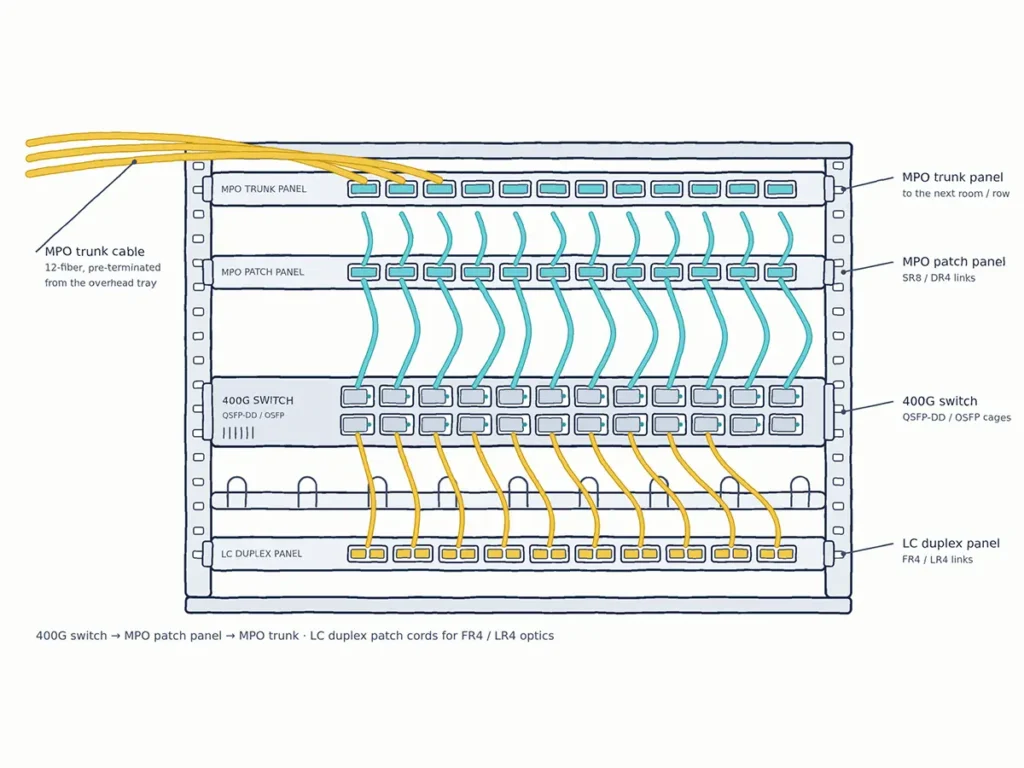
Pre-terminated assemblies remove field splicing and termination from the job site. Installers must still protect the connector ends, provide a large enough pathway, and order the correct length and polarity.

Cleaning, Testing, and Repair Require Different Skills
Connector contamination is a practical disadvantage that many comparisons overlook. Dust, skin oil, residue, or scratches on an end face can increase loss and reflectance. A connector may appear clean and still cause an unstable link. Good practice is to inspect, clean when necessary, and inspect again before connection.
Troubleshooting may require a visual fault locator, optical power meter, inspection microscope, or OTDR. Technicians must also understand polarity, link loss, and connector types. A damaged patch cord is usually replaced, while a permanent backbone may require fault location, precision cleaving, fusion splicing, splice protection, and final loss testing. This can increase downtime when trained technicians or spares are unavailable.
Fiber Cannot Power End Devices and May Need New Hardware
Standard fiber carries data but not electrical power. It cannot directly provide PoE to wireless access points, IP cameras, phones, or sensors. Those devices need local power, a separate power cable, or a hybrid fiber-and-power solution.
An existing copper network may also need new optical ports, SFP modules, media converters, or switches. Fiber mode, connector, wavelength, speed, and transceiver specifications must match; a connector that physically fits does not guarantee a working link.
When a deployment must carry both data and electrical power, fiber is often combined with separate copper conductors, hybrid fiber-and-power cables, or short equipment-side assemblies. The electrical portion must be specified for current, voltage, connector interface, shielding, jacket material, length, and operating environment. In these mixed systems, custom cable assemblies can provide purpose-built power and signal connections between converters, control cabinets, sensors, switches, and other powered equipment.
The Cable Must Match the Environment
EMI immunity does not make every fiber cable suitable for every location. Indoor, outdoor, aerial, duct, direct-buried, and industrial routes have different requirements for moisture, fire rating, pulling tension, crushing, chemicals, rodents, UV exposure, and temperature. Reliability begins with selecting the correct cable construction rather than merely choosing “fiber.”
Common Myths About Fiber Optics
Myth 1: Fiber Is Always Faster Than Copper
If copper and fiber links both operate at 1 Gbps, fiber does not automatically create more throughput. Its real advantages are greater bandwidth potential, lower loss over distance, resistance to interference, and support for high data rates over longer links. The slowest port, device, or service can still limit performance.
Myth 2: Any Bend Will Break Fiber
Fiber cable is designed to bend, but not to be sharply folded. The acceptable radius depends on the specific fiber and cable, particularly during pulling. As a general fiber-level reference, standard G.652.D fiber is commonly associated with a bend radius of about 30 mm, while bend-insensitive G.657.A1 and G.657.A2 fibers are designed for minimum radii of approximately 10 mm and 7.5 mm, respectively. These figures describe the fiber categories; the finished cable may require a larger bend radius, especially while it is under pulling tension. Modern bend-insensitive fiber can therefore tolerate tighter routing, but installers must still follow the cable manufacturer’s specifications.
Myth 3: Fiber Is Maintenance-Free
An undisturbed, correctly installed link can be highly reliable, but connectors still need protection, inspection, and cleaning when links are installed, moved, or changed. Cable management, labeling, polarity records, and loss-test documentation also simplify future maintenance.
Myth 4: Fiber Internet Always Works During a Power Outage
The cable is passive, but transceivers, switches, routers, and the optical network terminal require electricity. A local UPS may keep customer equipment running temporarily, but service also depends on backup power elsewhere in the provider’s network.
When Fiber Is—and Is Not—the Better Choice
Data Centers and Campus Backbones
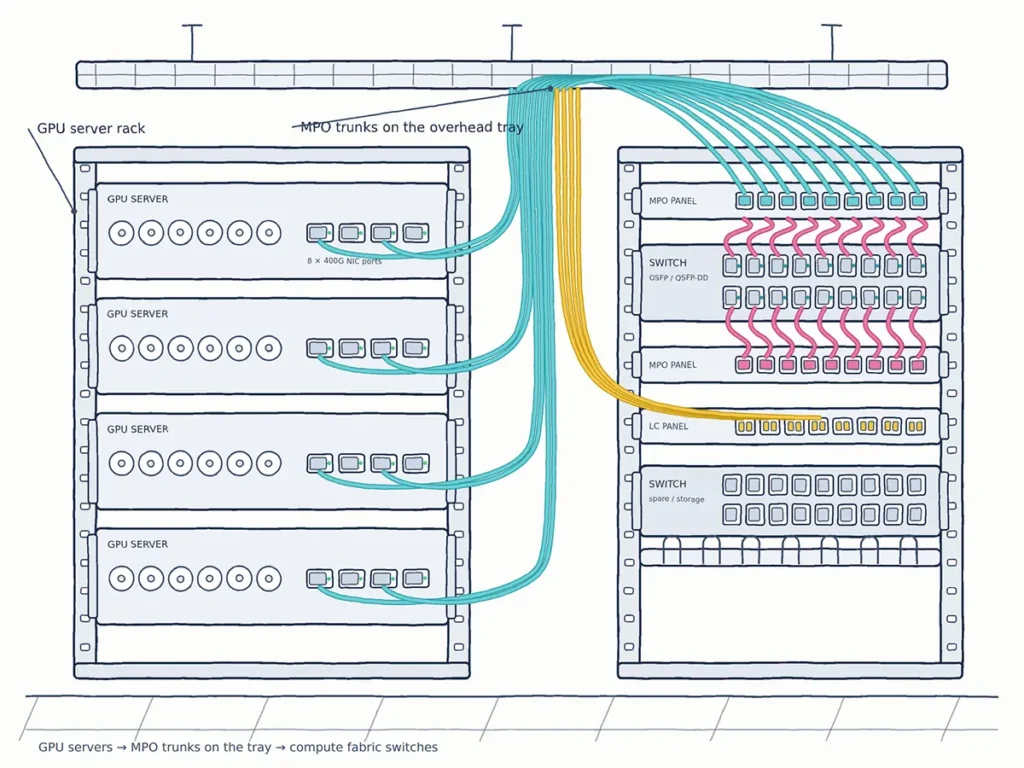
Fiber is usually stronger for high-speed switch links, building backbones, dense pathways, long equipment rows, and networks that must scale. The choice between single-mode and multimode should reflect distance, current optics, future speeds, and total system cost.
Industrial, Outdoor, and Inter-Building Networks
Long distance, strong EMI, and electrical isolation favor fiber. The route may still require armored, water-blocked, UV-resistant, rodent-resistant, or appropriately flame-rated cable, together with protected closures and termination points.
FTTH and Home or Office LANs
Fiber works well for provider access, risers, and backbones, but running it to every desk is not always beneficial. Most end devices use copper Ethernet, many need PoE, and quality copper cabling supports high speeds over normal room-to-room distances with simpler equipment.
For many sites, the best answer is a hybrid network: fiber for backbones, long runs, high-capacity uplinks, and electrically challenging routes; copper for short connections to powered endpoints.
Final Verdict: Are the Advantages Worth the Trade-Offs?
Fiber’s advantages outweigh its limitations when a network needs high capacity, long reach, electrical isolation, resistance to interference, compact cabling, or future growth. Copper may remain more practical when links are short, endpoints need PoE, budgets are limited, and simple field termination matters.