
Si acabas de adentrarte en el mundo de la fibra óptica, todos los términos técnicos y abreviaturas pueden resultarte abrumadores. Por eso he creado este serie de glosarios sobre fibra - para ayudarle a entender lo que significan realmente estos términos, de la forma más sencilla posible.
Te lo explicaré todo desde el punto de vista de un experto del sector, utilizando fotos reales siempre que pueda (no sólo renders extravagantes). También evito las explicaciones demasiado complejas, manteniendo un lenguaje claro y directo, para que puedas estar seguro de que entenderás el significado real de estos términos después de leerlos.
Hoy vamos a hablar de: Diferencia de índice de refracción relativo
ÍNDICE
¿Qué es la diferencia de índice de refracción relativo (Δ)?
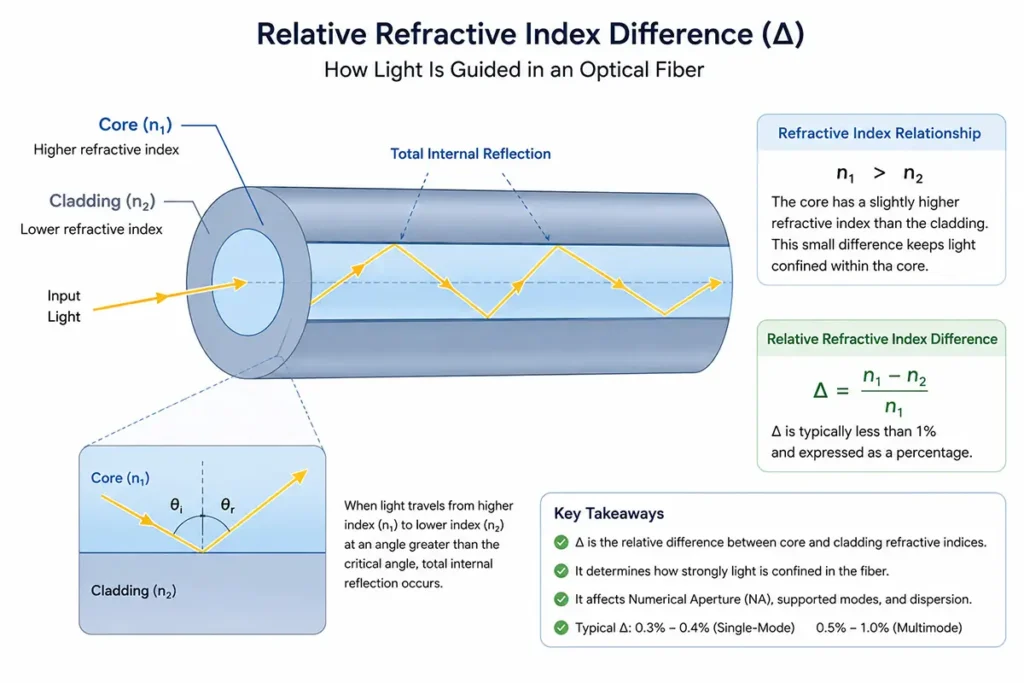
La diferencia de índice de refracción relativo (Δ) es un parámetro adimensional que expresa la diferencia entre el índice de refracción del núcleo de la fibra y el revestimiento en relación con el índice de refracción del núcleo. En las fibras ópticas, Δ suele ser inferior a 1%, aunque esta pequeña diferencia es esencial para guiar la luz a través de la reflexión interna total.
A pesar de su pequeño valor, Δ tiene una gran influencia en el rendimiento de la fibra. Afecta al grado de confinamiento de la luz en el núcleo, a la apertura numérica (NA) de la fibra, el número de modos de propagación admitidos, y el comportamiento de dispersión. Los valores más grandes de Δ proporcionan generalmente un confinamiento más fuerte de la luz y una mayor NA, mientras que los valores más pequeños se utilizan comúnmente en fibras monomodo para lograr un mejor control de los modos y una menor dispersión.
¿Qué significa realmente la diferencia del índice de refracción relativo?
A primera vista, la diferencia de índice de refracción relativo puede parecer un término óptico complicado. En realidad, simplemente describe lo diferentes que son los índices de refracción del núcleo y el revestimiento de la fibra.
Una fibra óptica estándar consta de dos capas:
- Núcleo - la región central por donde viaja la luz
- Revestimiento: la capa exterior que rodea el núcleo
Para que la luz permanezca atrapada en el núcleo, éste debe tener un índice de refracción ligeramente superior al del revestimiento.
Por ejemplo:
- Índice de refracción del núcleo (n₁): 1.468
- Índice de refracción del revestimiento (n₂): 1.462
Aunque la diferencia parece extremadamente pequeña, es suficiente para crear una reflexión interna total, que mantiene la luz confinada dentro de la fibra.
La diferencia de índice de refracción relativo es simplemente una forma cómoda de expresar esta pequeña diferencia en forma de porcentaje.
Índice de refracción relativo frente a índice de refracción: ¿Cuál es la diferencia?
Muchos principiantes confunden estos dos términos porque suenan muy parecido.
El índice de refracción describe la propiedad óptica de un material. Indica cuánto se ralentiza la luz cuando viaja a través de ese material.
Sin embargo, la diferencia de índice de refracción relativo no describe directamente un material. En su lugar, describe la relación entre dos materiales: el núcleo de la fibra y el revestimiento.
Piénsalo así:
- Índice de refracción = Propiedad de un material
- Diferencia de índice de refracción relativo = Diferencia entre dos materiales
En fibra óptica, ambos valores son importantes. Los índices de refracción determinan cómo se comporta la luz dentro de cada capa, mientras que Δ describe la eficacia con la que la fibra puede guiar esa luz.
¿Cómo se calcula Δ?
La diferencia de índice de refracción relativo se calcula habitualmente mediante la siguiente ecuación:
Δ = (n₁ - n₂) / n₁
Dónde:
- n₁ = Índice de refracción del núcleo.
- n₂ = Índice de refracción del revestimiento
Como la diferencia entre n₁ y n₂ es extremadamente pequeña, Δ suele expresarse en porcentaje.
En la mayoría de las fibras ópticas comerciales, el valor suele situarse entre 0,3% y 1%.
Por qué es importante Δ en las fibras ópticas?
Aunque Δ suele ser inferior a 1%, influye en varias características clave de la fibra.
1. Determina el confinamiento de la luz
El objetivo principal de tener diferentes índices de refracción es mantener la luz dentro del núcleo.
Un Δ mayor significa una mayor diferencia de índice de refracción entre el núcleo y el revestimiento. Esto crea un mayor confinamiento de la luz y facilita la reflexión interna total.
Como resultado, la luz permanece más firmemente guiada dentro del núcleo de la fibra.
2. Afecta a la apertura numérica (NA)
Un valor Δ más alto da lugar a un NA más alto.
Una mayor apertura numérica permite que una fibra óptica admita luz en un rango más amplio de ángulos de incidencia, lo que facilita el acoplamiento óptico.
Esta es una de las razones por las que las fibras multimodo suelen tener un valor Δ más alto que las fibras monomodo.
Para obtener más información sobre esta relación, consulta nuestra guía sobre apertura numérica (NA) de la fibra.
3. Influye en el diseño de la fibra monomodo y multimodo
El valor de Δ desempeña un papel importante a la hora de determinar cómo se propaga la luz a través de la fibra.
Las fibras multimodo suelen utilizar un Δ mayor porque están diseñadas para soportar múltiples modos de propagación y se benefician de una apertura numérica mayor.
Las fibras monomodo suelen utilizar un Δ más pequeño, lo que ayuda a mantener un control más estricto de la propagación de la luz, reduce los efectos modales y admite transmisiones de larga distancia y gran ancho de banda.
Por este motivo, los diseñadores de fibras seleccionan cuidadosamente Δ en función de la aplicación prevista.
Valores Δ típicos en fibras ópticas
Los distintos tipos de fibra utilizan diferentes diferencias de índice de refracción relativo.
| Tipo de fibra | Típico Δ |
|---|---|
| Fibra monomodo | 0.3% – 0.4% |
| Fibra multimodo | 0.5% – 1.0% |
Aunque estas cifras parezcan extremadamente pequeñas, incluso los cambios más ligeros pueden afectar significativamente al rendimiento de la fibra.
Una analogía sencilla para entender Δ
Imagine una autopista rodeada de quitamiedos.
Los vagones representan señales luminosas, mientras que las barandillas representan la diferencia de índice de refracción entre el núcleo y el revestimiento.
Si las barandillas son fuertes y están claramente definidas, resulta más fácil mantener los vehículos en movimiento en la dirección correcta.
Del mismo modo, un Δ mayor crea un mayor confinamiento óptico, ayudando a guiar la luz a través de la fibra.
Por supuesto, un mayor confinamiento no siempre es mejor. Los diseñadores de fibras deben equilibrar el confinamiento de la luz, la apertura numérica, el rendimiento de dispersión y los requisitos de transmisión a la hora de seleccionar el valor Δ adecuado.
Preguntas frecuentes
¿Es siempre mejor un Δ más grande?
No. Un Δ mayor proporciona un mayor confinamiento de la luz y una mayor apertura numérica, pero puede no ser adecuado para todas las aplicaciones. Las fibras monomodo suelen requerir valores de Δ menores para un mejor control de los modos.
¿Se mide Δ en dB?
No. La diferencia de índice de refracción relativo es un parámetro adimensional y suele expresarse en porcentaje.
Cuál es la Δ típica de la fibra monomodo?
La mayoría de las fibras monomodo estándar tienen un valor Δ entre 0,3% y 0,4% aproximadamente.
¿Cuál es la relación entre Δ y la apertura numérica?
En general, un Δ mayor da lugar a una apertura numérica (NA) mayor, lo que permite que la fibra acepte luz en una gama más amplia de ángulos de entrada.
Conclusión
La diferencia de índice de refracción relativo (Δ) es uno de los parámetros fundamentales en el diseño de fibras ópticas. Aunque suele ser inferior a 1%, influye directamente en el confinamiento de la luz, la apertura numérica, los modos de propagación y el comportamiento de dispersión.
Controlando la diferencia de índice de refracción entre el núcleo y el revestimiento, los fabricantes de fibras pueden optimizar las fibras ópticas para distintas aplicaciones, desde redes multimodo de corto alcance hasta sistemas de transmisión monomodo de larga distancia.
¿Aún tiene preguntas?
Si aún tienes dudas, no dudes en ponerte en contacto con nosotros.
¿Quieres conocer más términos sobre fibra óptica? Visite nuestra sección de blog.
Si el término que busca aún no está cubierto, hágamelo saber y lo añadiré a la lista de prioridades.
Por último, si es usted proveedor de telecomunicaciones, operador de redes o participa en el desarrollo de infraestructuras de fibra y busca un socio fiable en componentes de fibra óptica, no dude en ponerse en contacto con nosotros.