

Wenn Sie gerade erst in die Welt der Glasfaseroptik einsteigen, können die vielen Fachbegriffe und Abkürzungen überwältigend sein. Deshalb habe ich dieses Faser-Glossar-Serie - um Ihnen auf möglichst einfache Weise zu erklären, was diese Begriffe wirklich bedeuten.
Ich erkläre alles aus der Sicht eines Brancheninsiders und verwende, wann immer möglich, echte Fotos (nicht nur schicke Renderings). Außerdem vermeide ich übermäßig komplexe Erklärungen und halte die Sprache klar und direkt, damit Sie sicher sein können, dass Sie nach der Lektüre die wahre Bedeutung dieser Begriffe verstehen.
Heute werden wir darüber sprechen: Numerische Apertur (NA)
INHALTSVERZEICHNIS
Was ist die numerische Apertur (NA)?
Die numerische Apertur (NA) ist ein dimensionsloser Parameter, der die Fähigkeit einer optischen Faser beschreibt, Licht zu sammeln und zu leiten. Sie bestimmt den maximalen Winkelbereich, in dem Licht in die Faser eindringen kann und dennoch durch Totalreflexion auf den Kern beschränkt bleibt.
Einfach ausgedrückt, gibt NA an, wie leicht Licht in eine Faser eindringen kann. Eine größere NA ermöglicht es der Faser, Licht aus einem größeren Winkelbereich aufzunehmen, während eine kleinere NA eine genauere Ausrichtung erfordert, aber eine bessere Kontrolle der Lichtausbreitung ermöglicht. Folglich spielt die NA eine wichtige Rolle für die Effizienz der Faserkopplung, Modusausbreitung, und das Design des gesamten optischen Systems.
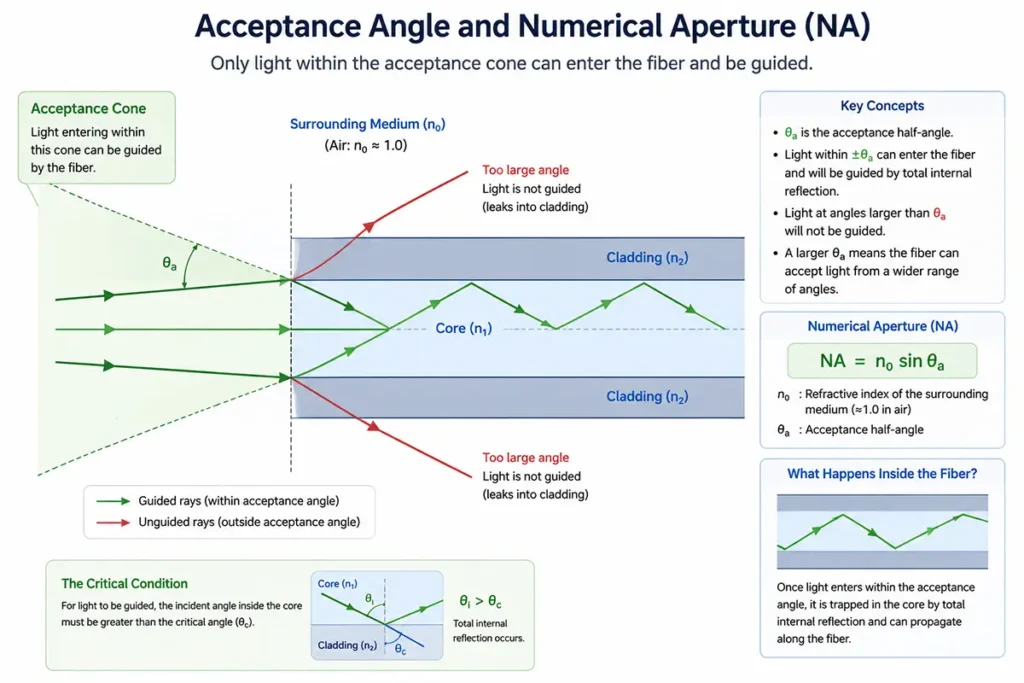
Was bedeutet eigentlich numerische Apertur?
Für Anfänger ist es am einfachsten, sich die numerische Apertur als die “Lichtaufnahmefähigkeit” einer Faser vorzustellen.”
Stellen Sie sich zwei Trichter vor, die während eines Regenschauers draußen stehen.
Ein Trichter hat eine breite Öffnung, der andere eine schmale Öffnung. Der breitere Trichter kann Regenwasser leichter auffangen, weil er Wasser aus einem größeren Bereich von Richtungen aufnimmt.
Optische Fasern verhalten sich auf ähnliche Weise.
Eine Faser mit einer größeren numerischen Apertur kann Licht über einen größeren Bereich von Eingangswinkeln aufnehmen, was die Einkopplung von Licht in die Faser erleichtert. Eine Faser mit einer kleineren numerischen Apertur kann Licht nur innerhalb eines engeren Winkelbereichs aufnehmen und erfordert daher eine präzisere Ausrichtung.
Aus diesem Grund wird die numerische Apertur häufig als einer der wichtigsten Parameter bei der Entwicklung von faseroptischen Kommunikationssystemen angesehen.
Den Winkel der Akzeptanz verstehen
Nicht jeder Lichtstrahl, der die Endfläche einer Faser erreicht, kann sie erfolgreich durchqueren.
Damit das Licht im Inneren des Kerns geführt wird, muss es innerhalb eines bestimmten Winkelbereichs in die Faser eintreten. Ist der Winkel zu groß, erfüllt das Licht nicht die Bedingungen für die interne Totalreflexion und entweicht in die Ummantelung.
Der maximale Winkel, unter dem das Licht in die Faser eintreten und sich noch durch den Kern ausbreiten kann, wird als Annahmewinkel.
Die numerische Apertur ist im Wesentlichen ein Maß für diese Aufnahmefähigkeit.
Ein größerer Akzeptanzwinkel bedeutet, dass die Faser das Licht leichter sammeln kann. Ein kleinerer Akzeptanzwinkel bedeutet, dass das einfallende Licht genauer ausgerichtet werden muss.
Diese Beziehung ist einer der Hauptgründe, warum die numerische Apertur bei der Bewertung der Faserkopplungsleistung häufig verwendet wird.
Wie wird die numerische Apertur berechnet?
Die numerische Apertur kann durch den Akzeptanzwinkel ausgedrückt werden:
NA = n₀ sin θₐ
Wo:
- n₀ ist der Brechungsindex des umgebenden Mediums (ungefähr 1 in Luft)
- θₐ ist der Akzeptanzwinkel (Halbwinkel)
Bei optischen Fasern kann die numerische Apertur auch anhand der Brechungsindizes von Kern und Mantel berechnet werden:
NA = √(n₁² - n₂²)
Wo:
- n₁ ist der Brechungsindex des Faserkerns
- n₂ ist der Brechungsindex der Ummantelung
Diese Gleichung zeigt, dass die numerische Apertur direkt mit dem Brechungsindexunterschied zwischen Kern und Mantel zusammenhängt.
Mit anderen Worten: Ein größerer Brechungsindexunterschied führt im Allgemeinen zu einer größeren numerischen Apertur.
Warum ist die numerische Apertur wichtig?
Obwohl die numerische Apertur ein einfacher Parameter ist, beeinflusst sie mehrere wichtige Aspekte der Faserleistung.
1. Sie bestimmt, wie leicht Licht in die Faser eindringen kann
Die Numerische Apertur wirkt sich am direktesten auf die Lichteinkopplung aus.
Eine Faser mit einer großen NA kann Licht aus einem größeren Winkelbereich aufnehmen, wodurch es einfacher wird, optische Leistung in die Faser einzuleiten.
Dies ist besonders nützlich, wenn Lichtquellen wie LEDs verwendet werden, die ihr Licht in einem relativ breiten Winkel abstrahlen.
Im Gegensatz dazu erfordern Fasern mit kleineren NA-Werten eine präzisere Ausrichtung zwischen der Lichtquelle und der Faser.
2. Beeinflusst die Effizienz der Kopplung
Die Kopplungseffizienz beschreibt, wie viel optische Leistung erfolgreich in die Faser gelangt.
Eine größere numerische Apertur verbessert im Allgemeinen die Kopplungseffizienz, da die Faser einen größeren Teil des einfallenden Lichts einfangen kann.
Dies ist einer der Gründe, warum Multimode-Fasern oft einfacher zu verbinden und auszurichten sind als Singlemode-Fasern.
In praktischen Anwendungen hat die Kopplungseffizienz einen direkten Einfluss auf die Einfügedämpfung und die Gesamtleistung des Systems.
3. Beeinflusst die unterstützten Modi
Die numerische Apertur beeinflusst auch, wie sich das Licht in der Faser ausbreitet.
Fasern mit größeren NA-Werten können eine größere Anzahl von Ausbreitungsmodi unterstützen. Dies ist ein Grund, warum Multimode-Fasern in der Regel größere numerische Aperturen haben.
Fasern mit kleineren NA-Werten unterstützen weniger Moden und bieten eine bessere Kontrolle über die Lichtausbreitung.
Das Ergebnis ist:
- Multimode-Fasern haben im Allgemeinen höhere NA-Werte.
- Singlemode-Fasern haben im Allgemeinen niedrigere NA-Werte.
Diese Beziehung erklärt, warum Singlemode-Fasern für Kommunikationssysteme mit großen Entfernungen und hohen Bandbreiten bevorzugt werden.
Numerische Apertur und relativer Brechungsindexunterschied
Die numerische Apertur steht in engem Zusammenhang mit der relativen Brechungsindexdifferenz (Δ).
Die Beziehung kann wie folgt vereinfacht werden:
Größeres Δ → Größere NA → Größerer Akzeptanzwinkel
Wenn der Brechungsindexunterschied zwischen Kern und Mantel zunimmt, kann die Faser das Licht stärker einschränken. Dadurch kann die Faser Licht über einen größeren Winkelbereich aufnehmen, was zu einer höheren numerischen Apertur führt.
Umgekehrt führt ein kleineres Δ im Allgemeinen zu einer kleineren NA und einem engeren Akzeptanzwinkel.
Das ist der Grund Singlemode-Fasern verwenden in der Regel kleinere Δ-Werte, während bei Multimode-Fasern häufig größere Werte verwendet werden.

Typische Werte der numerischen Apertur
Verschiedene Arten von Lichtwellenleitern verwenden je nach ihren Konstruktionszielen unterschiedliche Werte für die numerische Apertur.
| Faser-Typ | Typisch NA |
|---|---|
| Single-Mode-Faser | 0.10 – 0.14 |
| OM1 Multimode-Faser | 0.20 – 0.29 |
| OM2 Multimode-Faser | 0.20 – 0.29 |
| OM3 Multimode-Faser | ~0.20 |
| OM4 Multimode-Faser | ~0.20 |
| OM5 Multimode-Faser | ~0.20 |
Im Allgemeinen haben Multimode-Fasern größere numerische Aperturen, da sie so konzipiert sind, dass sie Licht leichter sammeln und mehrere Ausbreitungsmodi unterstützen.
Eine einfache Analogie zum Verständnis der numerischen Apertur
Stellen Sie sich vor, Sie versuchen, einen Ball in einen Eimer zu werfen.
Ein Eimer mit einer großen Öffnung ist leichter zu treffen, weil er den Ball aus einer größeren Bandbreite von Richtungen aufnehmen kann.
Ein Eimer mit einer kleinen Öffnung erfordert ein viel genaueres Zielen.
Die numerische Blende funktioniert auf ähnliche Weise.
Eine höhere NA schafft ein größeres optisches “Ziel”, wodurch das Licht leichter in die Faser eindringen kann.
Eine niedrigere NA schafft ein kleineres Ziel, was eine präzisere Ausrichtung erfordert, aber eine bessere Kontrolle über die Lichtausbreitung ermöglicht.
Häufig gestellte Fragen
Ist eine höhere numerische Apertur immer besser?
Nein. Ein höherer NA-Wert verbessert die Lichtsammlung und die Kopplungseffizienz, kann aber auch mehr Ausbreitungsmodi unterstützen. Der optimale Wert hängt von der jeweiligen Anwendung ab.
Was ist die typische NA einer Singlemode-Faser?
Die meisten Standard-Singlemode-Fasern haben eine numerische Apertur zwischen etwa 0,10 und 0,14.
Wie ist die Beziehung zwischen NA und Acceptance Angle?
Eine größere numerische Apertur entspricht einem größeren Akzeptanzwinkel, so dass die Faser Licht aus einem größeren Bereich von Richtungen sammeln kann.
Welcher Zusammenhang besteht zwischen der NA und der relativen Brechungsindexdifferenz?
Im Allgemeinen führt ein größerer relativer Brechungsindexunterschied (Δ) zu einer größeren numerischen Apertur.
Schlussfolgerung
Die numerische Apertur (NA) ist einer der wichtigsten Parameter in der Faseroptik, da sie beschreibt, wie effektiv eine Faser Licht sammeln und leiten kann. Sie beeinflusst direkt den Akzeptanzwinkel, die Kopplungseffizienz, die unterstützten Ausbreitungsmodi und die Gesamtleistung der Faser.
Obwohl es sich bei der NA um einen einfachen dimensionslosen Wert handelt, spielt sie eine entscheidende Rolle bei der Entwicklung und dem Betrieb von optischen Kommunikationssystemen und ist daher für jeden, der mit Glasfasern arbeitet, ein wichtiges Konzept.
Haben Sie noch Fragen?
Wenn Sie noch unsicher sind, können Sie sich gerne an uns wenden.
Möchten Sie weitere Begriffe aus dem Bereich der Glasfasertechnik kennenlernen? Besuchen Sie unseren Blog-Bereich.
Wenn der von Ihnen gesuchte Begriff noch nicht abgedeckt ist, lassen Sie es mich wissen - ich werde ihn auf die Prioritätenliste setzen!
Und schließlich - wenn Sie ein Telekommunikationsanbieter, ein Netzbetreiber oder an der Entwicklung einer Glasfaserinfrastruktur beteiligt sind und einen zuverlässigen Partner für Glasfaserkomponenten suchen, können Sie sich gerne an uns wenden.