
TABLE OF CONTENTS
For decades, power grids were designed around a relatively simple idea: electricity moved in one direction, from large power plants to homes and businesses. But that model is changing rapidly.
The rise of AI data centers, electric vehicles, renewable energy, and smart cities is placing an unprecedented burden on global energy infrastructure. A single large AI data center can consume more than 100 megawatts of electricity — enough to power tens of thousands of homes. At the same time, EV charging stations are appearing across cities and highways, creating highly dynamic and unpredictable power demand patterns throughout the day.
Traditional electrical grids were never designed for this level of real-time complexity.
This is why governments and utility companies around the world are accelerating investment in smart grid infrastructure. Unlike conventional grids, smart grids rely heavily on continuous communication, automated monitoring, and real-time decision-making. In many ways, electricity networks are becoming digital systems as much as power systems.
And behind this transformation, fiber optic communication is quietly becoming one of the most important enabling technologies.
What Makes Smart Grids Different from Traditional Power Grids?
A traditional power grid mainly focuses on transmitting electricity from generation facilities to end users. Communication inside the system is relatively limited, and many operations still depend on manual inspection or delayed reporting.
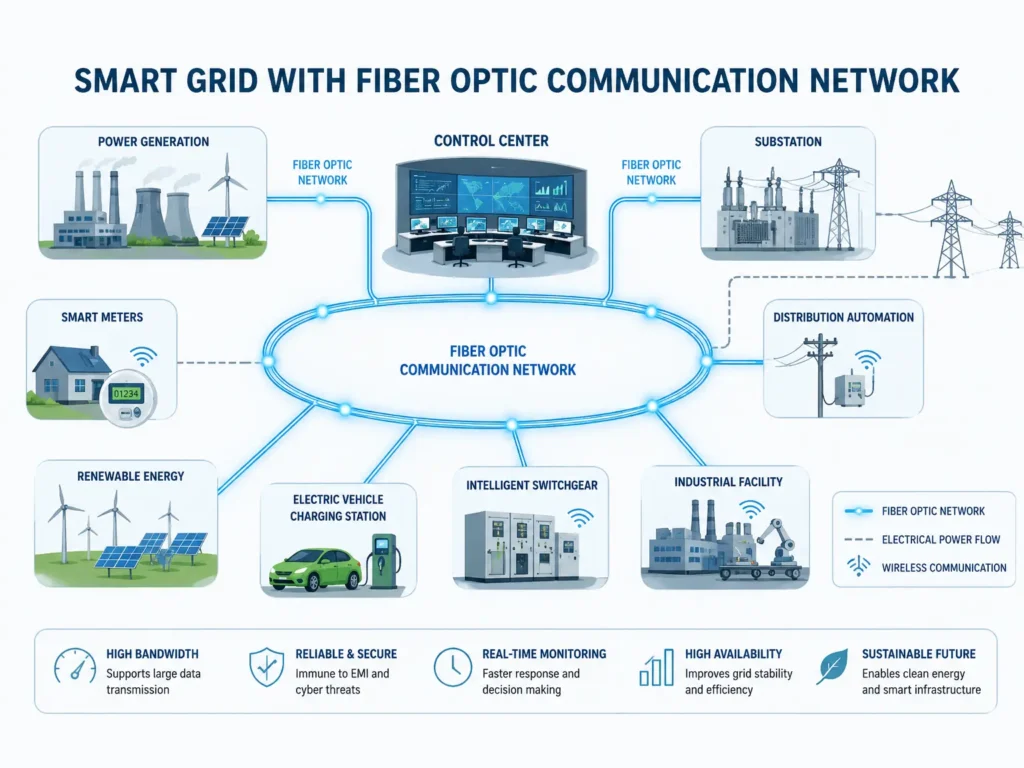
Smart grids operate very differently. Modern smart grids continuously collect and exchange data from substations, transformers, smart meters, renewable energy facilities, and distribution equipment. This allows utility operators to monitor power conditions in real time and react to failures much faster than before.
In traditional grids, identifying a fault could sometimes take hours, especially in large transmission networks. Smart grid systems equipped with automated monitoring and intelligent switching technologies can reduce outage response times by 30% to 50% in some scenarios. Real-time load balancing systems can also improve transmission efficiency while reducing unnecessary energy loss during peak demand periods.
Another major difference is communication architecture.
Traditional systems relied heavily on copper-based communication networks. However, as grid automation increases, copper infrastructure faces growing limitations in bandwidth, latency, signal stability, and electromagnetic interference resistance.
This is where fiber optic networks begin to play a critical role.
Why Fiber Optics Are Becoming Essential in Smart Grids

One of the biggest challenges inside modern power infrastructure is communication reliability.
Smart grids require enormous amounts of data to move continuously between substations, monitoring systems, distribution cabinets, renewable energy sites, and central control platforms. Delays of even a few milliseconds can affect automated protection systems and fault isolation mechanisms.
Fiber optic communication provides several advantages that make it ideal for this environment.
Low Latency and High Bandwidth for Real-Time Grid Communication
The first advantage is low latency. Fiber networks can transmit large volumes of data extremely quickly, allowing utility operators to detect abnormal conditions and respond almost instantly. In automated substations, this speed is essential for relay protection systems, remote switching operations, and real-time grid balancing.
The second advantage is bandwidth.
Modern smart grids generate far more data than traditional power systems ever did. Smart meters, AI-based monitoring systems, predictive maintenance platforms, video surveillance, and renewable energy sensors all contribute to growing communication demands. Fiber optic networks can handle this data growth far more effectively than conventional copper systems.
Why Fiber Performs Better in High-Voltage Environments
But perhaps the most important advantage is resistance to electromagnetic interference.
High-voltage environments naturally produce strong electromagnetic fields. Traditional copper communication cables can experience signal degradation or interference under these conditions, especially in substations or industrial power facilities. Fiber optic cables, however, are immune to electromagnetic interference because they transmit information using light rather than electrical signals.
This makes fiber particularly valuable in high-voltage transmission systems, automated substations, and industrial power distribution networks where communication stability is critical.
Distance is another important factor. Renewable energy projects such as wind farms and solar plants are often located far away from urban centers. Fiber optic networks allow stable long-distance communication between remote energy facilities and centralized control systems without significant signal loss.
As smart grids continue expanding, these advantages are becoming increasingly difficult to ignore.
Intelligent Substations Are Reshaping Power Infrastructure
Modern substations are no longer just electrical facilities filled with transformers and breakers. They are evolving into intelligent communication nodes capable of real-time monitoring, remote diagnostics, predictive maintenance, and automated fault response.
This transformation is changing how power infrastructure is designed.
In traditional substations, operators often needed to manually inspect equipment or rely on delayed alarms after failures occurred. Intelligent substations equipped with fiber communication systems can continuously monitor equipment conditions and detect abnormalities almost immediately. In some cases, automated monitoring systems can reduce fault detection times from hours to just seconds.
This shift is also influencing the equipment manufacturing industry itself.
As smart grids become more advanced, many modern switchgear manufacturers are beginning to integrate fiber optic communication systems directly into medium-voltage and high-voltage distribution equipment to improve monitoring speed, operational reliability, and grid response capabilities.
Instead of functioning as isolated electrical devices, intelligent switchgear systems are increasingly becoming part of a broader digital energy network.
This integration allows utility operators to remotely monitor equipment status, identify overload risks earlier, and isolate faults more efficiently during outages. Automated switching systems can also help reduce the scale of blackouts by limiting failures to smaller sections of the grid rather than allowing disruptions to spread across entire regions.
In large urban networks where millions of people depend on uninterrupted electricity, these improvements are becoming extremely important.
Renewable Energy and EV Charging Are Increasing Grid Complexity
The rapid growth of renewable energy is creating another major challenge for power systems worldwide.
Traditional grids were designed around stable power generation from centralized facilities such as coal, gas, or nuclear plants. Renewable energy behaves differently. Solar and wind power fluctuate constantly depending on weather conditions, time of day, and seasonal changes.
This variability creates new balancing challenges for utility operators.
For example, a sudden drop in solar output caused by cloud cover may require the grid to redirect electricity from other sources within seconds. Without fast communication and automated coordination, maintaining grid stability becomes significantly more difficult.
Electric vehicles add another layer of complexity.
Fast-charging stations can create sudden spikes in electricity demand, especially in densely populated urban areas. As EV adoption continues rising globally, utility companies must develop smarter ways to manage these fluctuating loads.
This is one reason why communication infrastructure is becoming just as important as power transmission infrastructure itself.
Fiber optic networks allow utilities to collect real-time data from charging stations, substations, renewable energy facilities, and smart meters simultaneously. Combined with AI-driven analytics, this data can help optimize energy distribution, predict demand surges, and reduce unnecessary strain on the grid.
In many ways, future power systems will depend not only on generating electricity, but also on moving information efficiently.
Fiber Optics May Become the Nervous System of Future Energy Networks
As AI infrastructure, smart cities, renewable energy, and electric transportation continue expanding, global energy systems are becoming more interconnected and data-driven than ever before.
Power grids are no longer simply physical networks for transmitting electricity. They are evolving into intelligent digital ecosystems that require constant communication between millions of devices, sensors, substations, and control systems.
This transformation is making communication reliability a foundational part of energy infrastructure planning.
Fiber optic technology is uniquely positioned to support this shift because it combines high bandwidth, low latency, long-distance transmission capability, and strong resistance to electromagnetic interference in demanding electrical environments.
While the public often focuses on power generation itself, the communication layer behind modern grids may become equally important in the years ahead.
Future energy systems will increasingly depend on fast, stable, and intelligent communication networks — and fiber optics are rapidly becoming one of the core technologies behind that transformation.