
TABLE OF CONTENTS
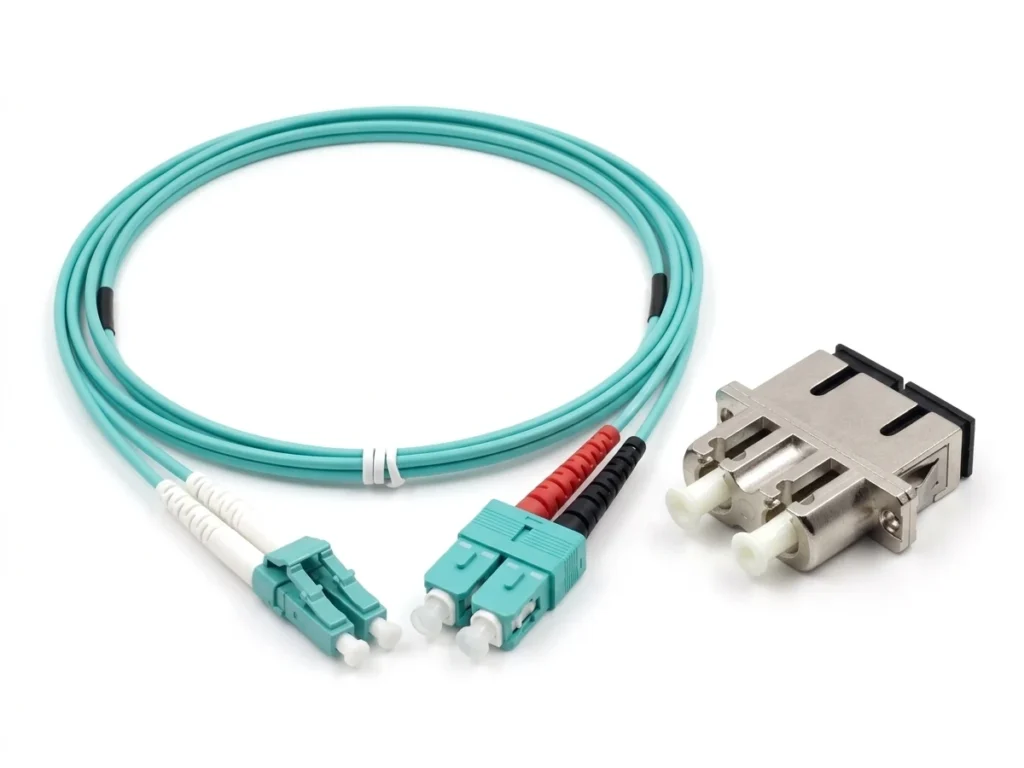
SC and LC connectors do not plug into each other. An SC connector carries a 2.5 mm ferrule in a square push-pull housing, while LC uses a 1.25 mm ferrule with a latch, so going from SC to LC always takes a conversion part. The part is one of two kinds: a hybrid patch cord with an SC connector on one end and LC on the other, or a hybrid adapter that has an SC interface on one side and an LC interface on the other. Which one fits depends on what in the link can be changed, and each choice affects how many connections the light has to cross.
Below, we compare the options side by side, show how to count the connections each one adds, explain where an APC-to-UPC change belongs, and finish with a checklist of what to specify when ordering. For ready-made parts, see our hybrid fiber optic adapters.
Why SC and LC Fiber Connectors Don't Plug Together
The two connectors differ in every dimension that matters for mating. SC is usually expanded as subscriber connector, and LC began as the Lucent Connector, a small form factor design whose ferrule is half the diameter of the SC ferrule. The housings are different too: SC is a square body that pushes in and pulls out; LC is a smaller body held by a latch similar to an RJ-45 clip. No adapter sleeve can hold a 2.5 mm ferrule and a 1.25 mm ferrule face to face unless it is built for exactly that job.
The same logic applies beyond SC and LC. ST, SC and FC all use a 2.5 mm ferrule, so their fibers can meet, but their couplings differ (bayonet, push-pull, screw thread), and joining them still requires a hybrid mating adapter.[1] LC to FC and LC to ST face both problems at once: different ferrule size and different coupling.
LC vs SC: Choosing One for a New Install
Ways to Go from SC to LC Compared
| Method | What it is | Extra mated pairs vs. a direct LC–SC cord | Best when | Watch out for |
|---|---|---|---|---|
| Hybrid patch cord | One cord, LC connector on one end, SC on the other | 0 | The cord between the LC equipment and the SC panel or outlet can be replaced | End face ordered per end; fiber type for the whole cord |
| Panel hybrid adapter, in place of the panel adapter | SC socket on one side, LC socket on the other, fitted where the old adapter was | 0 at the panel, if it simply replaces an SC-SC adapter | The panel stays, and the front cords will be LC | Cutout, flange and fixing must match the panel; check the model’s drawing |
| Hybrid adapter as an inline coupler | The same female-to-female part joining two existing cords, one LC and one SC | +1 | Both cords must stay and neither can be re-terminated | One more connection in the loss budget; the coupler needs somewhere secure to sit |
| Male-to-female converter | An SC plug body with an LC socket on the back | +1 | A test instrument or terminal has an SC port and the cord is LC | Strain on the port; best kept for temporary use |
How Much Loss Each Option Adds
Every place where two connectors meet is a mated pair, and every mated pair is a line in the link’s loss budget. Quality ceramic-sleeve connections commonly reach less than 0.3 dB per mated pair.[2] For budgeting, the TIA-568 cabling standard allows 0.75 dB for a mated pair of standard-grade connectors.[3]
Take a link where an LC switch port has to reach an SC panel, with the panel’s existing SC adapter left in place. A single LC–SC hybrid cord meets the panel at one mated pair, so a budget built on that allowance carries 0.75 dB for it. An LC cord, an inline hybrid adapter and an SC cord meet at two mated pairs on the same path, so the same budget carries 1.50 dB. These are planning allowances, not measured results. Whether the extra pair matters depends on how much margin the link has left against the loss its application allows, so check the budget rather than judging by distance. Our guide to insertion loss and return loss explains how these figures are measured.

Option 1: An LC to SC Fiber Patch Cord
A hybrid patch cord, often listed as an LC to SC patch cord or SC to LC patch cable, is an ordinary length of fiber optic cable with a different connector on each end. It is the default answer for most installers because it solves the conversion and the connection in one part, with the fewest mated pairs.
Typical uses:
- Patching an LC transceiver in a data center switch, router or media converter to existing SC patch panels or an ODF.
- Running from an SC wall outlet or terminal box to equipment with LC ports.
- Replacing a chain of cord, adapter and cord that has built up over several moves and changes.
The point people most often miss is that the connector and end face are specified for each end on its own, while the fiber type and cable build apply to the whole cord. The LC end follows the equipment port and the SC end follows the panel. A cord can be LC/UPC on one end and SC/APC on the other, which is exactly how an APC-to-UPC change should be made (see the end-face section below). Duplex versions carry two fibers, with an LC duplex connector on one end and an SC duplex connector or two SC simplex connectors on the other.
Length, fiber type and cable build are ordered the same way as any patch cord: single-mode or multimode, simplex or duplex, and a jacket that suits the route. For our range of standard and custom assemblies, see fiber optic patch cords.
Option 2: A Hybrid LC to SC Fiber Optic Adapter
A hybrid adapter, also sold as a hybrid coupler, joins two different connector families. A typical example is an LC socket on one side and an SC socket on the other.[2] Two forms are on the market, and they suit different jobs.
Panel (Bulkhead) Hybrid Adapters
A panel hybrid adapter is a female-to-female part that fits into a panel or box opening, much like a standard adapter. Fitted in place of an existing SC-SC adapter, it lets the panel accept LC cords from the front while the SC cord behind stays, and the port still has one mated pair. Inside, the adapter has to hold two ferrules of different diameters on the same axis. One manufacturer describes an internal ceramic sleeve assembly that aligns the 1.25 mm LC ferrule with the 2.5 mm ferrule of SC, FC or ST.[4] Many of these adapters are made to an SC footprint, but cutout size, flange and fixing differ from model to model, so check the drawing against the panel before ordering. The same part can also sit inline to join an existing LC cord to an existing SC cord, which adds a connection, as the table shows. Our SC to LC hybrid fiber adapter is a flanged simplex example.
Male-to-Female Converters
A converter has a connector body on one side and a socket on the other, for example an SC plug that goes into an SC port and presents an LC socket. Sellers name them by gender, such as SC male to LC female or LC male to SC female. They are common on OTDRs (optical time domain reflectometers), visual fault locators and optical power meters whose ports are SC or FC while the cord under test is LC. Because the converter sticks out of the port, any pull on the cord acts as a lever on the port, so it is best treated as a temporary fitting rather than a permanent part of a link. Inspect both end faces each time it goes on, clean only if needed, then inspect again; our fiber optic cleaning guide covers the routine.
For either form, a working connection does not prove the loss matches a same-type adapter. Check the datasheet for the exact combination and fiber type rather than assuming.

APC and UPC: Where to Change the End Face
APC and UPC connectors must never be mated with each other. Doing so raises insertion loss sharply, degrades return loss and can damage the fiber end faces.[2] In practice the rule is that an angled (APC) end face only meets another APC face, and a non-angled PC or UPC face only meets another PC or UPC face, at every mating point in the link.
The end face is usually decided by the equipment, not by the installer. For example, Cisco’s data sheet for its 10GBASE SFP+ modules states that the LC ports accept only PC or UPC patch cords and that APC cords are not supported.[5] On the other side of the link, many FTTH and carrier hand-off points use SC/APC. When an APC port and a UPC port have to be joined, the change can be made in a patch cord: an SC/APC to LC/UPC hybrid cord puts an APC connector on the APC port and a UPC connector on the UPC port, so both mating faces match.
A plain panel or inline hybrid adapter cannot make that change, because it simply holds the two cords’ ferrules against each other: an SC/APC plug and an LC/UPC plug meeting inside it are still an APC face on a UPC face. Converters sold as SC/APC male to LC/UPC female are a different build. They contain a short piece of fiber of their own, with an APC face on the plug side and a UPC face toward the socket, so check the exact model’s datasheet for both interfaces and both end faces before buying one. Color helps as a first check, since green usually marks APC and blue marks UPC, but some makers use other colors, so the label and the datasheet decide.
A cord or adapter changes the connector, not the optics. The transceivers or equipment at the two ends still have to be compatible with each other and with the installed fiber.

APC vs UPC at a Glance
UPC end faces are polished with a slight dome and no angle, while APC end faces are angled so reflected light leaves the core. Where each is used, and why, is explained in our APC vs UPC comparison.
Duplex Links: Keep Transmit Going to Receive
Most equipment links are duplex: one fiber transmits, the other receives, and somewhere along the link the two fibers have to cross so that each transmitter reaches a receiver. Getting this wrong is one of the most common reasons a newly installed fiber link does not work.[6] Where the crossing happens is a design choice. Many cable plants cross the fibers in the permanent cabling between panels and then use straight-through duplex patch cords, while others put the crossover in a patch cord, and the cabling standard allows several arrangements.
An SC to LC hybrid cord or a duplex hybrid adapter does not change that logic, but it adds one more part whose fiber mapping has to fit the plan. Before ordering, confirm whether the link needs an A-to-B (crossed) or an A-to-A (straight) duplex hybrid cord, and check transmit-to-receive across the whole path, from equipment port to equipment port. If a new SC to LC link shows light on the meter but the equipment reports no link, swapped transmit and receive is the first thing to check.

FC, ST and Other Combinations
Everything above applies to other connector types too. FC to SC and ST to SC share the 2.5 mm ferrule but still need a hybrid mating adapter because the couplings differ,[1] and FC or ST to LC adds the change in ferrule size. Common combinations offered by adapter makers include SC to LC, FC to SC, SC to ST and FC to LC.[4] FC still turns up on test instruments, laboratory optics and older telecom equipment, which is why FC-to-LC converters and FC to LC patch cords are common in test kits. Our SC to FC hybrid adapter covers one of these pairs.
One case looks similar but is different. Splitting an MPO trunk into several LC connectors is done with a breakout cord or cassette, not a hybrid adapter. For the full list of adapter families, see our fiber optic adapter types guide.
What to Specify When Ordering SC to LC Parts
| Item | What to confirm | Why it matters |
|---|---|---|
| Connector on each end | SC, LC, FC or ST; plug or socket for converters | Decides whether the part fits at all |
| End face on each end | PC/UPC or APC, set separately for each end to match the port it plugs into | APC must never meet PC or UPC |
| Fiber type | Single-mode (OS2) or multimode (OM3, OM4 and so on) for the whole cord, matching the installed link and the equipment’s optics | Single-mode and multimode fiber types should not be mixed |
| Simplex and duplex | Fiber count and, for duplex, A-to-B or A-to-A as the link design needs | Keeps transmit on receive |
| Cord details | Length, cable diameter, jacket and color | Fits the route and the labeling scheme |
| Adapter details | Panel replacement, inline coupler or converter; cutout, flange or clip-in; simplex or duplex | Fits the existing panel or port |
| Test data | Insertion loss and return loss records, if the project needs them | Speeds up acceptance |
Hybrid Adapters and Patch Cords from YingFeng
YingFeng makes a wide range of hybrid adapters, covering most of the combinations found on the market, including SC to LC and SC to FC simplex hybrid adapters, each listed in PC and APC versions with single-mode and multimode options. Our adapters are 100% scanned on automated 3D inspection systems. We also make patch cords and other cable assemblies with a different connector on each end, such as LC to SC or LC to FC, including cords with APC on one end and UPC on the other, in single-mode or multimode and simplex or duplex. Every standard patch cord is tested before shipment, measured insertion loss and return loss data can be supplied for each cord, and samples are available on request.
Hybrid Fiber Optic Adapters: SC to LC, SC to FC and other combinations in PC and APC View hybrid adapters
To get a quote, send the connector and end face for each end, the fiber type and the quantity, plus the length for cords or the mounting (panel, inline or port) for adapters.
Frequently Asked Questions
Can you plug an SC connector into an LC port?
No. The SC ferrule is twice the diameter of the LC ferrule and the housings are different, so an SC connector cannot enter an LC port. Use an SC to LC hybrid patch cord or a hybrid adapter.
Is an SC to LC adapter the same as an SC to LC patch cord?
No. An LC to SC adapter is a small part with a socket or plug on each side, used in a panel or on a port. A patch cord is a length of cable with SC on one end and LC on the other. Some sellers also call a short cord an “adapter cable”, so check the product photo and description.
Does an SC to LC hybrid adapter add loss?
It depends on how it is used. Fitted in place of an existing SC panel adapter, it keeps the same number of mated pairs at the panel. Used inline to join two cords, or as a plug-in converter, it adds one mated pair, for which a TIA-568 budget allows 0.75 dB. The real loss depends on the part, so check its datasheet.
Can I connect SC/APC to LC/UPC?
Yes, with a hybrid patch cord that has an SC/APC connector on one end and an LC/UPC connector on the other, or with a converter built for that change. A plain hybrid adapter between an SC/APC plug and an LC/UPC plug does not work, because an APC end face must never mate directly with a UPC end face.
Do I need a single mode or multimode SC to LC cord?
Match the fiber already installed in the link and the fiber the equipment’s optics are made for: single-mode (often a yellow jacket) or multimode such as OM3 or OM4 (often aqua). Jacket color is a clue, not a guarantee, so confirm with the cable marking or the link documentation.
External references
- The Fiber Optic Association: Fiber Optic Connector Identifier
- RP Photonics Encyclopedia: Fiber-optic Adapters
- Fluke Networks: New Loss Budget Values for Reference Grade Connectors in ANSI/TIA-568.3-E (knowledge base article)
- TTI Fiber: Hybrid Fiber Optic Adapter, SC-LC and Cross-Type Couplers (product documentation)
- Cisco: Cisco 10GBASE SFP+ Modules Data Sheet (product documentation)
- The Fiber Optic Association: Fiber Optic Link Polarity