
TABLE OF CONTENTS
LC and SC are the two fiber connectors people encounter most often. The difference between LC and SC is mostly physical. An SC connector has a 2.5 mm ferrule in a square body that latches with a push-pull motion. An LC connector has a 1.25 mm ferrule, about half the size, and locks with a small RJ-45-style latch.
Optical performance is not what separates them, because loss depends on the polish and on how the connector was terminated. The choice usually comes down to the port on the equipment, how many fibers must fit in the rack, what is already installed and any operator rule the project has to follow. Below we put numbers on the density difference using real panel data, show where each connector is specified today and explain how to mix the two in one link.
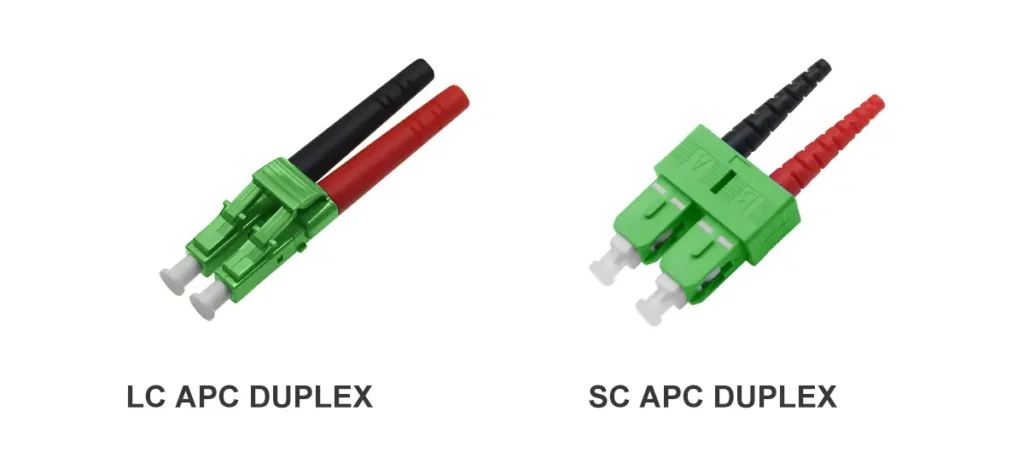
LC vs SC Fiber Connector at a Glance
| Feature | LC connector | SC connector |
|---|---|---|
| Ferrule diameter | 1.25 mm | 2.5 mm |
| Body | Small form factor, about half the size of SC | Square body |
| Latch | RJ-45-style latch: press the lever to release | Push-pull: push in to lock, pull the outer housing to release |
| Duplex versions | Duplex clip; uniboot (two fibers in one boot) | Duplex clip joining two connectors |
| Polish options | UPC and APC | UPC and APC |
| Fibers in 1 RU (same panel series, fully loaded) | 96 | 48 |
| Typical equipment port | SFP and SFP+ transceivers | Connects to them through an LC–SC patch cord |
| Where you often see it | High-density patch panels, data centers, switch ports | FTTH and access networks, telecom distribution, patch panels |
| Optical loss | Set by polish and termination | Set by polish and termination |
In practice, LC saves space and matches the ports on current switches, while SC is larger, easy to handle and still written into operator specifications. Each row is explained below. For any other type of connector, such as the ST connector, the FC connector or MPO, see our guide to the types of fiber optic connectors.
Size, Ferrule and Latch: What Physically Differs
The ferrule is the ceramic cylinder that holds the optical fiber and aligns it with the fiber on the other side. SC uses a 2.5 mm ferrule, the same size as ST and FC, while LC uses 1.25 mm. The rest of the size difference follows from that. A smaller ferrule allows a smaller body, so an LC connector takes roughly half the space of an SC.
The latches work differently. SC is a push-pull connector: it snaps in and latches with a simple push-pull motion. The installer pushes it into the adapter until it seats, and pulling the outer housing releases it. LC uses a latch modeled on the RJ-45 Ethernet plug, with an audible click when it locks, and the latch lever has to be pressed before the connector comes out.

The names are less settled than the shapes. LC is usually expanded as Lucent Connector, sometimes as little or local connector, and the FOA calls it the lightwave connector. For SC, the usual readings are subscriber, square or standard connector.
On site, the difference shows up in handling. Engineers who prefer SC point to the larger body, which is easier to grip with gloves and easy to swap when an installer crosses a pair. LC needs a fingertip on the latch, and in a fully loaded panel the neighboring cords sit close together.
For the parts inside each connector, see our breakdowns of the LC connector structure and the SC connector structure.
Port Density: What "Half the Size" Means on a Real Panel
Almost every comparison says LC doubles port density. Here is what that looks like on real hardware from two manufacturers that build the same panel series in both connector types.
| Manufacturer and series | LC configuration | SC configuration |
|---|---|---|
| Panduit Opticom, 1 RU enclosure holding 4 adapter plates | 12 duplex LC adapters per plate: 96 fibers | 6 duplex SC adapters per plate: 48 fibers |
| Corning Everon LAN1, 1U housing | LC duplex: 96 fibers | SC duplex: 48 fibers |

Example: in the same 1U sliding panel, 24 duplex LC adapters hold 48 fibers, twice the 24 fibers of the SC version.
In both product lines, the same rack space carries twice as many fibers when it is fitted with LC.[1][2] That is the practical reason LC is widely chosen for high-density fiber optic patch panels and switch faceplates.
Two cautions apply. These figures belong to these product lines: other panels use other layouts, and Panduit also lists a 6-duplex LC plate that holds the same 48 fibers as the SC version. And density only pays off when space is the constraint. If a panel will only ever hold a few dozen fibers, the space saving may not change the decision.
Loss, Return Loss and Durability: Compare Products, Not Connector Types
LC and SC connectors both use ceramic ferrules, and neither interface is optically better than the other. Factory-polished connectors of either type typically lose less than 0.3 dB per connection, and the TIA-568 cabling standard allows up to 0.75 dB per mated pair.[3] The first number is a typical value and the second is a limit. Neither is a promise for any particular product.
Return loss, the share of light reflected back toward the source, depends on the end-face polish. A UPC end face and an APC end face behave differently whether the body is LC or SC.
Many comparison tables online give SC about 1,000 mating cycles and LC about 500. Treat those figures with care, because they do not come from the connector standards. The international standards for the two connector families define the interface dimensions, so that any compliant LC mates with any other compliant LC and any compliant SC with any other SC.[4][5] Durability and loss are properties of a specific product and of how it was tested.
What to ask a supplier instead
- Insertion loss and return loss, with the test wavelength and the reference method
- End-face polish (UPC or APC) and end-face geometry results
- The durability test: how many matings, and what change in loss is allowed
Where LC and SC Are Used Today
Which connector turns up depends on the point in the fiber network and on who sets the rule there.
| Location | Usually decided by | LC | SC |
|---|---|---|---|
| Switch and transceiver ports | The equipment maker | Duplex LC on SFP and SFP+ optics | Reached through an LC–SC patch cord |
| Patch panels and ODFs | The designer and the installed base | Common, especially at high density | Common |
| Access network and home outlets | The network operator | Named by some operators, for example LC/APC in a Swiss home outlet | Named by some operators, for example SC-APC in a UK service |
| Test and spare cords | Whatever you plug into | Keep both | Keep both |
On equipment, the port decides. Cisco’s data sheet for its 10G SFP+ modules, for example, lists a dual LC/PC connector.[6]
In access networks the operator decides, and European operators do not all pick the same connector. An Openreach technical specification for one of its UK fiber services states that the connectors customers provide “will be of type single SC-APC”.[7] In Switzerland, the 2024 FTTH guidelines of SWL Energie AG terminate the fibers in the home optical outlet (OTO) on LC/APC connectors, and the sample apartment wiring shows an outlet with four of them.[8]
That is also why SC should not be filed as a legacy connector. Its international interface standard received a new edition in 2022 and an amendment in 2026,[4] and the US intermateability standards cover SC with SC-APC in one document and LC in another.[9][10]

How to Choose Between LC and SC Connectors
Five questions settle most choices, whether the order is for a panel, a cable assembly or a connector kit.
- What port does the active equipment have? Match the equipment end first. If it is an SFP-type transceiver, that end is duplex LC.
- How many fibers must fit in the rack or enclosure? Where space is tight, LC fits twice the fibers per panel position.
- What is already installed? Staying with the existing connector keeps spares, cords and test leads interchangeable.
- Is there an operator or project specification? In access networks the operator’s document comes before preference.
- How often will cords be moved, and by whom? Frequent re-patching by gloved hands favors the larger SC body.
Then confirm the polish. APC or UPC has to match from one end of the link to the other.
| Situation | Choose |
|---|---|
| New high-density rack or data hall | LC panels and LC cords |
| Switches with SFP optics, connecting to an existing SC panel | Keep the SC panel and use LC–SC patch cords |
| Extending a campus or building where every panel is SC | SC, for consistency |
| Building to an operator’s FTTH specification | The connector the specification names |
| Field cabinets with frequent manual re-patching | SC is often preferred for handling |
Whichever connector wins, the connector type, polish and simplex or duplex belong on the work order. Cabinets that mix LC, SC and ST often start with a job sheet that never named the connector.
Mixing LC and SC in One Link
Mixing the two is routine: LC equipment gets patched into SC panels every day. What matters is doing it cleanly.
| Method | Good for | Watch out for |
|---|---|---|
| Hybrid fiber patch cable (LC on one end, SC on the other) | Connecting LC equipment to an SC panel | Order the right fiber type and polish on each end |
| Hybrid adapter (SC on one side, LC on the other) | A fixed conversion inside a panel | A working connection does not mean the same loss as a same-type adapter |
| Re-terminate, or change the panel adapters | Moving a whole panel to LC | Labor and downtime |

- Polish must match. An APC connector should not be mated with a UPC connector. APC is usually green and UPC blue, though there are exceptions.[12] Some transceivers accept only PC or UPC cords: Cisco states that patch cords with APC connectors are not supported on its SFP+ modules.[6]
- Plugs and ports. A patch cord carries plugs on both ends, and the port holds the adapter. Anyone searching for an “SC female to LC male” cable is really looking for an LC–SC patch cord.
- Duplex polarity. Duplex links cross over, position A to position B, so that transmit meets receive. Check a hybrid duplex cord the same way as any other duplex cord.
- Extra mated pairs add loss. An SC cord, a hybrid adapter and an LC cord put one more mated pair in the link than a single LC–SC cord does. Every pair counts against the loss budget, so use one hybrid cord where you can.
UPC or APC on LC and SC
Both connectors come in UPC and APC versions, so the polish is a separate choice from the connector type. The connector end face on a UPC version is polished for physical contact, while an APC end face is angled, typically at 8 degrees, so that reflected light leaves the core.[13] APC is used where reflections matter, such as CATV and high-bit-rate single-mode links.[3] The two cannot be mated with each other, which is why an LC/APC to SC/APC cord is a different part from an LC/UPC to SC/UPC cord. For the full comparison, see our APC vs UPC guide.
LC and SC Connector Kits for Your Production
Fiber Optic Connector Kits: LC and SC connector kits and individual parts for patch cord and pigtail production. View connector kits
YingFeng supplies fiber optic connector kits for terminating fiber cables into LC and SC patch cords and pigtails. For SC, we offer SC/UPC and SC/APC fiber optic connector kits in simplex and duplex, plus individual SC parts. For LC, we offer LC duplex, uniboot, short-boot and simplex connector kits. All connector components are also available individually, and custom tooling is available for customer-specific parts. Assembled connectors can be produced to your requirements on request, and samples are available on request. To get a quote, tell us the connector type, polish (UPC or APC), cable diameter, simplex or duplex, and your planned quantity.
Frequently Asked Questions
Which is better, LC or SC?
Neither is better in general. LC saves panel space and matches the ports on SFP transceivers, while SC is larger, easier to handle and named in some operator specifications. Use the five questions in How to Choose Between LC and SC Connectors to decide for a given project.
What do LC and SC stand for?
LC is usually expanded as Lucent Connector, and sometimes as little or local connector; the FOA calls it the lightwave connector. SC is usually read as subscriber connector, with square connector and standard connector also in use.
Do SFP modules use LC or SC connectors?
SFP and SFP+ transceivers use duplex LC ports. If your patch panel is SC, connect the two with an LC–SC patch cord of the right fiber type and polish.
Can you connect an LC connector to an SC connector?
Yes. Use a hybrid patch cord with LC on one end and SC on the other, or a hybrid adapter in a panel. Match the polish on both sides and check duplex polarity.
Are LC connectors replacing SC?
On switches and transceivers, LC is the normal port. SC remains current: its international standard was amended in 2026, and operators such as Openreach still specify SC-APC.
Is LC single-mode or multimode?
Both. LC and SC each come in versions for single-mode fiber and for multimode fiber. Connector colors often indicate the type, for example blue for single-mode UPC and green for single-mode APC, but check the product marking rather than relying on color.
External references
- Panduit: Opticom Fiber Optic Patch Panels and Trays (specification sheet)
- Corning: Everon LAN1 Fiber Housing (product catalog)
- The Fiber Optic Association: The FOA Reference for Fiber Optics – Termination
- IEC 61754-4:2022, Fibre optic connector interfaces – Part 4: Type SC connector family (amended 2026): IEC Webstore
- IEC 61754-20:2012+AMD1:2022, Fibre optic connector interfaces – Part 20: Type LC connector family: IEC Webstore
- Cisco: Cisco 10GBASE SFP+ Modules Data Sheet (product documentation)
- Openreach: BDUK Phase 3 Segments Technical Specification, v1 (March 2018)
- SWL Energie AG: SWL FTTH Richtlinien für Planung und Installation, V-01/2024
- TIA-604-3-B (08/2004), FOCIS 3 Fiber Optic Connector Intermateability Standard – Type SC and SC-APC: Accuris standards store
- ANSI/TIA-604-10-D, FOCIS 10 Fiber Optic Connector Intermateability Standard – Type LC: TIA announcement
- TTI Fiber: Hybrid Fiber Optic Adapter, SC-LC and Cross-Type Couplers (product documentation)
- The Fiber Optic Association: Fiber Optic Connector Identifier
- The Fiber Optic Association: Connector Types and Terminology – What’s In A Name?