
As FTTH (Fiber to the Home) continues to expand worldwide, the design and deployment of the Optical Distribution Network (ODN) has become a critical factor in project success.
Traditionally, ODN networks have been built using on-site fiber splicing and manual installation. However, with increasing pressure on project timelines, labor costs, and network reliability, a new approach — Quick ODN — is gaining popularity.
If you want to better understand the concept and structure of Quick ODN, you can refer to our complete guide: What is Quick ODN? A Practical Guide to Faster FTTH Deployment
Both methods can deliver working fiber networks, but they differ significantly in how they are designed, installed, and maintained. Understanding these differences is essential for choosing the right solution for your project.
Have questions about ODN or planning a project? Contact us to discuss the right solution for your needs.
TABLE OF CONTENTS
How Traditional ODN Works
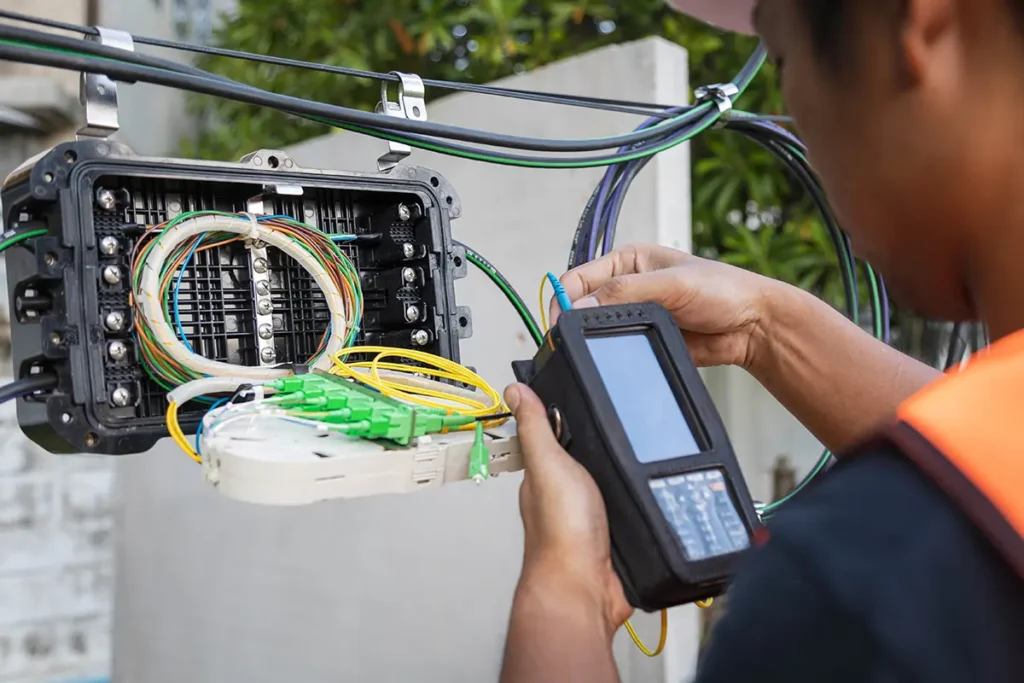
Traditional ODN deployment follows a relatively straightforward structure:
OLT → ODF → Splitter → FAT → End User
In this model, most fiber connections are completed on-site. Technicians typically use fusion splicing or mechanical connectors to join fibers at different network nodes, such as splice closures, distribution boxes, and access terminals.
Advantages of Traditional ODN
One of the main strengths of traditional ODN is flexibility. Because the network is built and adjusted in the field, it can be modified easily to fit complex or changing environments. This makes it suitable for:
- Small-scale deployments
- Network upgrades or retrofits
- Projects with unpredictable layouts
In some cases, the initial material cost may also appear lower, since fewer pre-configured components are required upfront.
Limitations of Traditional ODN
However, these advantages come with several challenges.
First, installation is time-consuming. Fiber splicing requires skilled technicians and specialized equipment, and each connection point adds to the overall project timeline.
Second, the quality of the network depends heavily on the technician’s experience. Variations in workmanship can lead to inconsistent performance, higher insertion loss, and long-term reliability issues.
Another major concern is maintenance. In traditional ODN systems, distribution boxes are frequently opened during installation, expansion, and repair. Over time, this can compromise sealing performance, increasing the risk of moisture, dust, and environmental damage.
As a result, many projects find that installation and maintenance — not equipment — become the biggest bottlenecks.
How Quick ODN Works

Quick ODN takes a different approach by shifting most of the complexity from the field to the factory.
A typical Quick ODN structure looks like this:
OLT → ODF → Hub Box → Sub Boxes → End Box → FRB → ONT
Instead of building the network connection by connection on-site, key components are pre-configured, pre-terminated, and tested in advance.
Advantages of Quick ODN
The most noticeable benefit of Quick ODN is speed.
Because pre-terminated cables and plug-and-play interfaces are used, installers can connect the network without performing extensive splicing work. This significantly reduces installation time.
Another important advantage is reduced reliance on highly skilled labor. Since most critical connections are completed in the factory, installation becomes more standardized and easier to manage.
Consistency is also improved. Factory-controlled production ensures stable optical performance across all components, reducing the variability commonly seen in field-built networks.
In addition, Quick ODN systems often use sealed enclosures with external connection ports. Since these boxes are typically designed to be installed once and remain closed throughout their lifecycle, their waterproof and dustproof performance is generally more reliable than traditional ODN boxes, which are frequently opened during installation and maintenance.
Finally, features such as unequal ratio splitters allow more efficient use of fiber resources, making the solution well-suited for large-scale deployments.
Limitations of Quick ODN
While Quick ODN offers many advantages, it is not without trade-offs.
Because the system relies on pre-configured components, it requires more careful planning in the early design stage. The network layout, cable lengths, and connection points need to be defined in advance.
Compared to traditional ODN, flexibility during installation is slightly reduced. Making major changes on-site can be more difficult if the design was not planned properly.
In some cases, the initial solution design may also appear more structured or standardized, which may not suit highly customized or irregular environments.
Quick ODN vs Traditional ODN: Key Differences
The differences between the two approaches can be summarized as follows:
| Aspect | Traditional ODN | Quick ODN |
|---|---|---|
| Installation | On-site splicing | Plug-and-play |
| Deployment Speed | Slower | Faster |
| Skill Requirement | High | Lower |
| Reliability | Depends on field work | Factory-controlled |
| Maintenance | Frequent intervention | Minimal |
| Scalability | Moderate | High |
The key difference lies in where the complexity happens.
👉 In traditional ODN, complexity is handled on-site.
👉 In Quick ODN, complexity is handled in the factory.
This shift has a significant impact on both project efficiency and long-term performance.
Which One Should You Choose?
Choosing between Quick ODN and traditional ODN depends on your project requirements.
Traditional ODN may still be a good option for:
- Small-scale deployments
- Network upgrades or expansions
- Projects that require high flexibility during installation
On the other hand, Quick ODN is generally more suitable for:
- Large-scale FTTH rollout projects
- Time-sensitive deployments
- Regions with high labor costs or limited skilled technicians
- Standardized network construction
For many modern FTTH projects, especially those focused on speed and consistency, Quick ODN is becoming the preferred choice.
Final Thoughts
Both traditional ODN and Quick ODN can support fiber network deployment, but they represent two different approaches.
Traditional ODN offers flexibility and adaptability, while Quick ODN focuses on efficiency, consistency, and scalability.
As the demand for faster and more reliable network deployment continues to grow, more contractors and network builders are turning to Quick ODN as a practical solution for modern FTTH projects.
In the end, selecting the right approach is not just about technology — it’s about choosing the method that best fits your project timeline, resources, and long-term goals.