
If you’re just stepping into the world of fiber optics, all the technical terms and abbreviations can feel overwhelming. That’s why I created this fiber glossary series — to help you understand what these terms really mean, in the simplest way possible.
I’ll explain everything from an industry insider’s point of view, using real photos whenever I can (not just fancy renders). I also avoid overly complex explanations, keeping the language clear and direct, so you can be confident you’ll understand the real meaning of these terms after reading.
Today, we’re going to talk about: CWDM (Coarse Wavelength Division Multiplexing)
TABLE OF CONTENTS
CWDM in One Simple Explanation
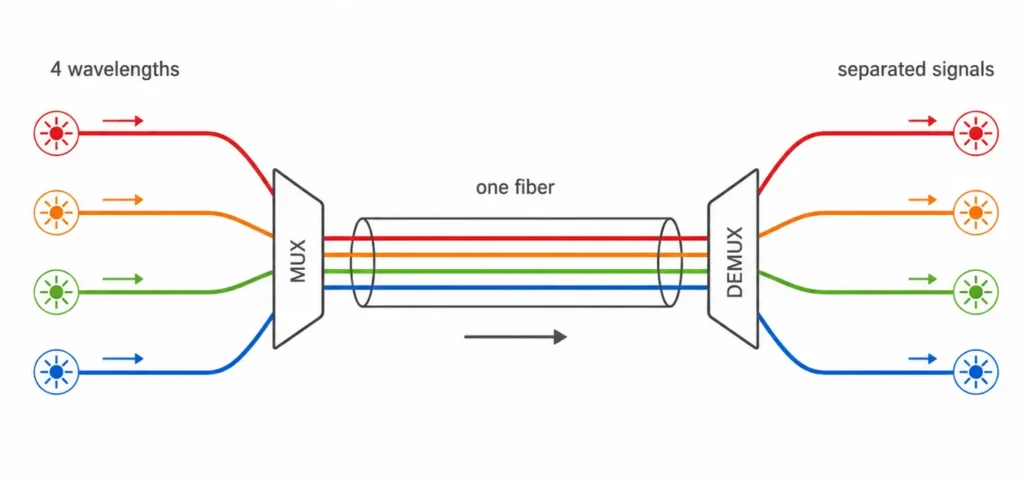
CWDM stands for Coarse Wavelength Division Multiplexing. It is a method that allows several separate data signals to travel through the same optical fiber at the same time. Each signal is placed on its own wavelength of light, so the signals can share the fiber without becoming mixed up.
Imagine a delivery truck carrying parcels with different colored labels. The parcels all travel in the same truck, but the labels let the receiver sort them into the right destination groups. CWDM uses different wavelengths as those labels. The fiber carries all the light together, while special optical components separate the wavelengths at the other end.
The word coarse does not mean poor quality. It means the wavelengths are spaced farther apart than in DWDM. That wider spacing makes CWDM a straightforward option for many lower-channel-count optical links.
Why Use CWDM Instead of More Fiber?
Fiber is extremely capable, but new cable installation is not always easy. A route may require permits, trenching, duct space, building access, and construction time. Spare fiber can also be limited.
CWDM gives a network another option: use the existing single-mode fiber pair more efficiently. Instead of running one service per fiber pair, several services can travel on different wavelengths over the same pair. At the receiving side, those wavelengths are separated and connected to their intended devices.
CWDM does not replace the switch, router, or server that creates the data. It is an optical transport method. Its job is to help multiple optical signals share the same fiber route.
How Does a CWDM Link Work?
Step 1: Each service uses a selected wavelength
At the sending end, each service uses a CWDM optical transceiver with a selected wavelength. The wavelength is normally printed on the module label, such as 1470 nm, 1510 nm, 1550 nm, or another channel in the CWDM plan.
The optical module changes electrical data into light. Each service uses a different wavelength, creating separate optical lanes.
Step 2: A CWDM mux combines the light
A multiplexer, often called a mux, combines those individual wavelengths onto one fiber. It does not need to understand the data inside the signals. It simply combines the selected light channels in an organized way.
In many basic CWDM deployments, the mux is passive. That means the mux itself does not need electrical power to combine or separate wavelengths. However, the switch, router, and optical transceivers still need power. “Passive CWDM” describes the optical combining component, not the entire network.
Step 3: The combined signal travels over the fiber
The fiber carries the wavelengths together. Because the wavelengths are intentionally different, they can share the same path. Good fiber handling still matters: loss from connectors, splices, bends, and dirty end faces can reduce the available optical power.
Step 4: A demux separates the wavelengths
At the far end, a demultiplexer or demux separates the wavelengths. Each output port sends the correct light channel to its matching receiver. A mux/demux pair is often sold as the core of a CWDM solution.
What Does “Coarse” Mean in CWDM?
“Coarse” refers to wider channel spacing. Standard CWDM channels are commonly separated by 20 nm, and the well-known CWDM wavelength plan spans nominal channels from 1271 nm to 1611 nm. A real project may use only a few of those channels rather than all of them.
The wider spacing gives CWDM a simpler channel arrangement than dense wavelength systems. A 1510 nm module belongs on a matching 1510 nm mux port, not a neighboring port.
Do not choose a module only because its wavelength number looks close. Check the channel plan, mux ports, optical budget, speed, connector type, and equipment compatibility together.
CWDM vs. DWDM: What Is the Difference?

CWDM and DWDM follow the same basic idea: multiple wavelengths share one fiber. The main beginner-level difference is how closely the wavelengths are placed. To understand the denser option in the same beginner-friendly style, read our guide to what DWDM is and how it works.
CWDM uses wider spacing and is often selected for simpler systems with fewer channels. DWDM uses much tighter spacing, allowing more wavelengths to fit into the useful optical spectrum. This makes DWDM a common choice when capacity needs are higher or long-term expansion is a major priority.
CWDM can be a very sensible solution when the required service count is modest and cost control matters. DWDM can make more sense when a valuable fiber route must carry a large amount of traffic. The right choice is not about which acronym sounds more advanced; it is about matching the design to the actual project.
Is CWDM the Same as Single-Mode or Multimode Fiber?
No. This is one of the easiest terms to mix up.
CWDM describes how wavelengths are organized on a fiber. Single-mode and multimode describe different types of fiber. In most practical CWDM transport applications, CWDM is used with single-mode fiber, but CWDM is not another name for single-mode fiber.
It is also not another name for a normal fiber optic patch cord. A patch cord is a cable assembly that connects ports. CWDM is a way of carrying several optical channels over a fiber route. A CWDM system may use patch cords, transceivers, mux/demux modules, and single-mode trunk fiber together.
Common CWDM Components
CWDM transceivers
CWDM transceivers are installed in switches, routers, media converters, or transport equipment. Each is built for a selected wavelength. Its format and data rate must fit the host equipment. The short links between equipment and optical ports are usually made with correctly specified fiber optic patch cords.
CWDM mux/demux modules
These modules combine and separate wavelengths. They may have four, eight, or more channel ports, depending on the design. Many also include a common line port, and some include an expansion or monitoring port. For tidy, serviceable rack connections, pair the design with an appropriate optical distribution frame (ODF).
Single-mode fiber and patch cords
Optional monitoring and add/drop equipment
Where Is CWDM Used?
CWDM is often used in campus networks, enterprise links, metro access networks, cable television environments, and site-to-site data connections. It is especially useful where two locations have limited spare single-mode fiber but need several independent links.
For example, two buildings might need separate links for office traffic, storage, cameras, and a backup connection. Rather than using several fiber pairs, a properly designed CWDM system can carry several of those services over one fiber pair using different wavelengths.
What Should You Check Before Building a CWDM Link?
Count the services you need now and estimate growth. A four-channel system can fit four services, but not a near-term need for far more channels.
Check the installed fiber type, route length, and link loss. Every connector, splice, patch panel, and mux adds loss, so the transceivers need enough power budget. Our insertion loss and return loss guide explains those two measurements before you review a link budget.
Build a clear wavelength plan. Record each service wavelength and use matching labels at both ends. Do not assume a CWDM transceiver works through a DWDM mux.
Finally, check support and interoperability before purchasing. A clear parts list and simple link diagram prevent many installation mistakes.
FAQ About CWDM
Does CWDM make the internet faster?
CWDM does not automatically increase the speed of one individual connection. It increases the total capacity available on a fiber route by allowing several separate connections to share it.
Does a passive CWDM mux need power?
The passive mux itself normally does not need power. The network devices and the optical transceivers connected to it still need power to create and receive data signals.
Can I use any CWDM optic with any CWDM mux?
Not automatically. The wavelength must match the mux port, and the optical module must be compatible with the switch or router. Link budget, connector type, and transmission requirements also need to match.
Can CWDM and DWDM optics be plugged into the same mux?
Not as a default assumption. They use different channel plans. Purpose-designed hybrid systems exist, but they require compatible components and an intentional engineering design.
Is CWDM only for telecom operators?
No. Telecom operators use it, but campus networks, enterprises, data centers, and service providers can also use CWDM when fiber availability is limited and multiple services must connect the same locations.
A Simple Way to Remember CWDM
CWDM lets several independent light channels share one fiber. Each channel has its own wavelength, a mux combines them, and a demux separates them at the other end. The channels are spaced farther apart than in DWDM, making CWDM a practical starting point for many moderate-capacity optical links.
Once you understand that one idea, product labels and system diagrams become much less intimidating. Start by matching wavelengths and ports, then move on to power budget, expansion plans, and more advanced optical networking topics when your project needs them.
Still Have Questions?
If you’re still unsure about something, feel free to reach out.
Want to explore more fiber optic terms? Head over to our blog section.
If the term you’re looking for isn’t covered yet, let me know — I’ll add it to the priority list!
And lastly — if you’re a telecom provider, network operator, or involved in fiber infrastructure development and looking for a reliable partner in fiber optic components — feel free to contact us.