
TABLE OF CONTENTS
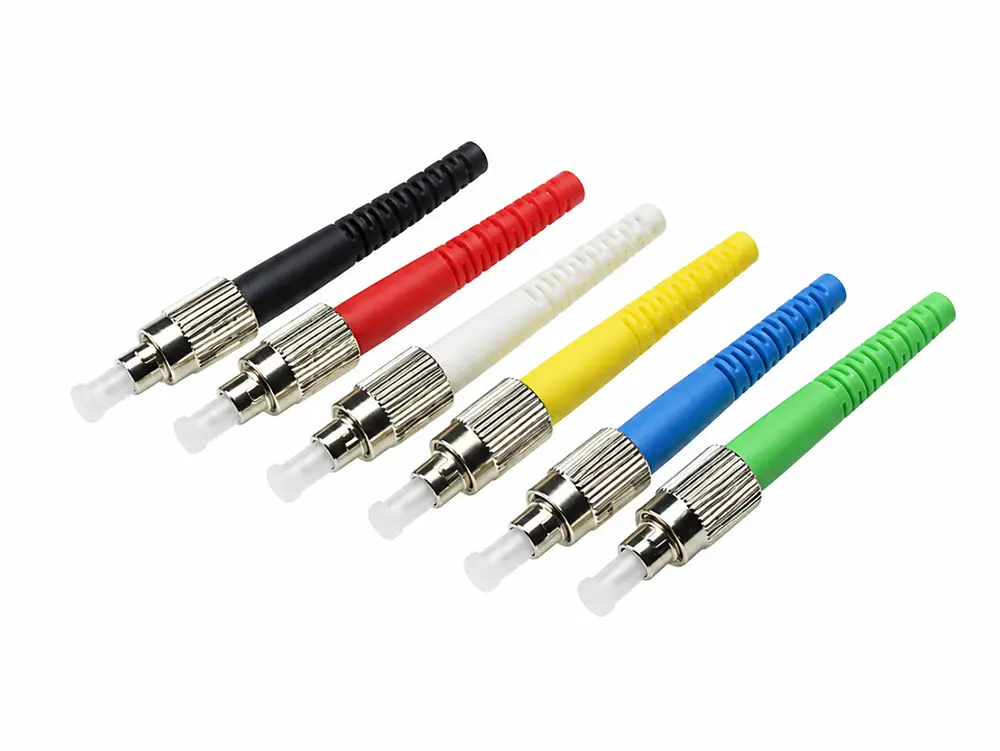
An FC connector is a round fiber optic connector that screws onto its mating adapter. A threaded coupling nut holds a keyed, spring-loaded 2.5 mm ceramic ferrule in place, so the joint stays put under vibration and the fiber end face cannot rotate. FC stands for ferrule connector. It was the most popular connector for single-mode fiber for several years before cost pushed new networks toward other types. Today engineers meet FC connectors mostly on test instruments, laboratory optics, polarization-maintaining fiber and telecom equipment, while new patch panels use SC and LC.
Below, we explain how an FC connector is built and mated, how to choose between FC/UPC and FC/APC, and why narrow-key and wide-key FC/APC parts cause so many mismatches. A comparison with SC, ST and LC follows, then a checklist of what to specify when ordering FC connectors and adapters. Our own FC kits and parts are on the FC & ST connector kits page.
What Is an FC Connector?
Structurally, FC is a single-fiber connector with a threaded body. The fiber sits in a 2.5 mm ferrule, the same diameter used by SC and ST connectors, and a key on the ferrule assembly fixes its rotation. The plug mates with a second FC connector inside an FC adapter, or screws straight onto an FC port on an instrument or a piece of telecom equipment. Catalogs also call the adapter a mating sleeve or a coupler; the word coupler is sometimes used for a simple adapter, not only for a device that splits light.
The name is usually expanded as ferrule connector. In catalogs the same part appears as an FC fiber connector or an FC fiber optic connector. In fiber optics, FC has nothing to do with FC-10P or FC-16P ribbon headers, which are electronic IDC connectors that happen to share the letters.
FC is also a standardized interface rather than one company’s design. The international standard that defines the interface dimensions of the FC-PC connector family was revised in 2024, in a third edition that added a clause on intermateability.[1] In North America, TIA-604-4 (FOCIS-4) covers FC and FC/APC, including connectors for polarization-maintaining fiber. In practice, that is why an FC plug from one supplier normally fits an FC port from another, which matters when a replacement has to go into a port that has been in service for years. The end face and, for FC/APC and PM fiber, the key still have to match, as explained below.
How an FC Connector Is Built and How It Locks
Take an FC connector apart and you will find these parts:
- Ferrule assembly: a 2.5 mm zirconia ceramic ferrule that holds the optical fiber, mounted in a holder that carries the alignment key.
- Spring: pushes the ferrule forward so the two end faces meet with a controlled force.
- Body and coupling nut: the threaded metal nut that screws onto the adapter.
- Cable retention: on 2.0 mm or 3.0 mm jacketed cable, a crimp sleeve clamps the cable’s strength yarn to the connector.
- Boot and dust cap: strain relief behind the connector and protection for the end face.

The ferrule floats inside the body. That isolates the contact point from the cable and the housing, which is why FC connectors hold up in high-vibration environments, and the key stops the fiber from turning while the nut is tightened. The price is more careful handling. The key has to find its slot before the nut turns, and a ferrule pushed in at an angle can scratch its own end face.
How to connect an FC connector:
- Inspect and clean the connector end face and the inside of the adapter or port.
- Line up the key on the connector with the slot in the adapter.
- Push the ferrule straight in until it seats, without twisting it.
- Turn the coupling nut until it is snug. Finger pressure is enough.
Checkpoint: if a new FC connection shows high loss or no light, take it apart and check the key first. A nut screwed down with the key off its slot can still feel tight. A dirty end face is the next suspect; see our fiber optic cleaning guide for the cleaning steps.
FC/UPC or FC/APC?
FC connectors come in two end-face geometries, which buyers usually call polish types: flat contact (PC and UPC) and angled contact (APC). FC/PC and FC/UPC have a domed end face square to the fiber axis, and UPC is a finer grade of the same polish. FC/APC is polished at 8°, so light reflected at the joint leaves the core instead of travelling back toward the laser. Housings and boots usually follow the color convention of blue for single-mode UPC and green for APC, although some suppliers and markets use other colors.
| FC/UPC | FC/APC | |
|---|---|---|
| End face | Domed, square to the fiber axis | Domed, angled 8° |
| Typical return loss | Better than 50 dB | Better than 60 dB |
| Unmated connector | Reflects light back | Stays low-reflection |
| Insertion loss | Lower | Normally slightly higher |
| Mates with | UPC (and PC) end faces only | APC end faces only |
| Typical use | General single-mode and multimode links | Reflection-sensitive single-mode links such as CATV |

The return loss values are typical for UPC and APC end faces in general, not FC-specific limits.[2] The other rows follow from the angle: an APC end face stays low-reflection even when the connector is unplugged, usually at the cost of a little more insertion loss. Both measurements are explained in what insertion loss and return loss mean.
Never connect FC/APC to FC/UPC. The threads and the key let the two screw together, so the mistake is easy to miss, but the angled and flat end faces leave an air gap, the loss rises sharply and the end faces can be damaged. Check the color and the marking on both sides before mating. The full comparison of the two polishes is in APC vs UPC.
Narrow Key vs Wide Key FC/APC Connectors
FC/APC has a second variable that FC/UPC users rarely notice: the width of the alignment key. Two versions are in common use, a narrow key about 2.0 mm wide (often called type R, for reduced) and a wide key about 2.14 mm wide (type N).[3] They are not fully interchangeable: one pairing does not fit at all, and the other fits but can lose alignment. Adapters and instrument ports have matching slots, usually labeled 2.0 mm (narrow) and 2.2 mm (wide).[4] A wide key is too wide for a narrow slot, so a wide-key plug will not go into a narrow-key adapter at all.
The opposite pairing causes the quieter problems. A narrow-key plug does fit a wide-key slot, but the extra play lets it sit at a slightly different angle. For a flat FC/UPC end face on standard fiber that hardly matters. For an angled FC/APC end face it makes proper alignment difficult, so narrow-key FC/APC connectors belong in narrow-key slots. PM fiber needs the same care with either end face, as the next paragraph explains.
| Plug key | Adapter or port slot | Result |
|---|---|---|
| Wide (type N) | Wide slot | Fits, with correct alignment |
| Wide (type N) | Narrow slot | Does not fit |
| Narrow (type R) | Narrow slot | Fits, with correct alignment |
| Narrow (type R) | Wide slot | Fits mechanically; usable for FC/UPC on standard fiber, but FC/APC and PM connections may not align properly |

Where FC Connectors Are Still Used
The screw thread that makes FC secure also makes it slow. Each connection takes a few turns of the nut and finger room around the port, which works against dense patch panels, and SC, a square push-pull connector that snaps in, is less demanding to handle. Add the higher cost, and SC and LC took over most new installations. Where the security of the joint matters more than speed, FC stays:
- Test and measurement. FC is still a common port on OTDRs and other precision test gear. If an instrument has an FC/APC port and the link under test is UPC, use a hybrid test cord with the right end face on each side rather than forcing a mismatched pair.
- Laboratory optics, lasers and PM fiber, where the key holds the end-face angle and polarization axis in place (see narrow key vs wide key).
- Telecom, CATV and wide-area network equipment, where many installed ports are still FC.
- Equipment that moves or vibrates, where the screw-on nut keeps the spring-loaded ferrule firmly mated.
- Maintenance of existing systems. When an installed port is FC, a matching connector or adapter is usually simpler than converting the interface.
How FC Compares with SC, ST and LC Fiber Optic Connectors
FC shares its 2.5 mm ferrule with SC and ST, while LC, a small form factor connector, uses a 1.25 mm ferrule. The main differences are in how each connector couples and where it is used today.
| FC | SC | ST | LC | |
|---|---|---|---|---|
| Coupling | Threaded nut | Push-pull, snap-in | Bayonet, push and twist | Push-pull latch |
| Ferrule diameter | 2.5 mm | 2.5 mm | 2.5 mm | 1.25 mm |
| Body shape | Round | Square | Round | Small, square |
| APC version | Yes | Yes | No | Yes |
| TIA intermateability standard | TIA-604-4 (FOCIS-4) | TIA-604-3 (FOCIS-3) | TIA-604-2 (FOCIS-2) | TIA-604-10 (FOCIS-10) |
| Typical use today | Instruments, PM fiber, telecom equipment | FTTH, telecom, patch panels | Legacy multimode LANs and campus links | Data center switches, transceivers, high-density panels |

The standard numbers are from the TIA FOCIS series.[5]
FC and ST are the pair people confuse most often, because both are round with a 2.5 mm ferrule. Look at the coupling. An ST connector looks very similar to an FC but uses a bayonet that locks with a short twist instead of a threaded screw, and it does not come in an angled polish. An FC connector has a nut that keeps turning until it is tight.
Because SC, ST and FC share a 2.5 mm ferrule design, they can be mated to each other through a hybrid adapter. LC has a smaller ferrule, so an FC-to-LC connection usually uses a hybrid patch cord with FC on one end and LC on the other, or a hybrid adapter built for the two ferrule sizes. Either way, keep APC with APC and UPC with UPC at each mated pair, and remember that every extra joint adds a little loss. The choice between the two most common connectors is covered in LC vs SC, and the other common types of fiber optic connectors in our fiber optic connector guide.
What to Specify When Ordering FC Connectors and Adapters
Two parts can both be called FC and still not fit each other. Before asking for a quote, collect these details.
For FC connectors and kits:
- End face: FC/UPC or FC/APC.
- Fiber type: single-mode or multimode, and for multimode the grade of the installed fiber, such as OM3 or OM4, so the connector and its housing color match it.
- Cable size: 0.9 mm buffered fiber, or 2.0 mm or 3.0 mm jacketed cable.
- Key type and PM alignment: narrow or wide key for FC/APC and PM fiber; for PM fiber, also the polarization axis alignment relative to the key.
- Supply format: complete connector kits for your own assembly line, individual parts, or assembled connectors.
- Reference: a drawing, photo or sample when the part has to match an existing design.
For FC adapters:
- Type: FC to FC, or a hybrid adapter such as FC to SC, FC to ST or FC to LC.
- End face and key slot: UPC or APC, and a narrow or wide slot for FC/APC and PM links, matching the connector key.
- Mounting: the panel cutout and flange style, flanged or flangeless, round or D-shaped.
- Alignment sleeve: a zirconia ceramic sleeve for single-mode links.
- Quantity and packing, plus any color or labeling requirements.
FC adapters come in many flange and hybrid styles, so a clear cutout drawing saves a round of questions. Our FC & ST connector page has a matching checklist for connector kits.
FC Connectors and Adapters from YingFeng
FC & ST Connector Kits and Components: FC/UPC and FC/APC connector kits and parts for single-mode and multimode fiber, for 0.9, 2.0 and 3.0 mm cable. View FC connector kits
YingFeng supplies FC/UPC and FC/APC connectors for single-mode and multimode fiber, for 0.9 mm, 2.0 mm and 3.0 mm cable, as complete kits or as individual parts. Assembled connectors can be produced to your requirements on request. We also offer a wide range of FC adapter styles, such as the FC simplex Big D-type adapter, alongside our other fiber optic adapters. Send us the end face, fiber type, cable size, key type and quantity, and we will confirm the matching parts. Samples are available on request.
Frequently Asked Questions
What does FC stand for in fiber optics?
FC is usually expanded as ferrule connector. It names a threaded fiber optic connector with a 2.5 mm keyed ferrule. It is unrelated to FC-10P or FC-16P ribbon headers used on circuit boards.
Is an FC connector single-mode or multimode?
Both. FC connectors are made for single-mode and multimode fiber, and they are most common on single-mode and polarization-maintaining fiber. Check the fiber type and end face before you order.
Can an FC connector plug into an SC or LC port?
Not directly. FC and SC share a 2.5 mm ferrule, so an FC-to-SC hybrid adapter joins them. For an LC port, the usual route is a hybrid fiber optic patch cable with FC on one end and LC on the other.
What is an FC adapter?
An FC adapter joins two FC connectors. It has an FC thread on each side and an alignment sleeve inside that brings the two ferrules together. Panel versions differ in flange and cutout style, and hybrid versions join FC to another connector type.
Are FC connectors obsolete?
No. Fewer new patch panels use them, but the international interface standard for FC was revised in 2024, and FC remains common on test instruments, PM fiber and telecom equipment.
External references
- IEC 61754-13:2024 (Edition 3.0, corrected version 2025-06): Fibre optic interconnecting devices and passive components – Fibre optic connector interfaces – Part 13: Type FC-PC connector family
- SENKO: Key Error and Apex Offset in APC Connectors (engineering white paper, 2022)
- RP Photonics Encyclopedia (R. Paschotta): Fiber Connectors
- Thorlabs: Fiber Optic Mating Sleeves and Bulkhead Adapters (product documentation)
- TIA Fiber Optics Tech Consortium (January 2019): Know Your Fiber Connectors