
If you’re just stepping into the world of fiber optics, all the technical terms and abbreviations can feel overwhelming. That’s why I created this fiber glossary series — to help you understand what these terms really mean, in the simplest way possible.
I’ll explain everything from an industry insider’s point of view, using real photos whenever I can (not just fancy renders). I also avoid overly complex explanations, keeping the language clear and direct, so you can be confident you’ll understand the real meaning of these terms after reading.
Today, we’re going to talk about: SC fiber connector
TABLE OF CONTENTS
So What is an SC Fiber Connector?
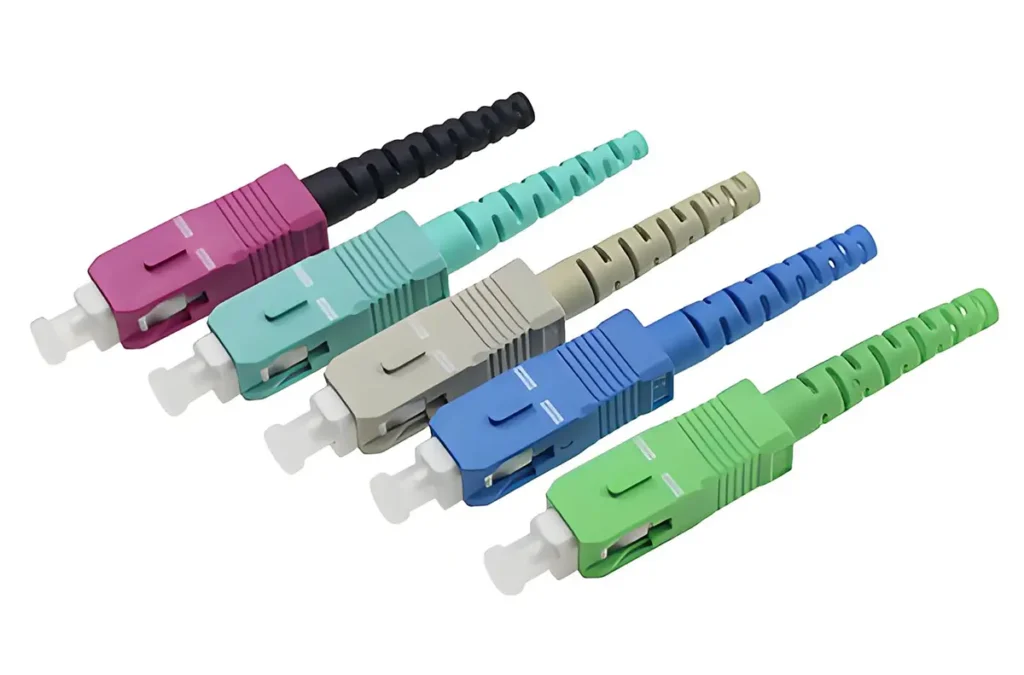
An SC fiber connector is a standard type of fiber optic connector used to connect optical fibers in communication systems. It is known for its simple structure, stable performance, and easy plug-and-play design.
The “SC” stands for Square Connector, a name that comes from its square-shaped body. It was originally developed by NTT in the 1980s and quickly became one of the most widely adopted fiber connectors in telecom networks.
Compared to smaller connectors like LC, SC connectors are slightly larger, but that also makes them easier to handle, especially during installation.
👉 In simple terms:
SC connector = a reliable, easy-to-use fiber connector designed for everyday network deployment
Why SC Fiber Connectors Are Still Widely Used
Even though LC connectors dominate in data centers today, SC connectors are still everywhere — especially in telecom and FTTH networks.
One big reason is ease of use. The SC connector uses a push-pull locking mechanism. You simply push it in, and it locks into place. No clips, no complicated handling. For technicians working on-site, especially in less controlled environments, this simplicity is very important.
Another advantage is its robust structure. The SC connector is less sensitive to handling compared to smaller connectors. In real projects, especially outdoor or field installations, this makes a noticeable difference.
There’s also a design detail many beginners overlook: the SC connector’s front interface aligns very well with adapter ports, ensuring stable physical contact. This helps maintain low insertion loss and reliable signal transmission over time.
In many FTTH deployments, SC connectors are still the default choice — not because they are newer, but because they are proven and practical.
SC vs LC Fiber Connector: Which One Should You Choose?
This is probably the most common comparison.
Instead of saying one is better, it’s more accurate to say they are used in different scenarios.
| Feature | SC Connector | LC Connector |
|---|---|---|
| Size | Medium | Small |
| Locking Method | Push-pull | RJ latch |
| Ease of Handling | Easier | More compact |
| Typical Use | FTTH, telecom | Data centers |
| Density | Medium | High |
From real-world experience:
- SC connectors are better when you need simple, reliable connections
- LC connectors are better when you need high-density cabling
If you’re installing fiber in a home or outdoor cabinet, SC is often the safer and easier option.
Types of SC Fiber Connectors
Although SC connectors look simple, they also come in several variations.
By fiber type
SC connectors can be used with:
- Single mode fiber (most common)
- Multimode fiber
In most FTTH networks, you’ll encounter single mode SC connectors.
By polish type
- SC UPC (blue) – standard use
- SC APC (green) – angled end face
APC connectors are commonly used in FTTH systems because they reduce reflection and improve signal quality over longer distances.
By structure
- Simplex SC – single fiber
- Duplex SC – paired fibers (less common than LC duplex)
SC Fiber Connector Structure Explained
Let’s take a common example: 3.0mm single mode SC APC connector
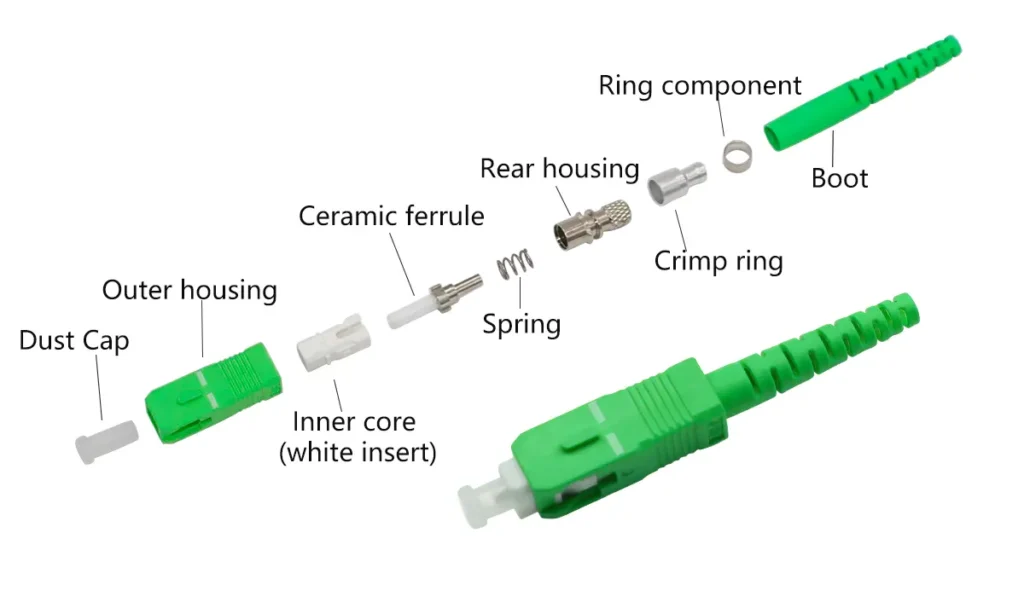
A typical SC connector includes:
- Dust cap
- Outer housing
- Inner core (white insert)
- Ceramic ferrule
- Spring
- Rear housing
- Main body
- Crimp ring
- Ring component
- Boot
At the heart of the connector is still the ceramic ferrule, which ensures precise fiber alignment.
Compared to LC connectors, SC connectors have a slightly larger and more robust housing. This makes them more forgiving during installation, especially for beginners or field technicians.
How SC Fiber Connectors Are Terminated
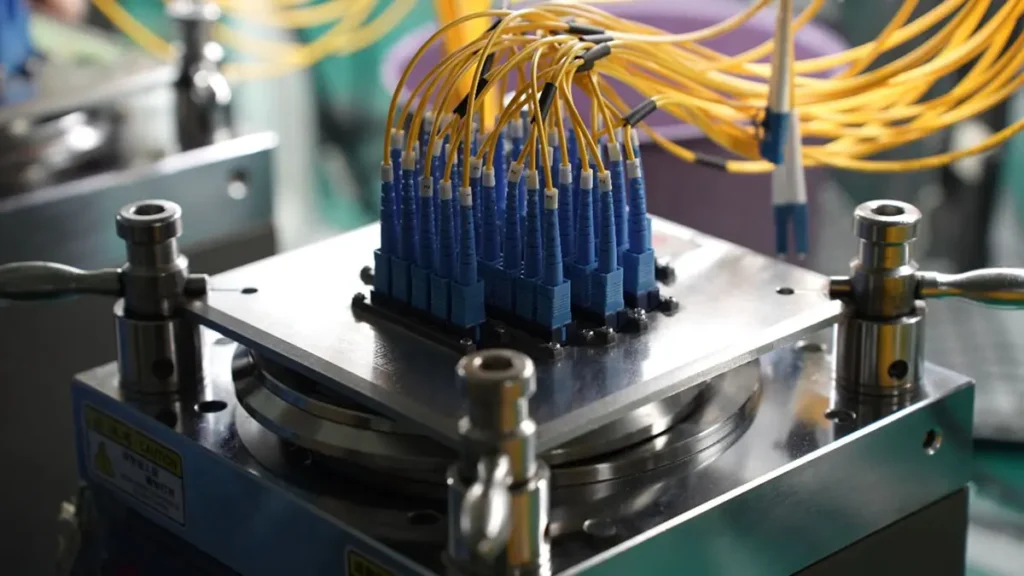
In many real scenarios, SC connectors are assembled from individual components rather than pre-installed units.
The process starts by threading all components — boot, ring, crimp ring, housing parts, and spring — onto the fiber in the correct order.
Then the fiber is stripped (usually around 3 cm), cleaned carefully with alcohol, and prepared for insertion.
Next, adhesive is injected into the ceramic ferrule. Once a small amount of glue appears at the tip, the fiber is inserted directly into the ferrule until it slightly protrudes.
After that, the connector is placed into a curing oven (typically around 15 seconds). Once cured, the crimp ring is compressed to secure the structure, and the end face is polished.
From an engineering perspective, the most critical steps are:
- Fiber stripping (to avoid breakage)
- Adhesive control
- End-face polishing
In practice, polishing quality often determines whether the connector performs well or not.
Where Are SC Connectors Used?
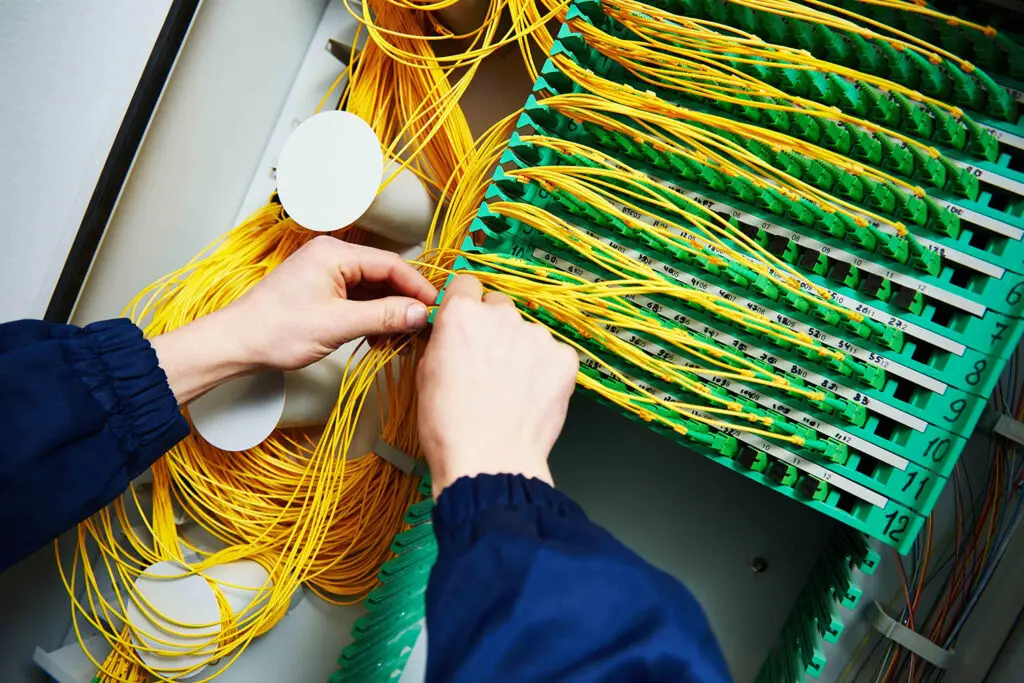
SC connectors are still widely used in many parts of fiber networks, especially:
- FTTH (Fiber to the Home)
- Telecom distribution boxes
- Fiber wall outlets
- Outdoor fiber installations
If LC connectors represent “high-density modern networks,” then SC connectors represent “stable and widely deployed infrastructure.”
Common Problems with SC Fiber Connectors
Even though SC connectors are relatively robust, issues still occur in real use.
The most common problems include:
- Dirty connector end face
- Scratched ferrule
- Improper insertion (not fully seated)
- Fiber bending near the connector
One practical insight from field work:
👉 Many connection issues are caused by installation habits, not the connector itself
A quick cleaning or re-insertion often solves the problem.
Still Have Questions?
If you’re still unsure about something, feel free to reach out.
Want to explore more fiber optic terms? Head over to our blog section.
If the term you’re looking for isn’t covered yet, let me know — I’ll add it to the priority list!
And lastly — if you’re a telecom provider, network operator, or involved in fiber infrastructure development and looking for a reliable partner in fiber optic components — feel free to contact to us.