
Quick Conclusion
Hybrid fiber optic cable is not an unnecessary design and a “premium version” of fiber cable.
In the right application — especially where remote devices require both power and data, it can simplify distributed infrastructure.
And that is why its application scope is expanding rapidly in 5G, FTTA, smart cities, and industrial networks.
TABLE OF CONTENTS
Why Are More Projects Switching to Hybrid Fiber Optic Cable?
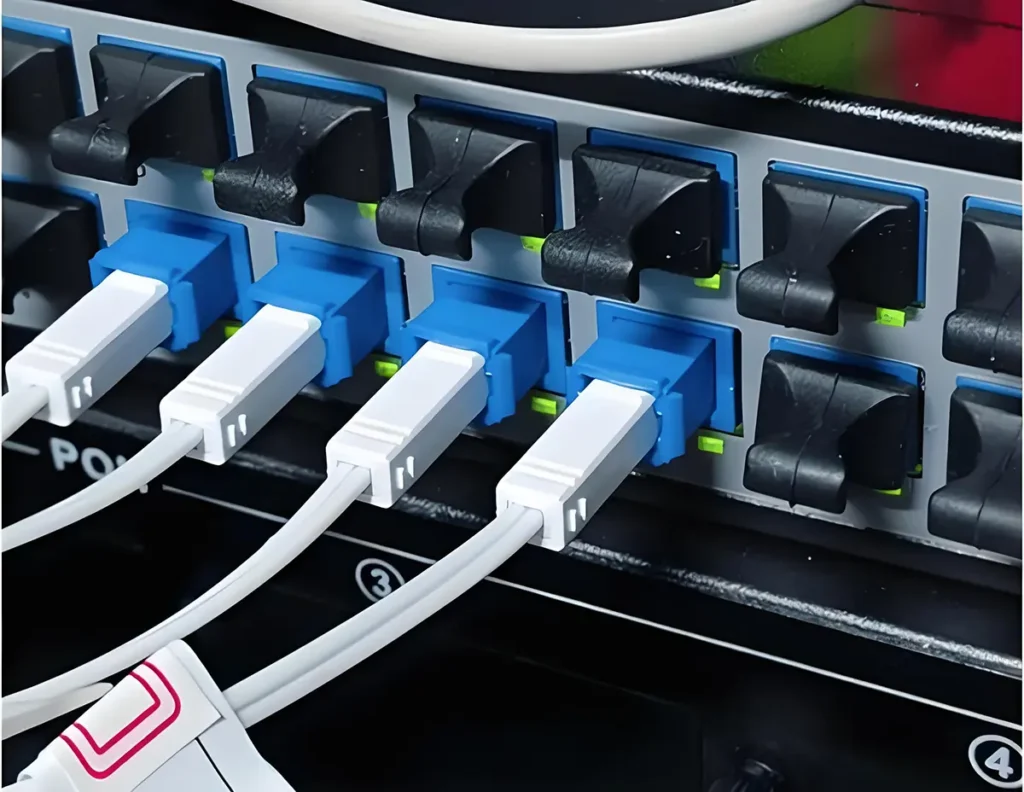
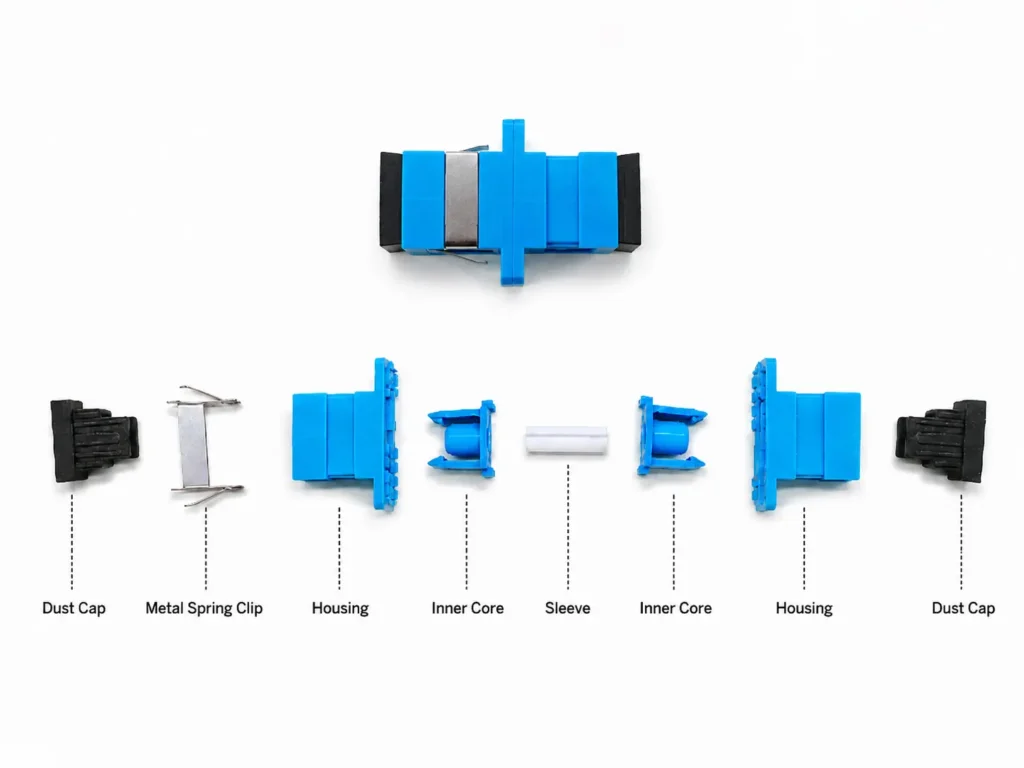
Figure 1: hybrid fiber optic cable and adapters
In real FTTX, 5G, and industrial deployments, one recurring problem keeps appearing:
You need to power a remote device — and you need to transmit data to it — but the device is 200 meters, 500 meters, or even 1 kilometer away from the nearest power cabinet.
Traditionally, that meant:
- One fiber optic cable for communication
- One copper cable for power
Two separate installations. Two separate routing paths. Double the management complexity.
This is exactly where hybrid fiber optic cable comes in.
It is not a marketing concept. It is an engineering response to distributed network architecture.
What Is Hybrid Fiber Optic Cable?

Figure 2: SC hybrid fiber optic cable
Hybrid fiber optic cable integrates:
- Optical fibers for signal transmission
- Copper conductors for DC power delivery
- Unified outer jacket for mechanical protection
It is a physical cable product, not a network architecture.
Its mission is simple: Deliver communication and electrical power through a single installation path.
In real telecom and industrial deployments, this single change significantly reduces complexity.
Hybrid Fiber Optic Cable Structure and Components
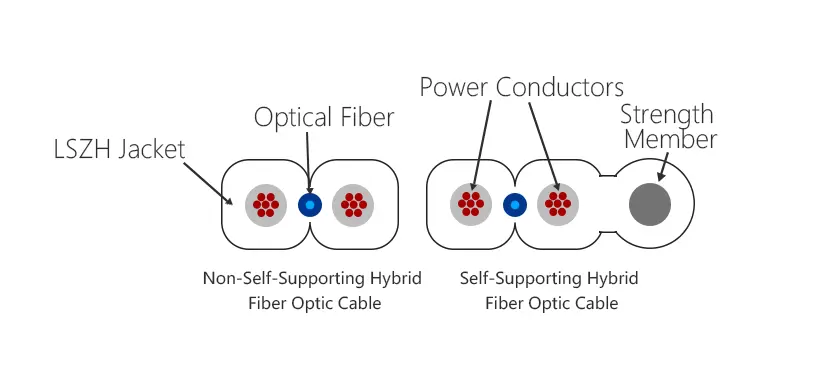
Figure 3: hybrid fiber optic sectional view
From a manufacturing and installation perspective, hybrid cable design must balance optical performance, electrical transmission capacity, and mechanical protection.
Below is a structural comparison:
Component | Hybrid Fiber Optic Cable | Standard Fiber Cable |
Optical Fibers | 1–4 core single-mode (G.657.A2 common) | Yes |
Copper Conductors | 0.2 mm² – 2.5 mm² | No |
Power Voltage | DC 48V / DC 280V / DC 380V | N/A |
Remote Power Distance | 300–2000 m (depending on gauge & voltage) | N/A |
Jacket Type | LSZH / PE / Outdoor UV resistant | Yes |
Temperature Range | -40°C to +85°C typical | Similar |
Optical Section
Most deployments use G.657.A2 bend-insensitive single-mode fiber.
Insertion loss at connection points is typically ≤ 0.3 dB.
Return loss ≥ 55 dB for APC interfaces.
Copper Section
Copper cross-section is selected based on:
- Power load (W)
- Transmission distance
- Acceptable voltage drop
Typical conductor area ranges from 0.2 mm² (low-power IoT) up to 2.5 mm² (high-power 5G units).
Mechanical Protection
In outdoor telecom projects, cables must withstand:
- Tensile strength during installation
- UV exposure
- Moisture ingress
- Temperature cycling
Service life in telecom-grade deployment is typically ≥ 20 years when properly specified.
Where Does Hybrid Fiber Optic Cable Sit in the Network?
To understand its real role, we must look at the full chain.

Figure 4: Hybrid fiber optic cable in newworks
In Standard FTTH / PON Networks
Core Router → OLT → ODN (splitters, splice closures, distribution fiber) → ONU → Hybrid Fiber Cable → Remote Device
ODN is fully passive. Hybrid cable appears after the first active device (ONU) when remote powered equipment is required.
In 5G FTTA Deployment
BBU / Equipment Room → Fiber → Hybrid Fiber Cable → AAU / RRU
In typical telecom projects, this reduces rooftop installation complexity significantly.
In Industrial or Smart City Deployment
Industrial Control Room → Aggregation Switch → Hybrid Cable → Cameras / WiFi AP / Smart Lighting / Sensors
Hybrid cable usually serves the “last powered segment” of distributed infrastructure.
Where Does Hybrid Fiber Optic Cable Sit in the Network?
From manufacturing and installation experience, hybrid fiber optic cable reduces total project cost primarily through labor and infrastructure simplification — not by reducing raw material cost.
In real projects, the following patterns are common:
- Installation labor time can be reduced by approximately 30% to 50%, because only one cable needs to be routed instead of two.
- Overall deployment cost (including labor, cable trays, conduits, accessories) can decrease by roughly 20% to 40% compared to separate power + fiber systems.
- Cable routing space in weak current shafts or cabinets can be reduced by 30% to 50%.
- On-site splicing points may decrease by around 30%, reducing future failure risks.
- Construction period can shorten by up to 50% in medium-scale deployments.
However, for very short indoor runs (e.g., under 30 meters), hybrid cable may not offer financial advantage.
Total Cost of Ownership (TCO) improves mainly in medium to long-distance installations.
“Isn’t It Harder to Connect?”
This is a common misconception.
Some engineers assume:
“Since it carries both power and fiber, connection must be complicated.”
Actually not.
Modern hybrid cables support:
- Pre-terminated connectors
- Cold splice / fast connectors
A trained technician can complete termination within 60 seconds.
The process is stable and repeatable.
In many FTTR-type deployments promoted by major telecom vendors such as Huawei, hybrid solutions have been used for years with strong field reliability.
In fact, installers report multi-year stability without failure when designed correctly.
Power Transmission Performance and Limits
Unlike Ethernet PoE (limited to about 100 meters), hybrid cable supports much longer remote power delivery.
With proper conductor sizing:
- DC 48V systems typically support 150–800 meters depending on load.
- High-voltage remote systems (DC 280V / 380V) can reach 1000–2000 meters.
Voltage drop must always be calculated:
Voltage Drop = Current × Resistance × Distance
Higher voltage reduces current and therefore reduces heat and loss.
Engineers must consider:
- Ambient temperature
- Continuous load
- Conductor cross-section
- Safety isolation requirements
Hybrid cable is powerful — but it must be designed correctly.
Advantages of Hybrid Fiber Optic Cable
In distributed infrastructure, hybrid cable provides measurable benefits:
- Installation efficiency improved up to 50%
- Reduced cable routing congestion
- Fewer maintenance points
- Simplified project management
- Suitable for distributed 5G and IoT networks
It aligns naturally with decentralized network architecture.
Engineering Limitations and Considerations

Figure 5: XC field-assembly hybrid fiber optic cable
It is not universal.
Engineers must consider:
- Heat accumulation in bundled environments
- Larger minimum bending radius
- More complex fault troubleshooting (power + signal integrated)
- Precise power calculation required
It should not replace backbone fiber.
It is a last-segment optimization tool.
Typical Applications
- 5G Small Cells & FTTA
Hybrid cable simplifies rooftop AAU deployment and reduces dual routing complexity. - Outdoor Surveillance
Long-distance powered cameras exceed PoE limits. - Smart Lighting
Single cable supports lighting control + data transmission. - Industrial Automation
Distributed sensors and controllers benefit from centralized power and fiber signal.
Is Hybrid Fiber Optic Cable a Long-Term Trend?
Distributed infrastructure is increasing.
- 5G densification
- Edge computing
- Smart cities
- Industrial digitalization
Hybrid cable is not replacing conventional fiber.
But it is expanding as a specialized, high-growth segment.
In markets with large-scale 5G rollout and industrial upgrades, demand is steadily rising.
How to Choose the Right Hybrid Fiber Cable
Instead of guessing, use this simplified engineering logic:
If distance < 100 m
→ Standard PoE solution is usually sufficient.
If distance 100–500 m AND medium power load
→ 48V hybrid fiber optic cable is appropriate.
If distance 500–1000 m AND moderate to high power
→ Larger conductor 48V system or consider higher voltage remote feed.
If distance > 1 km AND high-power equipment (e.g., 5G AAU)
→ High-voltage remote feed hybrid cable (280V / 380V) recommended.
If installation environment is harsh outdoor
→ Select UV-resistant PE jacket + IP-rated connectors.
Always define:
- Power load (W)
- Distance (m)
- Environmental conditions
- Maintenance accessibility
Hybrid cable is not “one type fits all.”
It is engineered per scenario.
Common Deployment Mistakes
This section alone can save thousands in rework.
Mistake 1: Using Hybrid Cable in Backbone
Hybrid cable is not designed for long-haul trunk transmission.
It is an access-layer tool.
Mistake 2: Ignoring Voltage Drop Calculation
Engineers sometimes select conductor size without calculating load. It will result: Voltage instability, Overheating, Device rebooting under load.
Mistake 3: Undersized Copper Conductor
Choosing 0.5 mm² when 1.5 mm² is required to save cost. Long-term result: Heat accumulation, Premature insulation degradation.
Mistake 4: No Temperature Margin
Outdoor installations can exceed 50°C cabinet temperature.
Ignoring this reduces service life.
Mistake 5: Over-Specifying Unnecessarily
Sometimes separate fiber + local power is cheaper for short runs.
Hybrid cable should solve a problem — not create one.
Mistake 6: Not Planning Maintenance Access
Since power and signal share one cable, fault diagnosis requires structured design.
Clear labeling and modular connectors reduce downtime.
Real-World Insight from Manufacturing & Installation
From manufacturing and installation experience, most project failures are not caused by cable quality.
They are caused by miscalculation.
When engineers define:
- Accurate power load
- Realistic future expansion margin
- Proper conductor cross-section
Hybrid cable will becomes extremely stable.
Hybrid cable is simple, but engineering thinking behind it must be precise.
At Yingfeng Communication, we often support integrators in reviewing load-distance calculations before production. If you are unsure about your voltage drop calculations, our engineering team can provide a free review.
Frequently Asked Questions
Can hybrid cable completely replace PoE?
No. For short distances (<100 m), PoE is simpler and cheaper.
Hybrid cable becomes valuable when distance exceeds Ethernet limits.
Is hybrid cable more difficult to maintain?
Not if designed with modular connectors and proper labeling.
In fact, fewer cables often simplify maintenance.
Does integrating power increase failure risk?
Not inherently.
When voltage drop and load are properly calculated, reliability is comparable to separate systems.
Is it suitable for indoor data centers?
Rarely. Data centers usually have structured power systems already.
Hybrid cable is more suitable for distributed environments.
What is the biggest mistake buyers make?
Choosing based on price per meter rather than total system design.
Hybrid cable should be specified based on electrical logic — not only budget.
Final Recommendation
Hybrid fiber optic cable is not a trend product.
It is a problem-solving tool.
Use it when:
- Remote equipment needs both power and fiber
- Distance exceeds PoE limits
- Deployment speed matters
- Infrastructure space is limited
Avoid it when:
- Distance is short
- Local power already exists
- No remote power is required
When used correctly, it reduces complexity, improves efficiency, and supports long-term distributed infrastructure growth.
The key is engineering judgment — not marketing language.
When used correctly, it reduces complexity.
When used blindly, it adds unnecessary cost.