

If you’ve been following our fiber glossary series, you’ll notice we’ve already covered some very important building blocks of fiber communication:
- OLT (Optical Line Terminal) – the central “brain” of the fiber network.
- ODN (Optical Distribution Network) – the middle layer of cables, splitters, and passive components.
- ONU (Optical Network Unit) and ONT (Optical Network Terminal) – the devices installed at the user side.
Now here comes the bigger picture: the Passive Optical Network (PON).
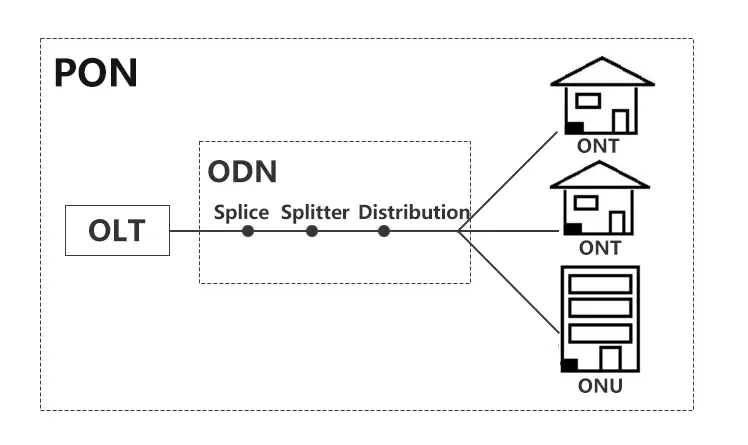
Simply put, PON = OLT + ODN + ONU/ONT.
It’s the complete architecture that brings fiber internet from the telecom provider’s office all the way to your home or office — reliably, efficiently, and at high speed.
TABLE OF CONTENTS
What Is a Passive Optical Network (PON)?
When people talk about fiber internet, most imagine a straight line running from the service provider directly into your home. But in reality, there’s a whole “middle layer” that makes this possible — and that’s the Optical Distribution Network (ODN).
The ODN is basically everything in between: the physical network of cables and passive components that carry optical signals from the provider’s OLT (Optical Line Terminal) all the way to your ONU/ONT (the devices inside your home or office).
In other words:
- The ODN is the “middle mile” of the fiber network.
- It connects the central brain (OLT) with the user-side devices (ONU/ONT).
- It includes fiber cables, splitters, connectors, adapters, patch panels, and distribution boxes.
Think of the ODN as the highway system of the fiber world. Without it, data would have no way to travel from the central office to individual homes and businesses.
Why Is PON So Important in Telecom?
If you’ve ever enjoyed fiber-to-the-home (FTTH) internet, chances are you’re already using a PON network — even if you didn’t realize it.
Here’s why it matters:
- Efficiency – One single fiber from the OLT can serve multiple homes or offices, thanks to passive splitters.
- Cost Savings – No need for powered equipment in the middle, which reduces installation and maintenance costs.
- Scalability – Easy to expand and add more users without major redesign.
- Reliability – Fewer active components mean fewer potential points of failure.
This is why PON telecom networks have become the global standard for broadband deployment.
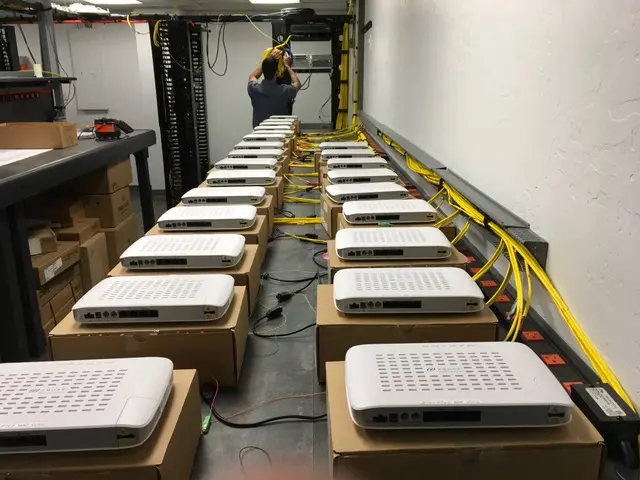
Image Source: Kortman
Types of Passive Optical Networks
Over time, different generations of PON technologies have been developed, each offering higher capacity:
- EPON (Ethernet Passive Optical Network) – Based on Ethernet standards. Easy to integrate with existing Ethernet systems.
- GPON (Gigabit Passive Optical Network) – The most widely used PON type, supporting higher bandwidth and better efficiency.
- 10G PON (XG-PON, XGS-PON, 10G-EPON) – Next-generation solutions that deliver up to 10 Gbps speeds for data-hungry applications.
All of these share the same foundation: OLT + ODN + ONU/ONT. The main difference is how fast and how efficiently they move data.
| Type | Downstream Speed | Upstream Speed | Typical Use Case |
|---|---|---|---|
|
EPON |
Up to 1.25 Gbps |
Up to 1.25 Gbps |
Small ISPs, enterprise LAN integration |
|
GPON |
2.5 Gbps |
1.25 Gbps |
FTTH for residential & business users |
|
10G PON (XG-PON, XGS-PON, 10G-EPON) |
Up to 10 Gbps |
Up to 10 Gbps |
High-demand users, 5G backhaul, smart cities |
This table makes it clear that while EPON and GPON are the backbone of current deployments, 10G PON is the future, supporting bandwidth-hungry services like 4K/8K streaming, cloud gaming, and enterprise-grade applications.
Fiber Optic Components Commonly Used in PON
A PON network relies on many passive fiber components to function smoothly, and the quality of its passive components is critical. Some of the most common ones include:
- Fiber Optic Connectors & Adapters – for precise and stable connections.
- Optical Splitters – to divide one optical signal into multiple outputs.
- Splice Closures & Distribution Boxes – for fiber protection and outdoor deployment.
- Patch Cords & Pigtails – for flexible connections between devices.
- Patch Panels (ODF) – for structured cabling and network management.
At YingFeng Communication, we manufacture all of these components in-house — meaning we can provide complete passive optical network solutions. Whether you’re an ISP, a system integrator, or a network builder, we offer reliable PON equipment that ensures stable connections from the central office to the end user.
How a PON Network Works (Step by Step)
To recap how everything ties together, here’s the flow in a PON network:
- OLT (Optical Line Terminal) at the provider’s central office sends optical signals into the network.
(Learn more in our article: What Is OLT?) - ODN (Optical Distribution Network) carries the light through fibers, splitters, and other passive components.
(Details here: What Is ODN?) - The signal reaches ONU/ONT at the customer’s premises, where it’s converted into usable data for internet, TV, or phone services.
(Read more: What Is ONU?, What Is ONT?)
This simple three-stage process is what makes PON networks so efficient and reliable.
Advantages of PON Networks
So why are telecom providers worldwide adopting PON as their main broadband architecture?
- Energy Efficiency – No powered equipment between OLT and ONU/ONT.
- Cost Savings – Lower CAPEX and OPEX compared to active networks.
- High Bandwidth – Easily supports gigabit and 10G internet.
- Triple Play Services – Internet, TV, and voice over a single fiber.
- Future-Proof – With 10G PON and beyond, networks can evolve without replacing the entire infrastructure.
FAQ: Common Questions About PON
What does PON mean in telecom?
In telecom, PON (Passive Optical Network) refers to a fiber network that uses passive optical splitters to deliver services from one OLT to multiple users without active equipment in between.
Is PON the same as fiber-to-the-home (FTTH)?
Not exactly. FTTH is one application of PON. PON is the technology, while FTTH is a deployment model that uses PON to bring fiber directly into homes.
What’s the difference between EPON and GPON?
EPON uses Ethernet protocols and is common in some regions (like Asia). GPON uses ITU-T standards, offers asymmetric speeds (2.5/1.25 Gbps), and is widely adopted globally.
Can PON support future technologies like 5G?
Yes. 10G PON and NG-PON2 are being deployed to support 5G backhaul, smart cities, and enterprise-grade connections.
What equipment do I need for a PON network?
A complete PON setup requires OLT, ODN components (cables, splitters, closures, patch panels), and ONU/ONT. (We provide all passive ODN products for building reliable PON networks.)
In Summary
A Passive Optical Network (PON) is the foundation of modern broadband — a cost-effective, scalable, and reliable way to bring ultra-fast internet into homes and businesses.
Built with OLT, ODN, and ONU/ONT, it represents the perfect combination of simplicity and power. With different flavors like EPON, GPON, and 10G PON, it can serve today’s needs while being ready for tomorrow’s demands.
Still Have Questions?
If you’re still unsure about something, feel free to reach out.
Want to explore more fiber optic terms? Head over to our blog section.
If the term you’re looking for isn’t covered yet, let me know — I’ll add it to the priority list!
And lastly — if you’re a telecom provider, network operator, or involved in fiber infrastructure development and looking for a reliable partner in fiber optic components — feel free to contact to us.






 English
  French
  German
  Spanish
  Arabic
  Turkish
  Japanese
  Russian
  Portuguese