

If you’re just stepping into the world of fiber optics, all the technical terms and abbreviations can feel overwhelming. That’s why I created this fiber glossary series — to help you understand what these terms really mean, in the simplest way possible.
I’ll explain everything from an industry insider’s point of view, using real photos whenever I can (not just fancy renders). I also avoid overly complex explanations, keeping the language clear and direct, so you can be confident you’ll understand the real meaning of these terms after reading.
Today, we’re going to talk about: Attenuation.
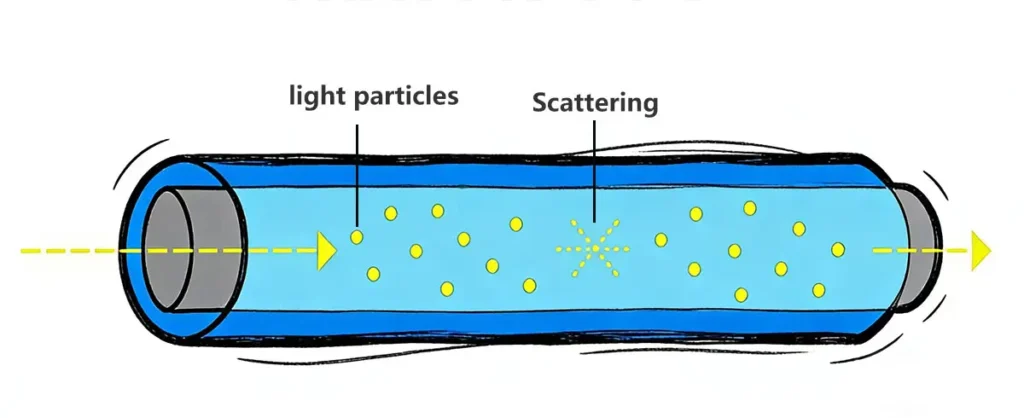
TABLE OF CONTENTS
So what Is Fiber Optic Attenuation?
Let’s keep it simple:
Fiber optic attenuation means signal loss as light travels through a fiber.
When light goes into one end of a fiber, it never comes out with the same strength at the other end. Some of the signal is always lost along the way. That loss is called fiber optic attenuation.
This is normal. It happens in every fiber network, no matter how good the fiber is.
The key is not to eliminate attenuation, but to understand it, control it, and design around it.
Why Attenuation Happens in Fiber Optics
Imagine you are shouting to a friend across a long hallway.
The farther your voice travels, the weaker it becomes. Walls absorb some sound, air scatters it, and distance does the rest.
Light in optical fiber behaves the same way.
As the light signal moves forward, part of its energy is slowly lost. By the time it reaches the receiver, the signal is weaker than when it started. That gradual loss of signal strength is what we call attenuation in fiber optics.
So when people ask, “What causes attenuation in fiber optics?”, the short answer is: Physics and real-world conditions.
Main Causes of Fiber Optic Attenuation
Now let’s break it down into the main causes.
Absorption
Some of the light energy is absorbed by the glass material and converted into heat.
This is one of the most fundamental causes of attenuation and cannot be completely avoided.
This is why people often talk about attenuation and absorption together.
Scattering
Not all light travels perfectly straight. Tiny imperfections in the glass cause part of the light to scatter in different directions.
The most common type is Rayleigh scattering, and it is actually the largest contributor to attenuation in modern single-mode fiber.
When people ask, “What causes most fiber optic attenuation?”, scattering is usually the top answer.
Bending Loss
Fiber does not like tight bends.
- Macrobending: large, visible bends
- Microbending: tiny bends caused by pressure, poor cable management, or tight ties
Both can force light to escape from the core, increasing attenuation.
How Attenuation Is Measured (Explained Simply)
Attenuation is measured in decibels (dB).
The basic formula used in fiber optics is:
Attenuation (dB) = 10 × log₁₀ (P_in / P_out)
You don’t need to love math to understand what this means.
- P_in is the input optical power
- P_out is the output optical power
If more power is lost, the dB value becomes larger.
Here is the key idea to remember:
👉 Higher attenuation = more signal loss
And because dB is a logarithmic unit, small numbers can represent big differences in signal strength.
Typical Attenuation Values in Optical Fiber
To make attenuation more practical, it helps to know what “normal” looks like.
For single-mode fiber:
- Around 0.35 dB/km at 1310 nm
- Around 0.20 dB/km at 1550 nm
For multimode fiber:
- Higher attenuation, especially at shorter wavelengths like 850 nm
These values are why longer-distance systems prefer single-mode fiber and specific wavelengths.
Attenuation is one of the first numbers engineers look at when designing a fiber link.
What Is a Fiber Optic Attenuator?
This may sound confusing at first, but sometimes attenuation is actually intentional.
A fiber optic attenuator is a device that reduces signal power on purpose.
In other words, it adds controlled attenuation to the system.
Why would anyone want that?
- To protect sensitive receivers from too much optical power
- To balance signal levels in a network
- To simulate real-world conditions during testing
So when you hear the term attenuator in optical fiber, remember:
👉 It is a tool, not a problem.
How Attenuation Affects Real Fiber Networks
In real networks, attenuation determines:
- How far a signal can travel
- Whether a link will work reliably
- How much margin a system has
This is why engineers calculate something called a loss budget. They add up:
- Fiber attenuation、
- Connector loss
- Splice loss
- Safety margin
If the total loss is too high, the signal may not reach the receiver correctly.
This is also where quality matters.
Low-loss connectors, stable polishing, and well-controlled manufacturing all help keep attenuation under control. From a factory perspective, consistent production and proper testing play a huge role in real-world performance.
Is fiber optic attenuation always bad?
Is GR-326 mandatory for all connectors?
No. Attenuation is normal and unavoidable. The goal is to keep it within acceptable limits.
What causes the most attenuation in fiber optics?
Scattering and absorption inside the fiber are the main causes, followed by bending and poor installation.
Is attenuation the same as insertion loss?
Not exactly. Attenuation refers to signal loss over distance, while insertion loss usually refers to loss caused by connectors, splices, or components.
How can I reduce attenuation in a fiber link?
Use proper cable routing, avoid tight bends, choose low-loss components, and follow good installation practices.
Why does attenuation change with wavelength?
Because light interacts differently with glass at different wavelengths. Some wavelengths travel more efficiently than others.
Final Thoughts: Attenuation Is Normal — Control Is the Key
Fiber optic attenuation is not a flaw. It is a natural part of how light behaves in the real world.
Once you understand what causes attenuation, how it is measured, and how it affects network design, it becomes something you can manage confidently. With proper planning, quality components, and good installation practices, attenuation stays predictable and controllable.
And that’s exactly what modern fiber networks are built on:
not zero loss, but well-managed loss.
Still Have Questions?
If you’re still unsure about something, feel free to reach out.
Want to explore more fiber optic terms? Head over to our blog section.
If the term you’re looking for isn’t covered yet, let me know — I’ll add it to the priority list!
And lastly — if you’re a telecom provider, network operator, or involved in fiber infrastructure development and looking for a reliable partner in fiber optic components — feel free to contact us.

 English
  French
  German
  Spanish
  Arabic
  Turkish
  Japanese
  Russian
  Portuguese