


Armored fiber optic cable is designed for environments where standard fiber cables may be exposed to physical stress, rodents, moisture, or harsh installation conditions. By adding a protective metallic armor layer around the fiber, armored fiber optic cables offer enhanced mechanical strength, improved durability, and long-term reliability.
And then I’ll tell you what an armored fiber optic cable is, how it is constructed, the main types available, important installation considerations, and when armored fiber makes sense compared to standard unarmored fiber cables.
TABLE OF CONTENTS
What Is an Armored Fiber Optic Cable?
An armored fiber optic cable is a fiber optic cable that incorporates a metallic protective layer—such as steel tape, corrugated steel, or steel wire—around the fiber structure. This armor layer acts as a physical shield, protecting the optical fibers from external damage including crushing, tensile stress, rodent bites, and mechanical impact.
Compared with unarmored fiber optic cable, the most notable difference is the additional metal armor layer, which significantly improves mechanical protection. As a result, armored fiber cable is widely used in industrial facilities, underground ducts, direct burial installations, and other high-risk environments.
Structure of an Armored Fiber Optic Cable
Typical Armored Fiber Cable Structure
| Layer | Common Materials | Function | Typical Applications |
|---|---|---|---|
|
Optical fiber core |
G.652D, G.657A1, G.657A2 |
Signal transmission |
Long-distance, access, backbone networks |
|
Loose tube |
PBT, PE |
Protects fiber, allows thermal and mechanical movement |
Outdoor and indoor armored cables |
|
Water-blocking layer |
Gel compound, dry water-blocking tape |
Prevents moisture ingress |
Underground, duct, direct burial |
|
Strength members |
Aramid yarn, FRP |
Enhances tensile strength |
Pulling and installation protection |
|
Metal armor layer |
Steel tape, corrugated steel, steel wire, aluminum tape |
Crush resistance, rodent protection |
Industrial, outdoor, harsh environments |
|
Outer jacket |
HDPE, LSZH, PVC |
Environmental and chemical protection |
Indoor, outdoor, flame-retardant zones |
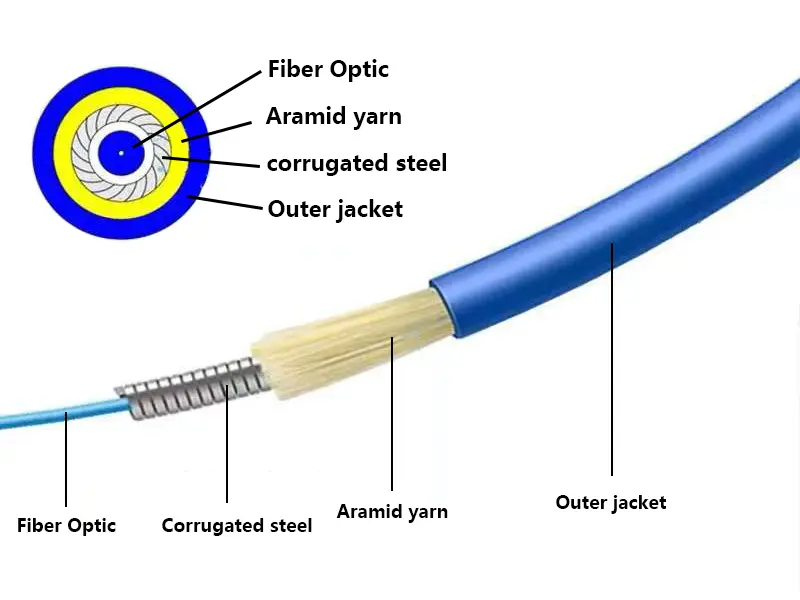
Optical Fiber Core
At the center is the optical fiber itself, which may be single-mode or multimode, commonly compliant with standards such as G.652D, G.657A1, or G.657A2. The fiber core is responsible for transmitting optical signals with low attenuation and controlled dispersion.
Single Mode Fiber Explained: G.652D, G.657A1, and G.657A2
Metal Armor Layer
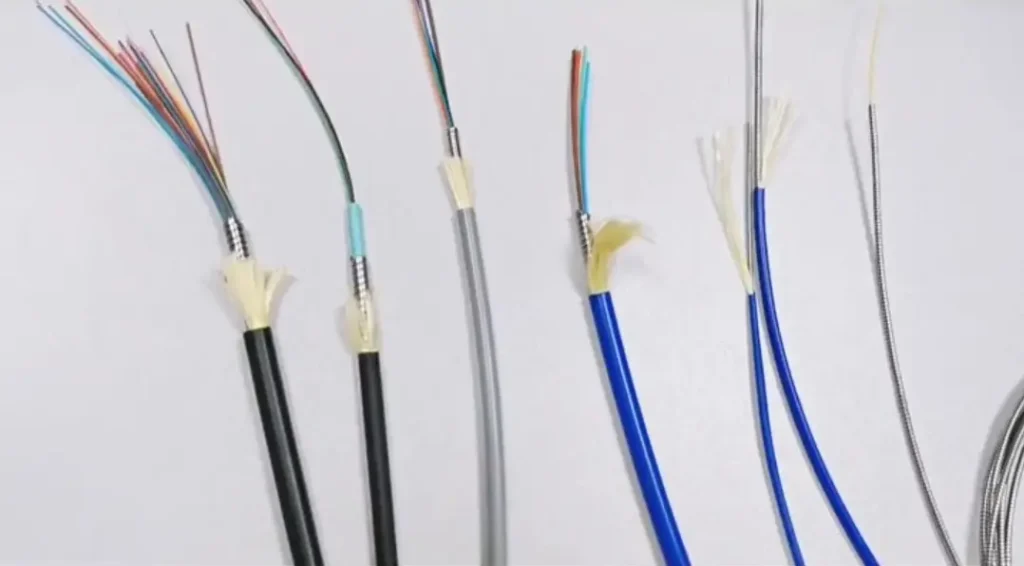
The metal armor layer is the defining feature of armored fiber optic cable. Depending on the design, it may use plastic-coated steel tape (PSP), corrugated steel tape (WSP), galvanized or stainless steel wire, or aluminum tape, providing excellent resistance to compression, tension, and rodent damage.
Types of Armored Fiber Optic Cable
Based on armor structure and application scenarios, armored fiber optic cables can be classified into several common types.
Steel Tape Armored Fiber Cable (GYTA53 / GYTS)
- GYTA53: Central loose tube, steel tape armor, PE outer jacket
- GYTS: Stranded loose tube, steel tape armor, PE outer jacket
These cables offer strong crush resistance, capable of withstanding pressures up to 1000N/100mm, making them suitable for direct burial and duct installations, especially in areas exposed to external mechanical stress.
Steel Wire Armored Fiber Cable (GYTY53 / GYXTW)
- GYTY53: Central tube with steel wire armor
- GYXTW: Double jacket with parallel steel wires
This type is designed for high tensile strength, supporting short-term loads up to 1500N and long-term loads exceeding 600N, often used in aerial or high-tension scenarios.
Light Armored Fiber Optic Cable (GYFTY / GYFXTY)
Light armored cables use non-metallic strength members combined with steel tape or steel wire armor. They are lighter in weight, reduce electromagnetic induction, and improve lightning resistance, making them suitable for specialized environments.
Rodent-Resistant Armored Fiber Cable (GYTA53+AS / GYTS+AS)
These cables include additional anti-rodent layers, such as fiberglass yarn or special coatings, designed for areas with severe rodent activity.
EMI-Shielded Armored Fiber Cable (GYTA53+EMI)
By combining steel tape armor with aluminum foil shielding, this type offers protection against electromagnetic interference, ideal for power stations, substations, and high-EMI environments.
Understanding Armored Fiber Optic Cable Model Naming
Cable models like GYTA53 follow standardized naming rules:
- G: Communication cable
- Y: Designed for outdoor use
- T: Filled structure with gel compound
- A: Aluminum-polyethylene bonded sheath
- 53: Double-layer jacket with steel tape armor
Other common symbols include:
- X: Central loose tube
- F: Non-metallic strength member
- W: Parallel steel wires
- Z: Flame-retardant outer jacket
Understanding these codes helps engineers quickly identify cable structure and performance characteristics.
Installation Considerations and Best Practices
Grounding Requirements
Because armored fiber optic cable contains metal components, proper grounding (earthing) is essential—especially for indoor installations or cables running between buildings.
- The metal armor must be bonded to ground to prevent electrical hazards
- Proper grounding protects against lightning strikes, surge currents, and static discharge
- Failure to ground armored fiber may create safety risks and violate local electrical codes
In many installations, grounding kits or grounding clamps are used at patch panels or building entry points.
Bending Radius and Handling
Although armored fiber optic cable offers excellent crush and tensile resistance, it is not immune to bending damage.
- Always follow the manufacturer’s minimum bending radius specification
- Excessive bending can damage the fiber core inside, even if the armor remains intact
- During routing and installation, avoid sharp corners and tight cable trays
This is particularly important in indoor armored fiber patch cable applications.
Cutting and Stripping Challenges
Due to the metal armor layer, armored fiber optic cable is:
- Harder to cut and strip than unarmored fiber
- More time-consuming to prepare for splicing
- More dependent on specialized tools and skilled technicians
For this reason, many projects choose pre-terminated armored fiber optic cables, which reduce installation time, lower error rates, and improve overall deployment efficiency.
Key Performance Characteristics
Mechanical Performance
Armored fiber optic cables provide excellent tensile and compressive strength, with carefully designed bending radius limits to ensure stable performance during installation and long-term operation.
Environmental Resistance
These cables typically operate reliably in temperatures from -40°C to +70°C, meet IP68 water resistance, and comply with rodent-resistance standards such as GB/T 27702-2011, making them suitable for harsh outdoor environments.
Optical Performance
When equipped with fibers such as G.652D, armored fiber cables maintain optimized attenuation at 1310nm and 1550nm, along with controlled dispersion for stable signal transmission.
Armored Fiber Patch Cable and Pre-Terminated Options
An armored fiber patch cable is an armored fiber optic cable pre-installed with connectors on both ends. Because field termination and splicing of armored fiber are more complex, pre-terminated armored fiber optic cables are increasingly preferred in modern deployments.
Final Thoughts
Armored fiber optic cable offers superior mechanical protection and environmental resistance, making it ideal for challenging installation conditions. However, factors such as grounding requirements, bending radius, weight, and installation complexity should always be considered.
This is why many users evaluate armored vs unarmored fiber optic cable before making a final decision.
Armored vs Unarmored Fiber Optic Cable: Which One Should You Choose?



 English
  French
  German
  Spanish
  Arabic
  Turkish
  Japanese
  Russian
  Portuguese