

If you searched for “simplex vs duplex fiber,” you’re probably trying to solve a practical problem — not read a textbook definition.
Maybe you’re selecting fiber patch cords.
Maybe you’re specifying a project.
Or maybe you just want to avoid ordering the wrong cable.
What makes this topic confusing is that people often mix up two different things:
- Fiber structure (simplex or duplex)
- Data transmission mode (simplex, half-duplex, full-duplex)
- They sound similar, but they are not the same.
So let’s walk through this the way engineers actually think about it — starting from how data flows, then moving to fiber structure, and finally to what really matters in deployment.
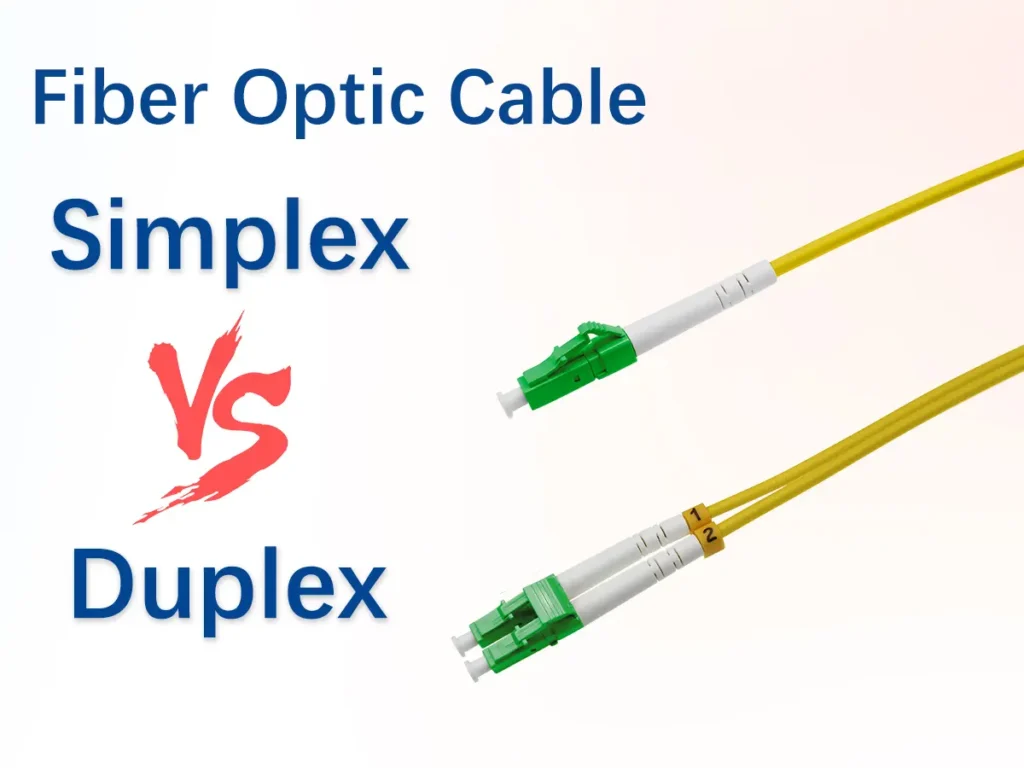
Figure 1: Know the difference between simplex and duplex in fiber optic
TABLE OF CONTENTS
Understanding Data Transmission Modes in Optical Communication
Before discussing fiber structure, we need to clarify how data actually flows between devices.
In data communication, transmission direction is generally divided into three basic modes: Simplex, Half-duplex, Full-duplex
These describe how devices communicate — not how many fibers are inside a cable.
Full-Duplex Transmission
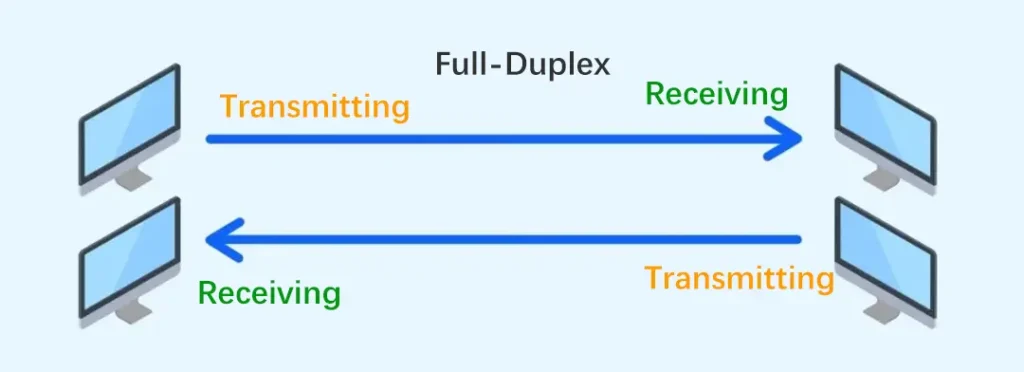
Figure 2: Full-Duplex Transmission Work
Full-duplex allows data to be transmitted and received at the same time.
In optical systems, this is typically achieved using two separate transmission paths — one for transmitting (Tx) and one for receiving (Rx). With matched optical modules or fiber media converters on both ends, both devices can send and receive simultaneously without waiting.
Because there is no direction switching, full-duplex avoids switching delays. In environments where latency matters — such as enterprise core networks or data centers — full-duplex is the standard.
A simple analogy helps here. A phone call is full-duplex. Both people can speak and hear at the same time.
In modern Ethernet networks, almost all fiber links operate in full-duplex mode.
Half-Duplex Transmission

Figure 2: Half-Duplex Transmission Work
Half-duplex allows communication in both directions — but not simultaneously.
Only one side can transmit at a time. When one device sends data, the other must wait until transmission is complete before responding. This introduces switching time.
A walkie-talkie is a classic example. You press to talk, release to listen.
Half-duplex was more common in early Ethernet systems. Today, it is rarely used in modern fiber-based enterprise or data center environments.
Simplex Transmission

Figure 3: Simplex-Duplex Transmission Work
Simplex transmission allows data to flow in only one direction.
One device sends. The other only receives. There is no return path.
Broadcast television is a good analogy. You receive signals, but you cannot transmit back.
In optical networks, true simplex communication is mainly found in monitoring or broadcast-style systems.
Now Let’s Talk About Fiber Structure
Once we understand transmission modes, we can move to the physical layer: fiber structure.
This is where simplex and duplex fiber come in.
What Is Simplex Fiber?

Figure 5: lc Simplex-fiber optic cable structure
Simplex fiber refers to a cable that contains a single optical fiber strand.
Physically, it has one core and one connector termination. Light travels along one fiber path.
Think of it as a single-lane road.
In real FTTX deployments, simplex fiber is commonly used in monitoring systems or in conjunction with BiDi optical modules. With BiDi technology, two different wavelengths are transmitted over the same fiber, enabling two-way communication on a single strand.
This is an important distinction: a simplex fiber cable can still support full-duplex communication when used with wavelength-division optics.
From a manufacturing and installation perspective, simplex cables are smaller in diameter and easier to route in tight conduits. They are sometimes selected when space is limited or when infrastructure fiber count needs to be minimized.
Wavelength Division (WDM) Principles in BiDi Modules
The ability of simplex fiber to support Full-duplex communication relies on Wavelength Division Multiplexing (WDM). This technology allows different light frequencies to pass each other in a single strand of glass without interference.
- Wavelength Pairing: BiDi (Bidirectional) transceivers must always be used in matched pairs. Common wavelength combinations include 1310nm/1550nm or 1270nm/1330nm.
- Bidirectional Logic:
Side A: Transmits (Tx) at 1310nm and Receives (Rx) at 1550nm.
Side B: Transmits (Tx) at 1550nm and Receives (Rx) at 1310nm. - BOSA Technology: Inside the module, a Bidirectional Optical Sub-Assembly (BOSA) acts as a precise filter. It reflects the incoming specific wavelength to the photodetector while allowing the locally generated laser wavelength to exit into the fiber.
- Strategic Trade-offs: While BiDi significantly conserves fiber plant and reduces cable bulk, the transceivers themselves are more complex and often carry a higher price tag than standard dual-fiber modules.
What Is Duplex Fiber?
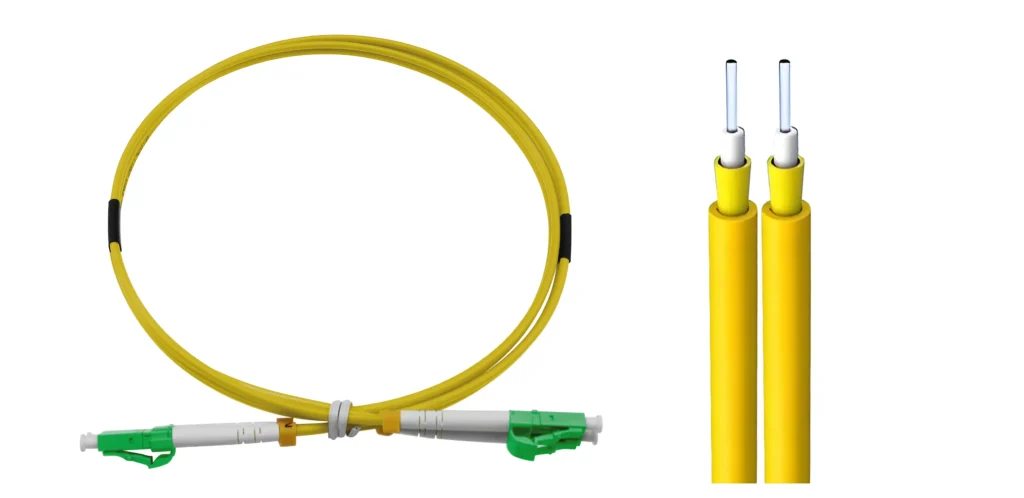
Figure 6: lc Duplex-fiber optic cable structure
Duplex fiber contains two optical fiber strands within the same cable assembly.
Typically, one fiber is used for transmitting (Tx) and the other for receiving (Rx). Most duplex cables are clearly marked A/B to prevent polarity issues.
If simplex is a single-lane road, duplex is a two-lane road — traffic flows in both directions simultaneously.
In typical telecom and data center projects, duplex fiber is the standard configuration. Most SFP and SFP+ optical modules are designed for dual-fiber operation.
If you are building a modern Ethernet network, duplex fiber is usually the default assumption unless your equipment specifically supports single-fiber BiDi transmission.
Polarity Management in Duplex Systems
In a duplex fiber optic system, Polarity is the foundational logic that ensures the network can actually transmit data. Simply put, polarity defines whether the transmit (Tx) signal at one end of the link accurately reaches the receive (Rx) component at the other end.
- The Crossover Principle: Most standard duplex patch cords utilize an A-to-B structure. This means the fiber strands are physically “flipped” inside the cable jacket to ensure the Tx of Device A connects to the Rx of Device B.
- A/B Labeling: This physical inversion is typically identified by “A” and “B” tags on the connectors or by color-coded boots (e.g., blue and beige or red and black).
- Common Pitfalls: In complex environments like data centers with multiple patch panels, using the wrong type of “straight-through” adapters or mismatched MPO trunk cables can lead to a “Tx-to-Tx” conflict. This is one of the most frequent causes of link failure during physical layer deployment.
Simplex vs Duplex Fiber — Side-by-Side Comparison
To make things clearer, here is a direct structural comparison:
| Item | Simplex Fiber | Duplex Fiber |
|---|---|---|
|
Fiber count |
1 |
2 |
|
Physical transmission paths |
Single |
Separate Tx and Rx |
|
Typical cable size |
Smaller |
Standard zip-cord |
|
Common usage |
BiDi, monitoring |
Ethernet, telecom, data center |
|
Default compatibility |
Limited scenarios |
Most network equipment |
|
Cost structure |
Cable cheaper, BiDi modules more expensive |
Cable slightly higher, standard SFPs widely available |
|
Inventory impact |
BiDi modules must be paired (Tx1310/Rx1550 & reverse) |
Same module type on both ends |
At this point, you should ask yourself one key question:
Does your device transmit and receive at the same time?
In most modern networks, the answer is yes — which usually means duplex fiber is required.
How Fiber Structure and Transmission Mode Relate
This is where confusion often happens.
Fiber structure and transmission mode are independent concepts.
For example:
- A duplex fiber link almost always runs in full-duplex mode.
- A simplex fiber link (with BiDi optics) can also run in full-duplex mode.
- A duplex system can technically be configured to operate in half-duplex at the device level.
The number of fibers does not automatically define how data flows.
In real projects, we’ve seen buyers assume “single fiber equals half-duplex,” which is incorrect. Communication behavior is determined by the equipment and protocol, not just the cable.
Once you separate physical structure from communication logic, selection becomes much clearer.

Figure 7: Light in fiber optic
When Should You Use Simplex Fiber?
Simplex fiber makes sense when:
- You are using BiDi optical modules
- The application truly requires only one-direction transmission
- Conduit space is limited
- You need to reduce cable bulk
In some FTTX scenarios, reducing fiber count across long distances can simplify infrastructure planning.
However, you should look at total system cost. While simplex cable uses less material, BiDi optical modules may cost more than standard duplex modules. Many buyers focus only on cable pricing and overlook the optics.
When Should You Use Duplex Fiber?
Duplex fiber is recommended for:
- Standard Ethernet deployments
- Enterprise LAN networks
- Data centers
- Most telecom backbone connections
In typical enterprise and data center projects, duplex fiber remains the mainstream choice because it matches the design of most network equipment.
If you are unsure and using standard SFP-based hardware, duplex is generally the safer default option.
Common Mistakes to Avoid
One of the most common mistakes is assuming simplex is automatically cheaper. In reality, total system cost depends on both cable and transceiver selection.
Another frequent issue is failing to confirm the optical module type before ordering patch cords. From installation experience, mismatched fiber structure and transceiver type is one of the most preventable causes of project delays.
Before placing an order, always confirm:
- Transceiver type (dual-fiber or BiDi)
- Connector interface
- Fiber mode (single-mode or multimode)
- Required transmission distance
Most selection problems disappear once those four points are clear.
Final Thoughts
Simplex and duplex describe fiber structure.
Simplex, half-duplex, and full-duplex describe communication behavior.
They are related — but not interchangeable.
In modern Ethernet networks, duplex fiber is the dominant choice because most equipment is designed for simultaneous transmit and receive.
Simplex fiber is typically used in specific scenarios such as BiDi transmission or true one-direction systems.
If you choose based on equipment compatibility rather than assumption, you will avoid most deployment mistakes.
And in real-world network projects, avoiding the wrong decision is often more valuable than saving a few dollars on cable.







 English
  French
  German
  Spanish
  Arabic
  Turkish
  Japanese
  Russian