

Modern life is built on connectivity. From streaming video and cloud computing to smart transportation systems and urban monitoring platforms, reliable communication networks have become as essential as roads and electricity. Yet, while people interact daily with digital services, the infrastructure that makes them possible often goes unnoticed.
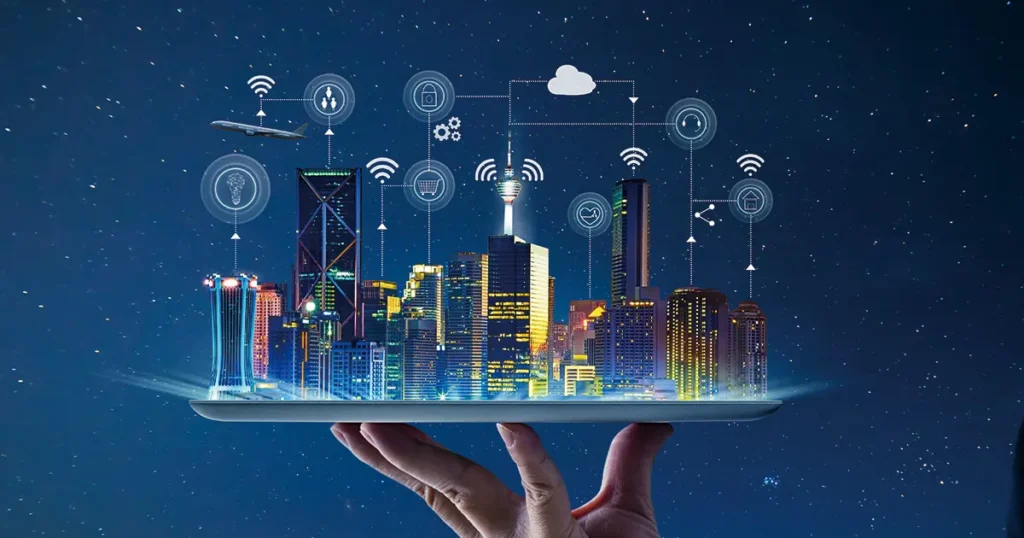
TABLE OF CONTENTS
Smart Cities Demand More Than Connectivity: Bandwidth, Latency, and Density
Smart cities are often discussed in terms of digital transformation and intelligent services, but at a technical level, their success depends on whether the underlying network can meet a set of very concrete requirements.
Modern urban applications place simultaneous demands on:
- Bandwidth, driven by high-definition video, AI analytics, and massive sensor data
- Latency, often requiring millisecond or sub-millisecond response times
- Endpoint density, as thousands of connected devices are deployed within limited geographic areas
Traditional centralized networking models—where all data is transmitted back to a remote core—struggle to satisfy these requirements at scale. As cities move toward real-time, automated decision-making, network architecture itself becomes a critical constraint.
Fiber Optics as the Only Viable Physical Layer

At the physical layer, few technologies can support the performance envelope required by smart cities. Copper-based networks face fundamental limits in distance and interference resistance, while purely wireless solutions lack the determinism and capacity needed for large-scale, mission-critical systems.
Fiber optic networks offer a fundamentally different foundation. They provide extremely high bandwidth potential, stable and predictable latency, and immunity to electromagnetic interference. Just as importantly, fiber infrastructure is inherently future-proof: capacity upgrades can be achieved by updating terminal equipment rather than replacing the physical medium.
For this reason, modern smart city networks are increasingly designed as all-optical networks, where fiber is not only used for long-haul transmission but extended deep into access and aggregation layers.
From Centralized Networks to Edge Computing Architecture
As smart city applications evolve, a purely centralized network model is no longer sufficient.
In early deployments, data from cameras, sensors, and controllers was typically transmitted back to a central data center for processing. While this approach simplifies management, it introduces unavoidable latency, consumes excessive backhaul bandwidth, and creates large failure domains.
Many emerging use cases—such as AI-based video recognition, intelligent traffic control, and assisted autonomous driving—require immediate local responses. Sending all raw data to a distant core is neither efficient nor technically viable.
This has driven a shift toward edge computing architectures, where computing and storage resources are deployed closer to data sources—at street, neighborhood, or district level. Fiber optic networks are the key enabler of this model, providing ultra-low-latency, high-capacity links between endpoints, edge nodes, and regional data centers.
Technologies such as F5G (Fifth Generation Fixed Network) and POL (Passive Optical LAN) further accelerate this transition by extending fiber access to the very edge of the network, simplifying architecture while improving reliability and energy efficiency.
To clearly illustrate why this architectural shift matters, the differences between traditional centralized networks and edge-based fiber architectures are summarized below.
Centralized Network vs. Edge-Based Fiber Architecture in Smart Cities
| Dimension | Centralized Network Architecture | Edge-Based Fiber Architecture |
|---|---|---|
|
Data Processing Location |
Central data center |
Distributed edge nodes (street / district level) |
|
Typical Latency |
High and unpredictable |
Ultra-low and deterministic |
|
Backhaul Bandwidth Usage |
Very high |
Optimized through local processing |
|
Scalability |
Limited by core capacity |
Highly scalable with modular edge expansion |
|
Fault Impact |
Single failure can affect large areas |
Localized failures with limited impact |
|
Suitability for AI & Real-Time Applications |
Poor |
Excellent |
|
Role of Fiber |
Primarily long-distance backhaul |
End-to-end access, aggregation, and edge interconnection |
|
Typical Use Cases |
Legacy monitoring systems |
AI video analytics, smart traffic, autonomous systems |
This comparison highlights a fundamental reality: as application requirements become more time-sensitive and data-intensive, fiber must move closer to where data is generated and processed.
Fiber Deployment Challenges in Real Cities: Cost and Construction
Despite its technical advantages, deploying fiber at city scale presents practical challenges—particularly in established urban environments.
Older districts often face constraints such as limited underground space, strict construction regulations, and high disruption costs associated with road excavation. These factors can make traditional trenching slow, expensive, and politically sensitive.
To address these challenges, the industry has adopted several proven deployment strategies:
- Micro-duct and air-blown fiber technologies, which significantly reduce excavation requirements and allow fibers to be added or upgraded with minimal surface impact
- Composite fiber-power cables, enabling both data transmission and power delivery within a single cable—especially valuable for distributed edge devices
- Reuse of existing infrastructure, including underground utility corridors, municipal pipelines, and street furniture, to accelerate rollout and reduce civil works
These approaches do not eliminate deployment costs, but they transform fiber installation from a disruptive construction project into a manageable engineering task, making large-scale optical networks more feasible for cities.
Fiber and 5G/6G: Cooperation, Not Competition
Fiber optics are sometimes viewed as alternatives to wireless technologies such as 5G or future 6G networks. In practice, the two are deeply interdependent.
Wireless networks act as the access interface, connecting mobile users, vehicles, and sensors. Fiber networks form the transport backbone, carrying data between radio units, edge computing nodes, and core systems.
As 5G networks become denser, this dependency intensifies. Small cells, massive MIMO deployments, and ultra-wideband applications dramatically increase the demand for fronthaul and midhaul capacity. Without extensive fiber infrastructure, these wireless systems cannot deliver their promised performance.
In simple terms: the more advanced wireless networks become, the more they rely on fiber.
Case Study: Smart Solar Street Lighting as an Edge Node

Image source: Leap Pole
Smart street lighting provides a clear and practical example of how modern network architecture is applied in real cities.
Street lights are evenly distributed, already integrated into municipal infrastructure, and ideally positioned for sensing and communication tasks. In smart city deployments, they evolve from passive lighting assets into multi-functional edge nodes.
A typical smart solar street lamp system integrates:
- Fiber optic connectivity for high-speed, low-latency communication
- Edge computing modules for local data processing and decision-making
- Solar power systems, enabling autonomous operation and reducing grid dependence
- Sensors and cameras supporting lighting control, monitoring, or security functions
In this architecture, fiber connects street-level nodes to nearby edge cabinets or district aggregation points, where real-time processing occurs. Only relevant or aggregated data is transmitted to central platforms, minimizing latency and backhaul load.
The innovation lies not in any single component, but in how optical connectivity, edge computing, and renewable energy are combined into a coherent system.
Beyond Connectivity: The Future Role of Fiber in Smart Cities
Looking ahead, the role of fiber in smart cities extends beyond communication alone.
Emerging distributed fiber sensing technologies allow optical fibers to detect vibration, temperature changes, and physical disturbances along their entire length. Using techniques such as Distributed Acoustic Sensing (DAS), a single fiber can function as a continuous sensor for roads, pipelines, and critical infrastructure.
This capability transforms fiber from a passive transmission medium into an active sensing layer. Roads can be monitored for structural stress, unauthorized excavation can be detected in real time, and environmental changes can be observed without deploying additional sensors.
As these technologies mature, fiber will play an increasingly central role in how cities perceive and respond to their physical environment.
Conclusion
Smart cities are built on systems rather than isolated technologies. While applications and devices will continue to evolve, the underlying network architecture determines how effectively these systems operate together.
Fiber optic networks provide the bandwidth, latency stability, and scalability required to support edge computing, dense wireless access, and future sensing technologies. As cities move toward more distributed and intelligent architectures, fiber is not merely an option—it is the structural foundation of smart urban environments.
 English
  French
  German
  Spanish
  Arabic
  Turkish
  Japanese
  Russian