

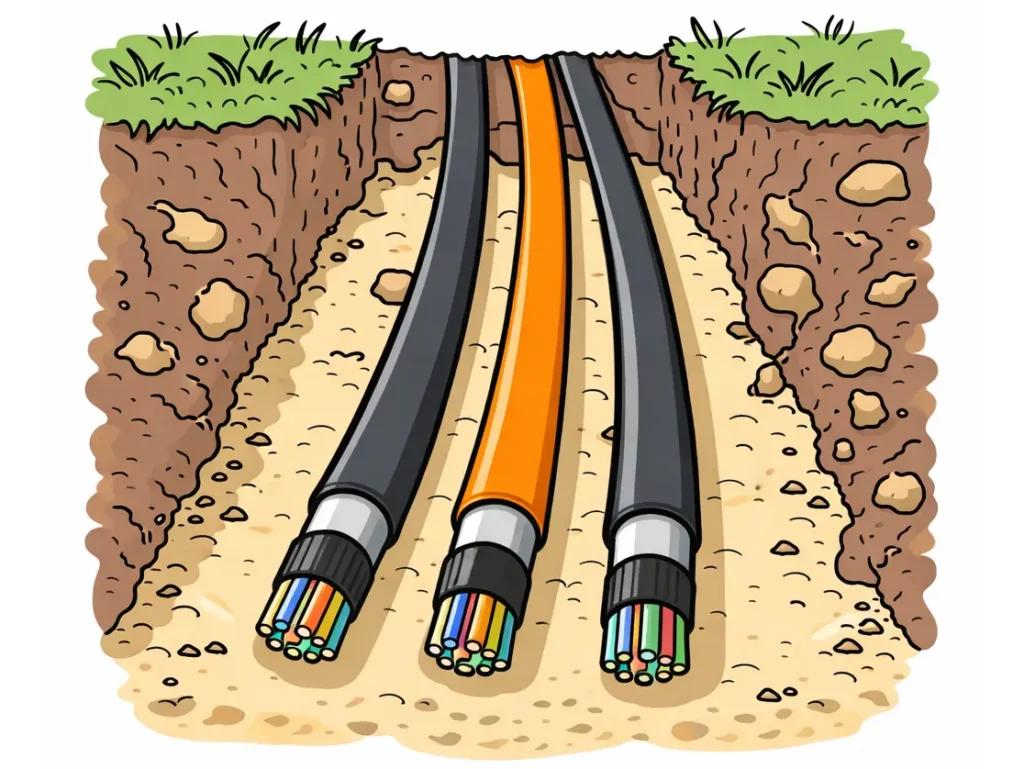
Fiber optic cables are widely used in residential, commercial, and outdoor communication networks. In many projects, these cables are installed underground to protect them from environmental damage and improve long-term reliability. One of the most common questions people ask before installation is:
How deep is fiber optic cable buried?
The answer is not a single fixed number. Burial depth depends on installation method, cable structure, environmental conditions, and local regulations. In this guide, we’ll explain typical burial depths for fiber optic cables, why depth matters, and what additional safety and technical factors should be considered when planning an underground fiber installation.
TABLE OF CONTENTS
Why Burial Depth Matters for Fiber Optic Cables
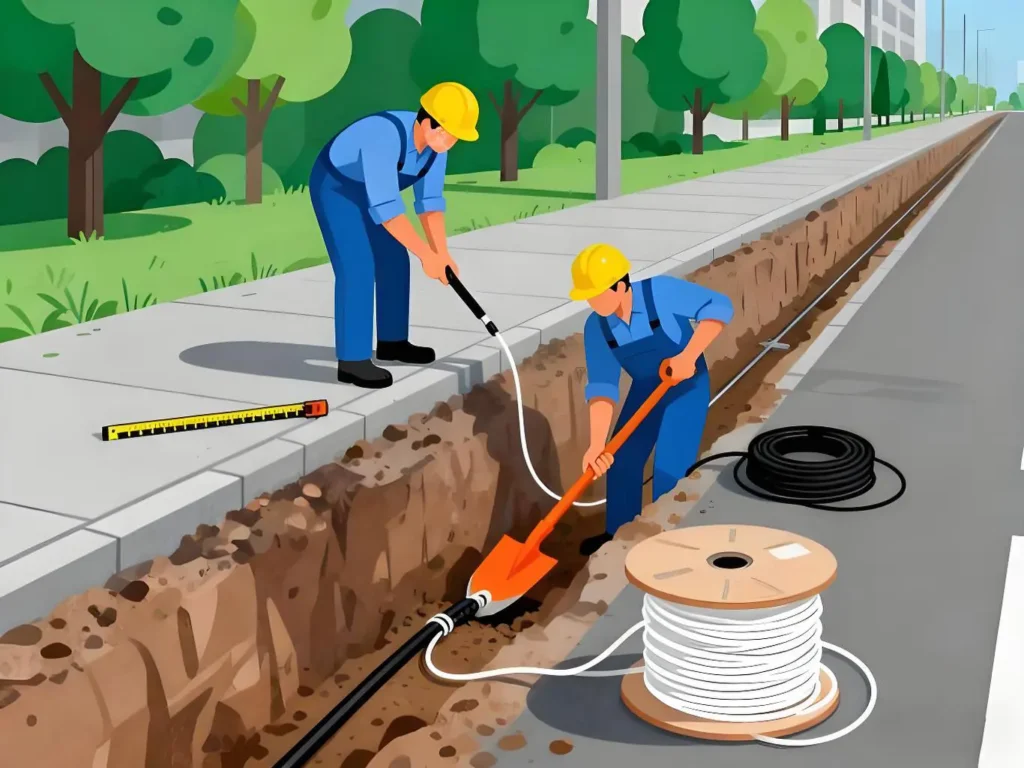
Burying fiber optic cable at the correct depth is essential for both performance and durability. A cable buried too shallow may be damaged by landscaping, digging, vehicle traffic, or seasonal ground movement. Conversely, burying the cable unnecessarily deep can increase installation costs and complicate future maintenance.
Proper burial depth helps to:
- Protect the cable from mechanical damage
- Reduce the impact of temperature changes and frost heave
- Minimize the risk of accidental cuts during future excavation
- Ensure compliance with electrical and municipal installation standards
In real-world deployments, many fiber failures are caused not by cable quality, but by improper burial depth and insufficient protection.
How Deep Is Fiber Optic Cable Buried? (Quick Answer)
In most installations, fiber optic cables are typically buried between 12 and 36 inches (30–90 cm / 0.3–0.9 m) underground. The exact depth varies based on application, environment, and regulatory requirements.
Typical burial depths by scenario:
| Installation Scenario | Typical Depth |
|---|---|
|
Residential yards |
12–18 in (30–45 cm) |
|
Commercial properties |
18–24 in (45–60 cm) |
|
Road or driveway crossings |
24–36 in (60–90 cm) |
|
Direct-buried fiber cable |
Usually deeper |
|
Fiber installed in conduit |
Can be shallower |
Always check your local municipal building codes, as some jurisdictions have specific minimum burial depth requirements that supersede general industry standards. In certain regions, burial depth is governed by the National Electrical Code (NEC) or local city and utility regulations.
Different Installation Methods, Different Burial Depths
Burial depth recommendations vary largely because fiber optic cables can be installed using different methods. The two most common approaches are direct burial and conduit installation.
Direct-Buried Fiber Optic Cable
Direct-buried fiber optic cables are designed to be placed directly in the ground without additional conduit. They typically feature:
- Thick, rugged outer jackets
- Moisture-resistant materials
- Optional metal or dielectric armor
Because the cable itself provides the primary protection, direct-buried fiber is generally installed at greater depths to reduce the risk of crushing, accidental digging, and long-term soil movement.
The choice between armored and unarmored designs plays a major role in underground protection and depth planning.
Fiber Optic Cable Installed in Conduit
In conduit installations, the fiber cable is placed inside a protective duct such as PVC or HDPE. The conduit absorbs most external stress and shields the cable from moisture, soil pressure, and mechanical impact.
Because of this additional protection, conduit-installed fiber cables can often be buried at shallower depths while still achieving excellent long-term reliability. Conduit systems are also preferred when future cable replacement, upgrades, or splicing work is anticipated.
Key Factors That Affect How Deep Fiber Cable Should Be Buried

Cable Structure
Armored fiber optic cables provide increased resistance to crushing and rodent damage. Non-armored cables typically require either deeper burial or installation inside conduit for adequate protection.
Soil and Ground Conditions
Soft soil or sand allows easier installation at moderate depths. In rocky or compacted soil, deeper burial alone may not provide sufficient protection. A common best practice is to:
- Lay a layer of fine sand beneath the cable
- Place the cable on the sand bed
- Cover it with another sand layer before backfilling
This helps prevent sharp stones from pressing directly against the cable jacket.
Surface Load
Areas exposed to vehicle traffic, heavy machinery, or frequent foot traffic generally require deeper burial to avoid compression damage.
Climate and Environmental Risks
In cold climates, frost heave can gradually push shallow cables upward. In flood-prone regions, erosion and soil movement can expose buried cables over time. These risks often justify deeper burial or conduit use.
Local Codes and Regulations
Local electrical codes, municipal standards, and utility regulations may define minimum burial depths. These rules vary by city and country and should always be confirmed before installation. Many professional projects exceed minimum requirements to improve long-term reliability.
Important Safety Warnings Before Digging
Call Before You Dig (811)
In the United States and Canada, anyone planning to dig must contact Call Before You Dig (dial 811) before excavation. This free service identifies underground utilities such as fiber optic cables, electrical lines, gas pipes, and water mains.
Failing to call 811 can lead to service outages, serious safety hazards, and legal liability. This step is considered a standard and responsible practice in any professional underground fiber installation.
Warning Tape for Buried Fiber
To reduce the risk of accidental damage, it is recommended to install warning tape above buried fiber optic cables. The tape is typically placed 6–12 inches (15–30 cm) above the cable and clearly marked with messages such as:
Caution: Fiber Optic Line Below
Detectability Considerations for Non-Metallic Fiber Cables
Many modern fiber optic cables are non-metallic or all-dielectric. While this design offers advantages such as immunity to electromagnetic interference, it introduces one important challenge: these cables cannot be detected using standard metal detectors once buried.
To address this, a common best practice is to install a toning wire (also known as a tracer wire) alongside non-metallic fiber optic cables. The toning wire allows technicians to locate the buried cable in the future using electronic detection equipment, significantly reducing the risk of accidental cuts during excavation or upgrades.
Technical Considerations Beyond Burial Depth
Minimum Bend Radius
Burial depth alone does not guarantee fiber performance. Improper handling at turns and corners can damage the fiber internally, even if the cable is buried deep enough.
Every fiber optic cable has a specified minimum bend radius. Exceeding this limit—especially at underground turns or entry points—can cause microbending or fiber breakage, resulting in signal loss.
Backfill Material and Compaction
Proper backfill is just as important as correct depth. Backfill material should be free of sharp debris and compacted evenly. Excessive force during compaction can damage the cable, while loose backfill may allow future soil movement.
Underground vs. Aerial Fiber Installation
Underground and aerial fiber installations each have advantages.
Underground fiber offers:
- Better protection from weather and UV exposure
- Cleaner appearance
- Lower long-term risk of environmental damage
Aerial fiber:
- Is faster and more cost-effective to deploy
- Allows easier access for maintenance
- Is commonly used in rural or temporary networks
For permanent infrastructure and urban environments, underground installation is often preferred despite higher upfront costs.
Additional Frequently Asked Questions
Is burial depth the same for single-mode and multimode fiber?
In most cases, burial depth is determined by installation conditions rather than fiber type. Single-mode and multimode cables follow similar depth guidelines.
Can buried fiber optic cable be spliced underground?
Yes, but fiber splicing is typically performed inside sealed splice closures designed for underground use.
Do conduit systems eliminate the need for deeper burial?
Conduit improves protection but does not override local code requirements. Minimum burial depths still apply.
Should fiber optic cable be buried deeper in areas with future construction?
Yes. In areas likely to be excavated again, deeper burial, conduit, warning tape, and tracer wire are strongly recommended.
Conclusion: Burial Depth Is Part of a Complete System
The question of how deep fiber optic cable should be buried cannot be answered with a single number. Burial depth must be evaluated alongside cable structure, installation method, soil conditions, safety practices, detectability, and technical limits such as bend radius.
A well-planned underground fiber installation balances protection, compliance, and future maintainability. When these elements are addressed together, underground fiber optic networks can deliver stable, reliable performance for decades.



 English
  French
  German
  Spanish
  Arabic
  Turkish
  Japanese
  Russian
  Portuguese