

Expert Summary
Hollow Core Fiber (HCF) is an emerging optical fiber technology that allows light to travel primarily through air instead of glass, significantly reducing signal delay and nonlinear optical effects. Because the refractive index of air is much lower than that of silica, signals in HCF can propagate about 46% faster than in traditional fiber, reducing latency to roughly 3.3 μs/km.
With rapid progress in manufacturing and attenuation reduction—reaching 0.138 dB/km at 1550 nm in research environments—HCF is increasingly seen as a promising technology for AI backend networks, cloud infrastructure, financial trading networks, and next-generation telecom systems.
TABLE OF CONTENTS
Why a New Type of Optical Fiber Is Emerging
For decades, optical fiber has been the backbone of the internet. Every email, video call, cloud service, and AI workload ultimately depends on signals traveling through glass fibers across continents and oceans.
However, traditional fiber technology is gradually approaching its physical limits. As global data traffic continues to grow—driven by artificial intelligence, cloud computing, and real-time digital services—network operators are searching for new ways to reduce latency and increase transmission efficiency.
A new approach is now gaining attention: Hollow Core Fiber (HCF).
Instead of sending light through solid glass, this technology allows signals to propagate primarily through air, fundamentally changing how optical communication works.
What Is Hollow Core Fiber?
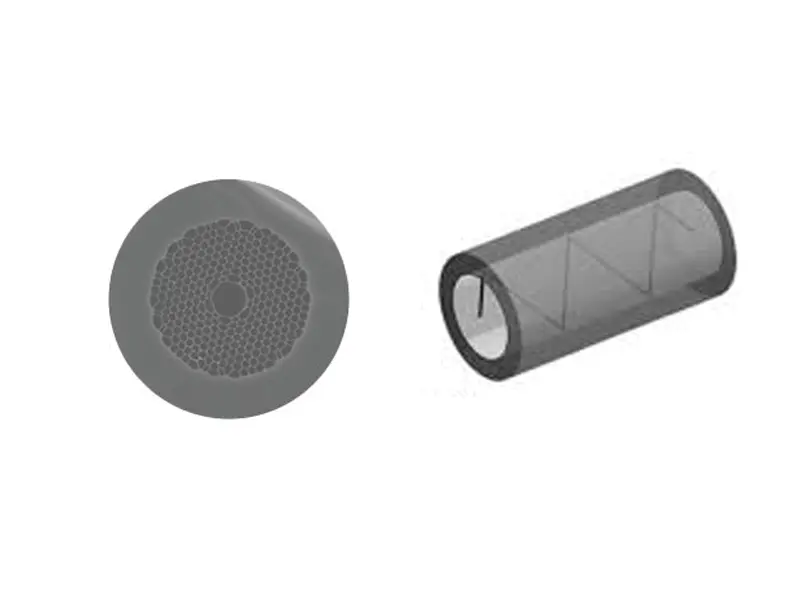
Figure 1: hollow core fiber example
Hollow Core Fiber (HCF) is a special type of optical fiber where the central core is mostly air rather than solid glass.
In conventional fiber, light travels through a glass core surrounded by cladding. In hollow core fiber, the glass structure forms a complex microscopic framework around an air channel, which acts as the primary transmission path.
Because air has a refractive index close to 1 while silica glass has a refractive index of roughly 1.47, light traveling through air experiences significantly less delay and fewer nonlinear effects.
A simple analogy helps illustrate the difference:
- Traditional fiber is like sending light through a glass tunnel.
- Hollow core fiber is like sending light through an air tunnel surrounded by reflective walls.
Despite this structural difference, hollow core fiber still resembles standard fiber externally. Typical parameters include:
- outer diameter: about 125 μm
- air core diameter: typically several to tens of micrometers
- internal structure: precisely arranged micro-air-hole cladding
These microscopic structures are what allow the fiber to guide light through air while maintaining signal stability.
How Hollow Core Fiber Works
Traditional optical fibers guide light using
Total Internal Reflection.
Light repeatedly reflects between the core and cladding as it travels down the fiber. While this mechanism has enabled global communication networks, it also introduces limitations because the signal interacts continuously with the glass medium.
Glass interaction leads to:
- optical absorption
- scattering losses
- nonlinear optical effects
- signal distortion at high optical power
Hollow core fiber avoids many of these issues by confining the light inside an air channel, minimizing interaction with glass.
Two major guiding mechanisms are used today.
Photonic Bandgap Hollow Core Fiber

Figure 2: Different structural designs of photonic bandgap hollow core fibers (PBGF), showing how periodic microstructures in the cladding confine light within the air core.
One of the earliest designs relies on the concept of a Photonic Band Gap.
In this approach, the cladding contains a periodic arrangement of microscopic air holes that form a photonic crystal structure. This structure prevents certain wavelengths from escaping the core, effectively trapping the light within the central air channel.
You can imagine this as a microscopic mirror maze surrounding the light path, reflecting the signal back toward the center.
Anti-Resonant Hollow Core Fiber
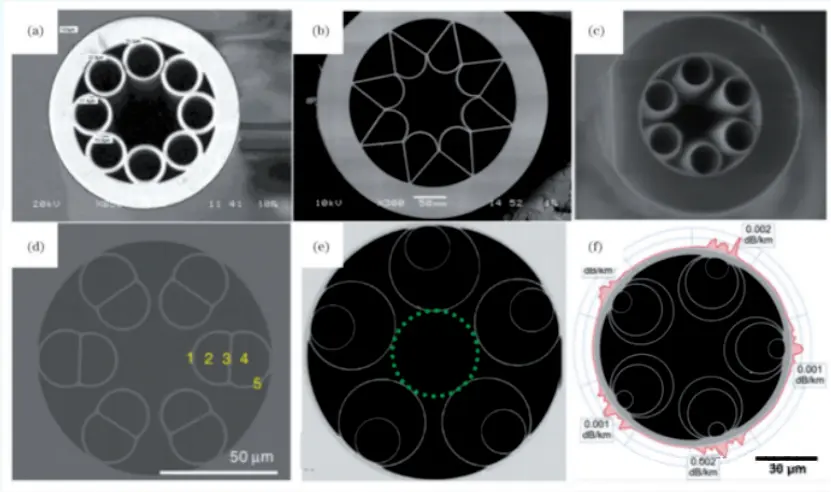
Figure 3: Representative structural configurations of anti-resonant hollow core fibers (HC-ARF), where thin glass capillaries surrounding the air core reflect light through anti-resonant mechanisms.
A newer and increasingly popular approach is anti-resonant hollow core fiber.
Instead of relying on a dense photonic crystal, this design uses thin glass capillaries surrounding the air core. These capillaries reflect light back into the core through resonance-based optical effects.
One of the most promising designs in this category is Nested Anti-Resonant Fiber (NANF). The NANF structure places additional nested capillaries inside the cladding tubes, which improves confinement and reduces loss.
Compared with earlier designs, NANF hollow core fibers offer several advantages:
- lower attenuation
- broader low-loss bandwidth
- simpler fabrication structures
Because of these improvements, NANF-based HCF designs are widely considered one of the most promising candidates for large-scale deployment.
Hollow Core Fiber vs Traditional Optical Fiber
The differences between conventional fiber and hollow core fiber become clearer when comparing key performance metrics.
Feature | Traditional Fiber | Hollow Core Fiber |
Light propagation medium | Glass | Air |
Typical latency | ~5 μs/km | ~3.3 μs/km |
Relative signal speed | Baseline | ~46% faster |
Nonlinear optical effects | Significant | >1000× lower |
High-power laser transmission | Limited | Very high capability |
Manufacturing maturity | Highly mature | Emerging |
Two characteristics make HCF particularly attractive.
Ultra-Low Latency
In conventional single-mode fiber, signal latency is typically around 5 microseconds per kilometer.
Hollow core fiber reduces this to roughly 3.3 microseconds per kilometer, saving approximately 1.54 microseconds of round-trip delay per kilometer.
Although this difference may seem small, it becomes extremely significant over long distances or in applications where microseconds matter.
Extremely Low Nonlinear Effects
Because light in hollow core fiber travels mostly through air, nonlinear optical effects are more than 1000 times lower than in conventional single-mode fiber.
This property allows HCF to support:
- significantly higher optical power
- cleaner signal transmission
- reduced distortion in high-capacity communication systems
It also makes the technology particularly suitable for high-power laser delivery systems.
Rapid Progress in Loss Reduction
Historically, one of the biggest obstacles for hollow core fiber was attenuation. Early prototypes exhibited losses of hundreds of dB/km, making them impractical for real networks. Over the past decade, however, major breakthroughs have dramatically improved performance.
Researchers at University of Southampton have demonstrated hollow core fibers with attenuation as low as:
0.138 dB/km at the 1550 nm communication wavelength.
This figure approaches—and in some wavelength ranges even challenges—the theoretical limits of conventional silica fiber.
These advances suggest that hollow core fiber could soon become viable for long-distance communication links.
How Hollow Core Fiber Is Tested: OTDR vs OFDR
Testing hollow core fiber (HCF) presents unique challenges. Because light propagates mainly through air rather than solid glass, traditional measurement methods designed for conventional fiber do not always deliver sufficient resolution or sensitivity.
Currently, the most common testing solutions for hollow core fiber still rely on traditional tools such as Optical Time Domain Reflectometers (OTDR) and optical power meters. These instruments are widely used in fiber networks to measure attenuation, splice loss, and continuity.
However, when applied to hollow core fiber, two major limitations often appear:
Long dead zones in OTDR measurements
Limited sensitivity for detecting very small scattering signals
These limitations become more apparent when testing long spans of HCF or when analyzing detailed structural properties.
To overcome these challenges, researchers are increasingly turning to Optical Frequency Domain Reflectometry (OFDR), a high-resolution distributed sensing technology capable of mapping optical characteristics along the entire length of a fiber.
At the Optical Fiber Communication Conference 2025 (OFC 2025), researchers led by N. K. Fontaine demonstrated two advanced OFDR systems capable of performing highly detailed distributed characterization of Double Nested Anti-Resonant Hollow Core Fiber (DNANF).
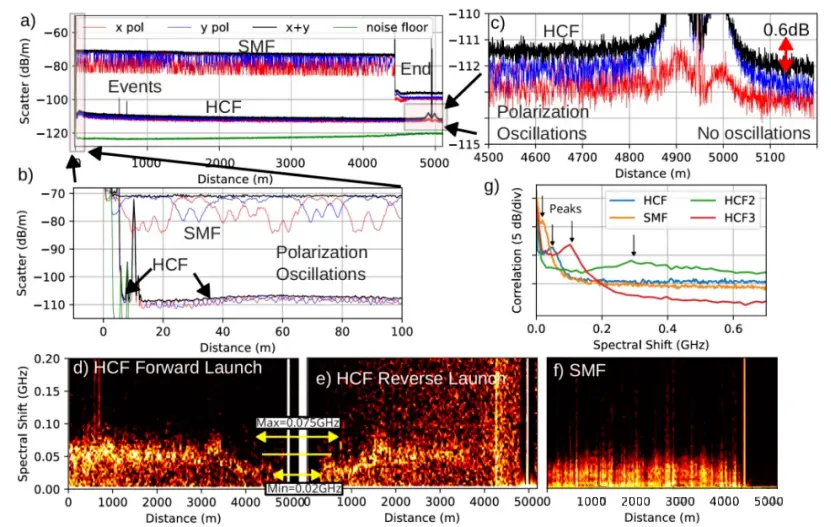
Figure 4: Polarization-resolved OFDR measurement of a 4.9 km DNANF hollow core fiber. (a) shows the comparison between SMF, HCF, and the electronic noise floor; (b–c) zoom in on the fiber input and HCF output ends; (d–f) illustrate polarization spectral shifts derived from backscatter correlation for forward and backward HCF launches and SMF reference; (g) compares the average polarization spectral shift across multiple fiber types.

Figure 5: Long-range OFDR measurement results averaged over 50 wavelengths across a 100 km span. (a) forward and backward OFDR traces; (b) measured fiber attenuation profile.
Their work introduced two complementary measurement systems:
| OFDR System | Measurement Range | Resolution | Capability |
|---|---|---|---|
| High-resolution OFDR | Up to 5 km | Sub-millimeter | Distributed mode birefringence measurement |
| Long-range OFDR | Over 100 km | 3 m @10 km / 25 m @100 km | Dynamic range > 90 dB |
These results represent one of the most detailed distributed measurements ever performed on hollow core fibers.
Real-world testing is also beginning to appear outside academic labs. For example, engineers using OFDR equipment from HaoHeng Technology recently performed distributed scattering measurements on a ~1 km hollow core fiber sample.
The measurement results showed a gradual increase in transmission loss as distance increased, which is consistent with theoretical expectations. Because the tested fiber was a Photonic Bandgap Fiber (PBGF) designed for sensing applications, the OFDR scanning curve closely matched the predicted performance model.
As hollow core fiber technology continues to evolve, high-resolution distributed measurement methods like OFDR are expected to become essential tools for both research and industrial validation.

Figure 5:Distributed scattering measurement of a 1 km hollow core fiber using OFDR equipment, illustrating signal attenuation characteristics along the fiber length.
Real-World Applications and Industry Adoption
Although still emerging, hollow core fiber is already being explored in several high-performance networking environments.
High-Frequency Trading Networks
Financial markets were among the earliest adopters.
Organizations connected to Nasdaq and several London-based hedge funds have investigated HCF links to reduce latency between trading centers.
In high-frequency trading systems, a single microsecond advantage can translate into millions of dollars in profit.
HCF is currently one of the few cable technologies capable of approaching the speed of microwave communication links while maintaining the reliability of fiber infrastructure.
AI and Data Centers
Another rapidly emerging use case is AI backend networks inside large data centers. As AI models scale to trillions of parameters, the bottleneck is often no longer compute power, but the interconnect latency between GPU nodes. Modern GPU clusters used for AI training require extremely fast synchronization to handle these massive workloads.
Many of these systems rely on technologies such as RDMA (Remote Direct Memory Access) to exchange data directly between servers. Latency in these backend networks can significantly affect the efficiency of distributed AI training. HCF directly addresses this by accelerating the collective communication patterns essential for distributed training. By reducing signal delay and minimizing optical nonlinearities, HCF has the potential to drastically improve RDMA communication latency in large GPU clusters, making it a cornerstone for next-generation AI infrastructure.
The industry is already moving in this direction. In 2022, Microsoft acquired the hollow core fiber manufacturer Lumenisity. This acquisition aims to explore the integration of HCF technology into Azure cloud infrastructure, particularly for high-speed links between large-scale data centers.
Telecom Network Experiments
Telecommunications companies are also evaluating the technology.
For example, BT Group and Ericsson conducted experiments using a 10-kilometer hollow core fiber link for 5G backhaul networks.
Their tests showed that reduced latency could potentially extend the effective coverage radius of 5G base stations.
Another experiment came from Comcast, which deployed a 40-kilometer hollow core fiber link in 2022 to demonstrate the technology’s feasibility in metropolitan networks.
Why Hollow Core Fiber Is Not Widely Used Yet
Despite its advantages, hollow core fiber has not yet replaced conventional fiber infrastructure. Several challenges remain.
- Manufacturing Complexity
The microstructured cladding required for HCF must be manufactured with extremely high precision. Producing these structures consistently over long distances remains technically challenging. - Higher Cost
Because production volumes are still relatively small and fabrication is complex, hollow core fiber currently costs significantly more than traditional single-mode fiber. - Splicing and Connector Challenges
Conventional connectors and splicing techniques were designed for solid glass fibers. Adapting them for hollow structures requires new manufacturing and installation methods. - Limited Production Capacity
Only a small number of manufacturers currently have the capability to produce hollow core fiber at industrial scale.
The Future of Hollow Core Fiber
Despite these challenges, hollow core fiber continues to attract strong interest from both academia and industry.
As demand grows for:
- ultra-low-latency communication
- large-scale AI computing clusters
- advanced sensing technologies
- high-power laser delivery
HCF may become an important component of next-generation optical infrastructure.
Rather than replacing traditional fiber entirely, hollow core technology is likely to play a crucial role in specialized high-performance networks where latency and signal integrity are critical.
Frequently Asked Questions
What is the main advantage of hollow core fiber?
The primary advantage is low latency. Because light travels through air rather than glass, signals propagate about 46% faster than in traditional silica fiber.
How much latency can hollow core fiber reduce?
Typical latency in standard fiber is around 5 μs per kilometer, while hollow core fiber reduces this to approximately 3.3 μs/km, saving about 1.54 microseconds of round-trip delay per kilometer.
Why are nonlinear effects lower in hollow core fiber?
Most nonlinear optical effects occur when light interacts with glass. Since light in HCF travels mainly through air, these effects are more than 1000 times lower than in conventional single-mode fiber.
Who is developing hollow core fiber technology?
Several organizations are actively researching and commercializing the technology, including University of Southampton, Microsoft, and Lumenisity.
Will hollow core fiber replace traditional optical fiber?
Not entirely. While HCF offers major advantages in latency and high-power transmission, traditional fiber remains cheaper and easier to manufacture. Hollow core fiber is expected to complement existing networks rather than fully replace them.


 English
  French
  German
  Spanish
  Arabic
  Turkish
  Japanese
  Russian