


The rapid expansion of artificial intelligence is reshaping global infrastructure investment. While much of the discussion revolves around advanced chips and computing power, those of us closer to the industry know that none of this works without one fundamental layer: optical connectivity.
As demand accelerates, the fiber optic industry is going through structural changes that go far beyond simple market growth. To really understand what is happening—and what it means for procurement—we need to look beyond individual company names and take a closer look at how the industry is organized across the supply chain.
TABLE OF CONTENTS
AI-Driven Infrastructure Growth and the Shift in Fiber Optic Demand
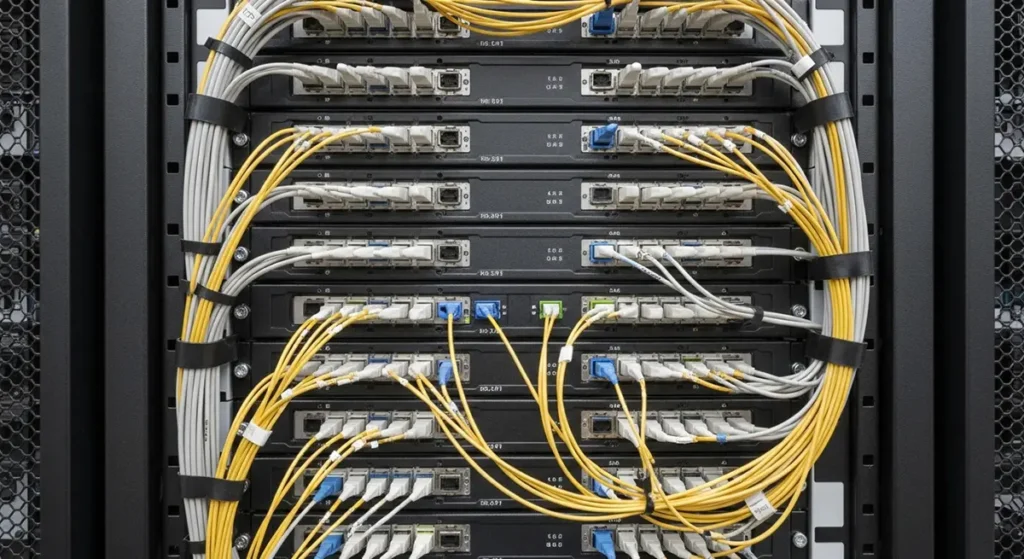
AI workloads generate enormous volumes of data that must move quickly, reliably, and continuously. Inside modern data centers and between data centers, bandwidth density and signal integrity have become critical design constraints. In this environment, fiber optics are no longer just supporting components—they are strategic infrastructure.
What we are seeing in the market is a clear shift in requirements. Compared with traditional telecom applications, AI-related deployments demand optical fiber with much tighter performance tolerances and long-term stability. Consistency, low attenuation, and manufacturing control matter as much as headline specifications.
At the same time, the ability to produce fiber that meets these requirements is concentrated among a very limited number of manufacturers. High-end fiber capacity cannot be expanded overnight. As AI-driven projects rapidly scale up, available production capacity is being prioritized toward data center and hyperscale applications.
This has created a noticeable “capacity squeeze” across the industry:
- High-performance fiber is increasingly allocated to AI and data center projects
- Traditional segments such as FTTX and conventional telecom face reduced available capacity
- Fiber prices begin to rise across multiple application areas, not only at the top end
From a buyer’s perspective, this is not simply a short-term fluctuation—it reflects deeper structural constraints in the supply chain.
What Recent Industry Developments Tell Us About the Fiber Market
Recent industry developments reinforce this shift. Large technology companies are no longer treating optical fiber as a passive input but as a strategic resource requiring long-term planning.
In January 2026, Corning and Meta announced a multiyear agreement—valued at up to USD 6 billion—to accelerate data center buildout in the United States. While details vary, moves like this send a clear signal to the broader market: access to high-performance optical fiber is now a strategic consideration at the highest level.
When upstream capacity is finite and expansion cycles are measured in years, large-scale commitments by hyperscale players inevitably influence how fiber is allocated across different sectors. For anyone sourcing fiber-related products, understanding this context has become essential.
The Fiber Optic Industry as a Layered Ecosystem
One reason fiber sourcing can feel confusing is that the term “fiber optic companies” covers very different types of businesses. In practice, the industry operates as a layered ecosystem, with each layer facing distinct technical, financial, and operational realities.
Broadly speaking, we can look at the industry across three levels: upstream, midstream, and downstream.
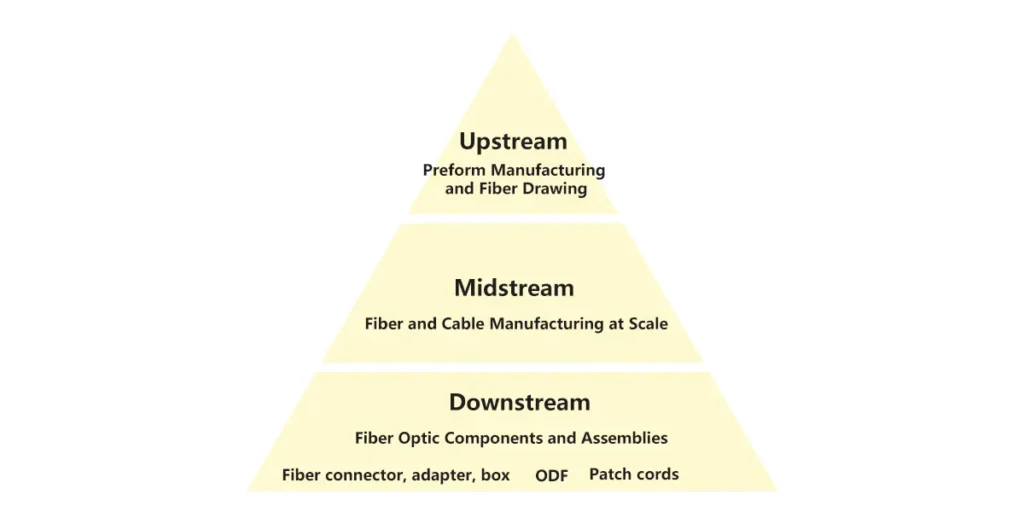
Upstream: Preform Manufacturing and Fiber Drawing
Upstream production—preform manufacturing and fiber drawing—represents the highest technical and capital barriers in the fiber optic industry. This is where the fundamental performance limits of optical fiber are defined.
Material science, proprietary processes, and decades of accumulated experience all play a role. Building and expanding upstream capacity requires massive long-term investment, and process stability is critical. As a result, this segment remains highly concentrated.
Several global players operate at this level, often combining preform technology with fiber drawing capabilities. Companies such as Corning, YOFC (Yangtze Optical Fibre and Cable), Hengtong, and FiberHome have built strong positions through long-term R&D investment and vertical integration. Many of these companies span multiple layers of the supply chain, but their upstream capabilities are what ultimately shape industry-wide capacity and pricing dynamics.
Midstream: Fiber and Cable Manufacturing at Scale
The midstream segment focuses on transforming drawn fiber into cables and deploying it across large-scale networks. Compared with upstream production, the technology is more mature, but the business remains capital-intensive and operationally demanding.
Midstream manufacturers typically compete on:
- Production scale and automation
- Project execution and delivery capability
- Compliance with regional and operator standards
This segment plays a critical role in national broadband projects, telecom backbone networks, and large enterprise deployments. Companies such as CommScope and others with strong system-level capabilities are well positioned to support standardized, high-volume applications.
That said, scale-oriented operations are not always optimized for flexibility. Rapid customization, small-batch production, or frequent specification changes can be challenging in manufacturing environments designed primarily for throughput and long-term contracts.
Downstream: Fiber Optic Components and Assemblies
Downstream manufacturing includes fiber optic connectors, patch cords, adapters, and FTTX-related components. On the surface, this segment appears crowded, and entry barriers are lower than in upstream production. In reality, the gap between manufacturers can be significant.
The key difference is not whether a product can be made, but how consistently it can be made over time. As network density increases—particularly in data centers and access networks—even small variations in quality can lead to system-level issues.
From our experience in the industry, buyers increasingly look beyond datasheets and focus on factors such as:
- Process stability and yield control
- Long-term consistency records
- Traceability and quality management systems
- Delivery reliability under sustained volume
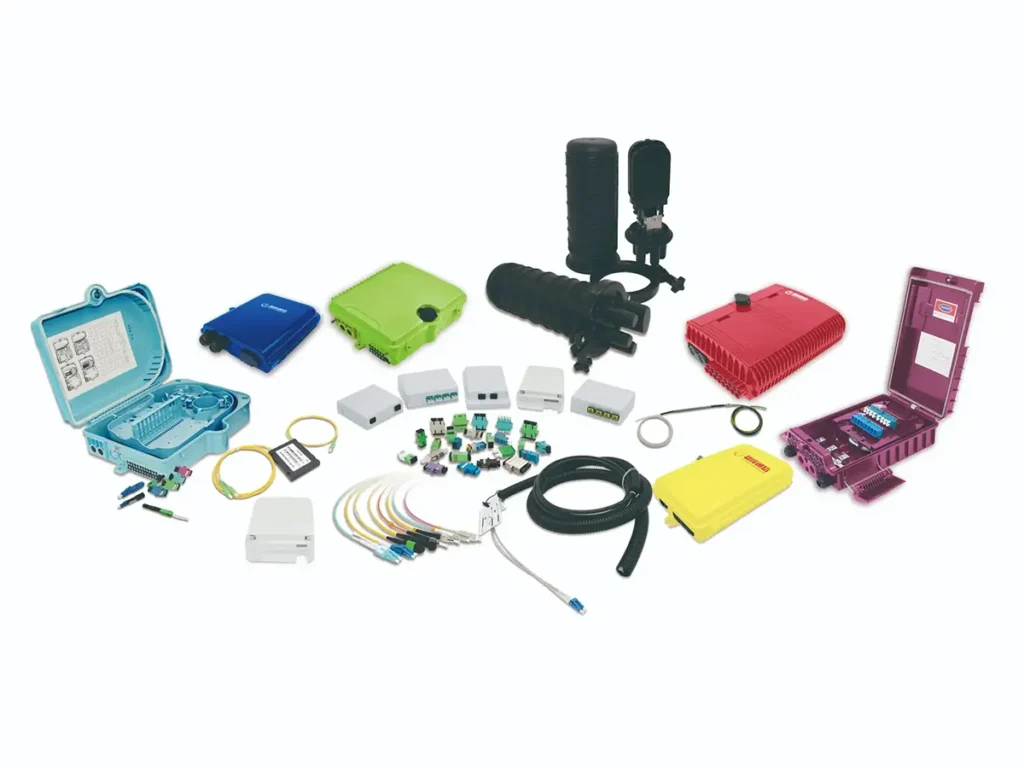
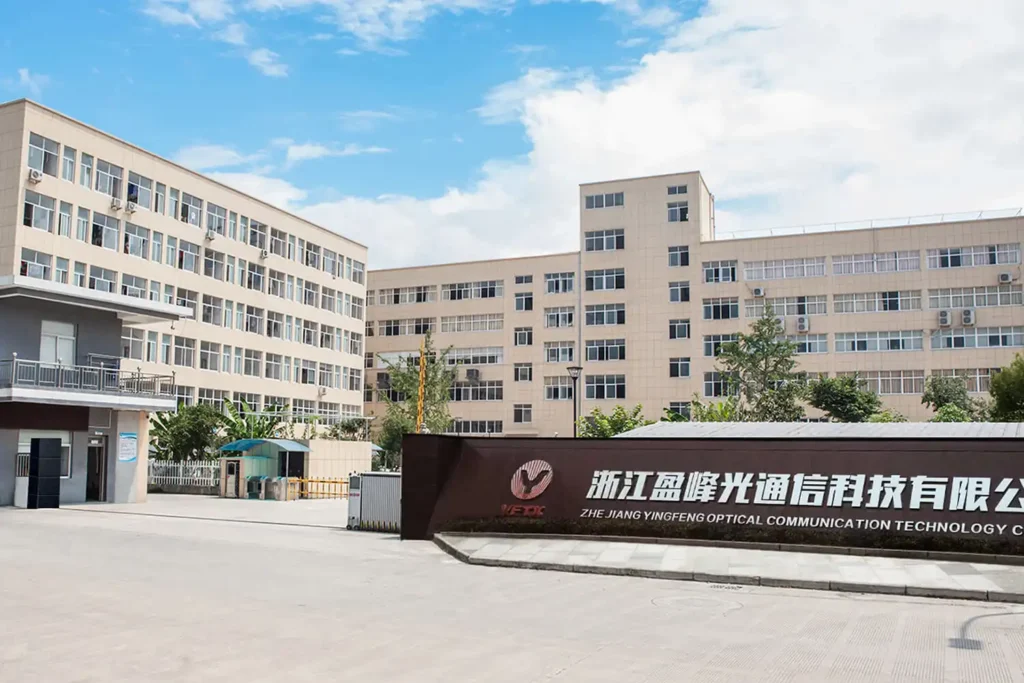
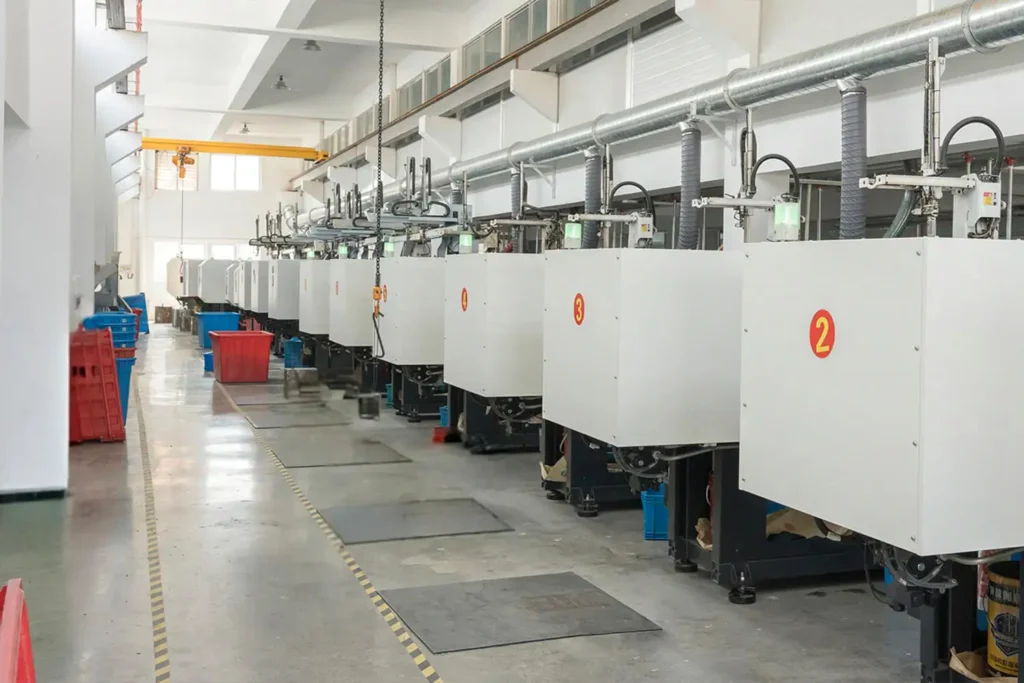
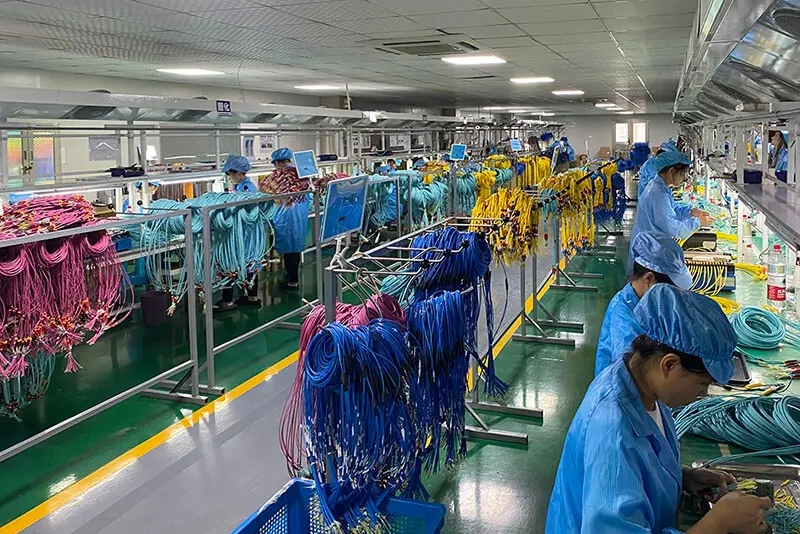
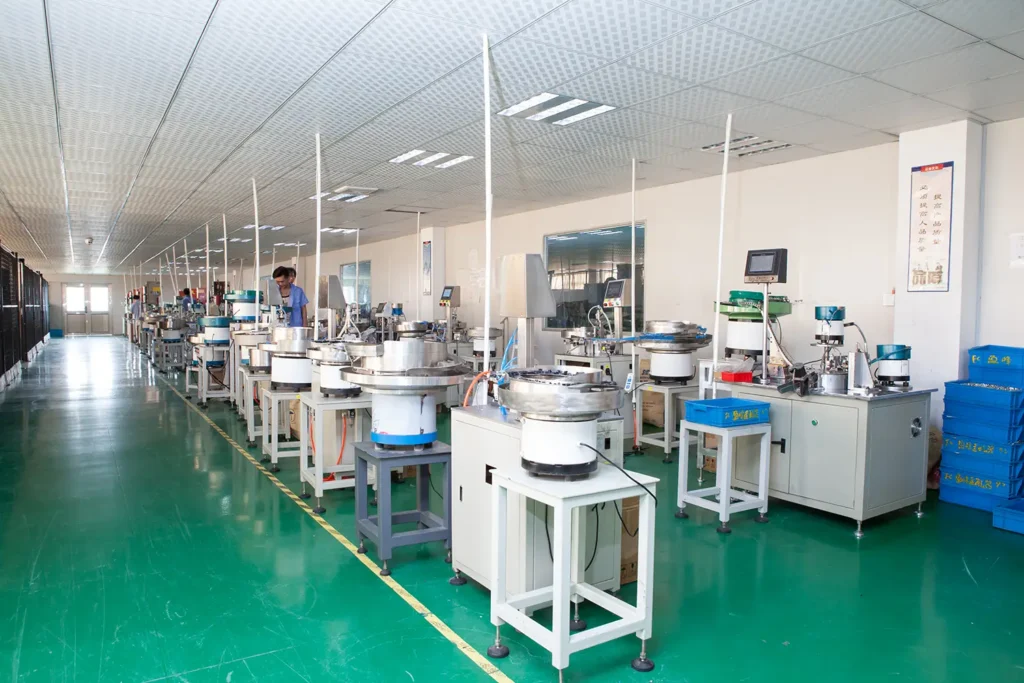
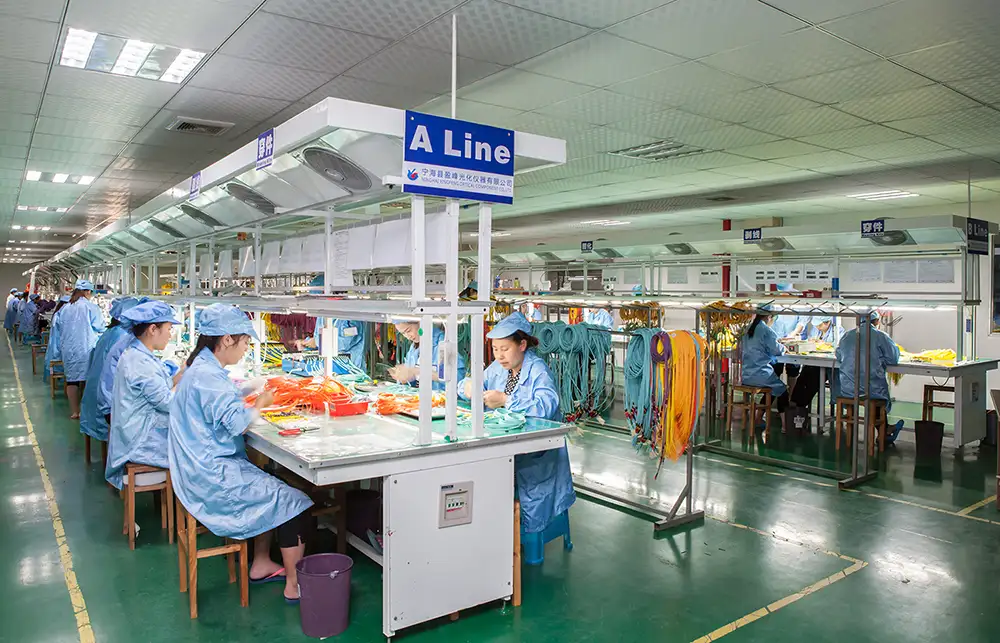
YingFeng Communication operates in this downstream segment, focusing on the manufacturing of fiber optic connectors, patch cords, and FTTX components. With in-house production facilities and long-term manufacturing experience, the company supports OEM and ODM customers who value consistency, transparency, and stable supply rather than short-term price advantages.
Practical Procurement Considerations in a Changing Market
As supply chains tighten and performance requirements rise, procurement decisions become more complex—especially in the downstream segment, where manufacturer capabilities vary widely.
In practice, downstream suppliers range from well-established factories with mature production systems to small workshops with limited process control. While specifications on paper may look similar, long-term performance often tells a different story.
When evaluating potential partners, it is worth considering several practical steps:
- Conduct on-site factory audits to understand real production processes
- Review long-term consistency and quality records, not just sample results
- Assess whether quality control is embedded throughout production or added only at final inspection
- Look at how the supplier handles volume fluctuations and repeat orders
For many buyers, visiting the factory remains one of the most effective ways to assess a manufacturing partner. If you are sourcing from China and have the opportunity, seeing daily production operations firsthand often provides insights that no specification sheet can fully capture. YingFeng Communication welcomes such visits and believes transparency is a key part of building long-term partnerships.
Choosing the Right Fiber Optic Partner by Application
There is no single “best” fiber optic company that fits every scenario. The right choice depends on application requirements and sourcing priorities.
- AI and data center projects typically prioritize consistency, performance stability, and long-term supply assurance
- Large telecom and broadband deployments often emphasize scale, certification, and execution capability
- System integrators and OEM brands may value flexibility, customization, and responsiveness
Understanding where a supplier is positioned within the industry ecosystem—and what it is optimized to deliver—matters far more than rankings or brand recognition alone.
Looking Ahead
As AI adoption continues to accelerate, optical fiber will remain a foundational technology enabling global digital infrastructure. Capacity constraints, long investment cycles, and shifting demand patterns are likely to persist.
In this environment, informed sourcing decisions start with understanding how the fiber optic industry is structured. For buyers, that understanding provides a more reliable framework for evaluating partners and navigating future changes than any simple list or ranking ever could.
 English
  French
  German
  Spanish
  Arabic
  Turkish
  Japanese
  Russian