

Key Takeaways
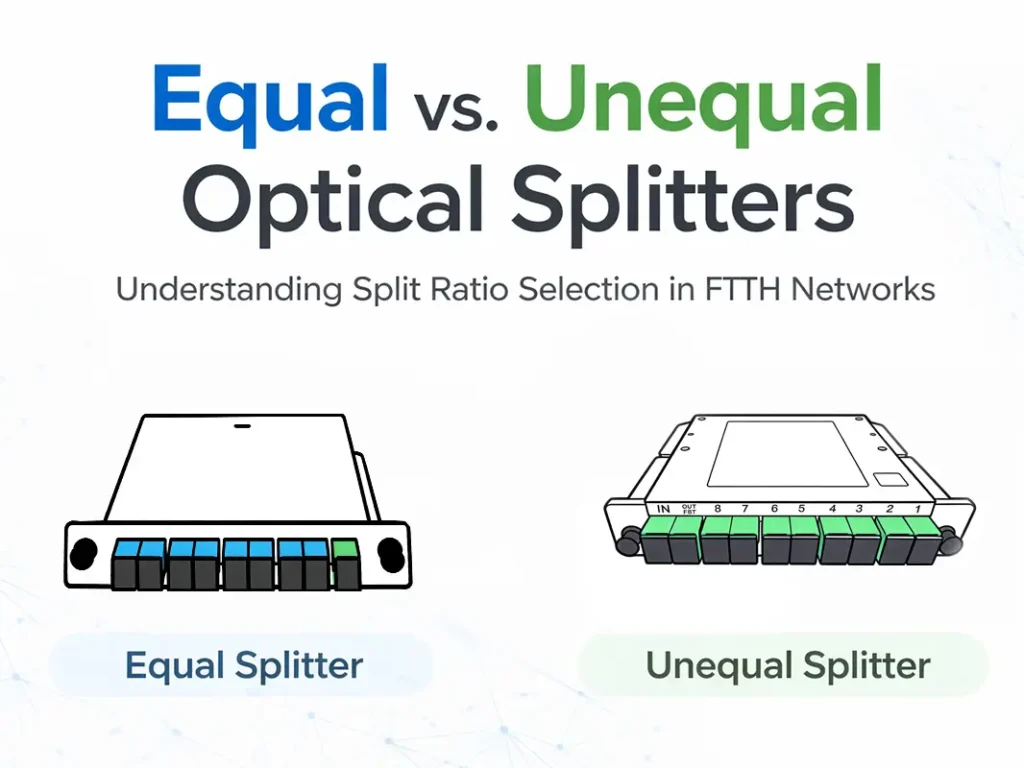
- Equal optical splitters distribute optical power uniformly and are best suited for dense FTTH deployments with similar transmission distances.
- Unequal optical splitters enable flexible power allocation and are commonly used in cascaded or bus-style network topologies, especially in rural and low-density areas.
- Split ratio selection directly affects optical power budget, ONU receive levels, and long-term network reliability.
- PLC technology is typically used for equal splitters due to its stability and uniformity, while FBT technology is more common for unequal splitter designs.
- xThere is no universal splitter solution—effective FTTH design requires balancing optical performance, scalability, and maintenance complexity.
Introduction
Optical splitters are a fundamental component in Fiber-to-the-Home (FTTH) and Passive Optical Network (PON) deployments. By allowing multiple subscribers to share a single feeder fiber, splitters significantly reduce infrastructure costs and simplify access network architecture.
However, splitter selection is not only about how many outputs are required. The way optical power is distributed—whether evenly or unevenly—has a direct impact on signal attenuation, ONU receive power, network scalability, and long-term maintenance. In real-world FTTH design, this often leads to a practical comparison between equal (symmetrical) and unequal (asymmetrical or unbalanced) optical splitters.
Understanding how these two splitter types behave in different scenarios is essential for building reliable and efficient optical access networks.
TABLE OF CONTENTS
Equal (Symmetrical) Optical Splitters in FTTH Networks

An equal optical splitter distributes the input optical signal evenly across all output ports. Each subscriber receives approximately the same optical power, aside from small variations caused by manufacturing tolerances and connector losses.
Typical equal splitter ratios include:
- 1×4
- 1×8
- 1×16
- 1×32
From a theoretical perspective, a 1×8 splitter introduces around 10.5 dB of splitting loss per output, excluding additional losses from splices or connectors.
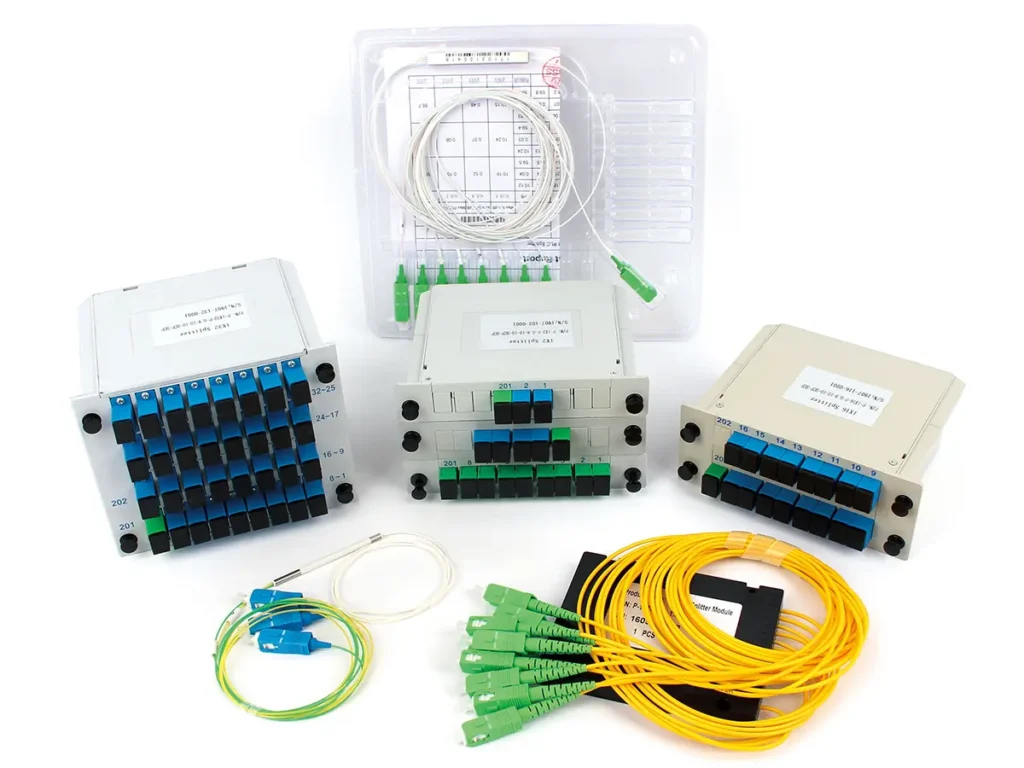
In most modern FTTH deployments, equal splitters are manufactured using PLC (Planar Lightwave Circuit) technology. PLC splitters offer excellent channel uniformity, high stability over temperature, and consistent optical performance, making them well suited for large-scale and standardized network architectures.
Because every output port experiences similar attenuation, equal splitters are easy to model during the network planning phase. This simplicity is one of the main reasons they are widely used in urban FTTH networks, apartment buildings, and office complexes where subscribers are densely distributed and fiber distances are relatively similar.
That said, equal splitting can become a limitation when deployment conditions are less uniform. In short-distance scenarios with small split ratios, ONU receivers may experience relatively strong input signals. On the other hand, when high split ratios are combined with long fiber runs, total attenuation can quickly approach the limits of the optical power budget.
Unequal (Asymmetrical) Optical Splitters and Flexible Power Distribution

Unlike equal splitters, unequal optical splitters distribute optical power unevenly between output ports. Common nominal split ratios include:
- 90/10
- 80/20
- 70/30
where most of the optical power is directed toward a designated “through” or cascade port, while a smaller portion is allocated to local access.
From a theoretical standpoint, a 90/10 splitter introduces only about 0.5 dB of loss on the 90% pass-through port, while the 10% tap port experiences roughly 10 dB of attenuation. These values make unequal splitters particularly useful when optical power needs to be preserved for downstream distribution.
Unequal splitters are most commonly produced using FBT (Fused Biconical Taper) technology. Compared to PLC, FBT manufacturing allows more flexible control of split ratios by adjusting the fiber fusion and tapering process. This makes FBT especially suitable for asymmetrical designs.
In FTTH networks, unequal splitters are a key enabler of cascaded and bus-style (or “snake”) topologies. In rural or suburban deployments where users are spread along roads or across large geographic areas, a single feeder fiber can serve multiple access points sequentially. By tapping a small portion of the signal at each location and allowing the majority of the power to continue downstream, service providers can significantly reduce the number of feeder fibers required.
Split Ratio, Power Budget, and ONU Receive Levels
Regardless of splitter type, all FTTH designs must operate within a defined optical power budget. Each ONU has a specified receive power range, and maintaining signals within this window is critical for stable operation.
If excessive splitting or long fiber distances push attenuation too high, the ONU may experience increased bit error rates or intermittent service loss. Conversely, insufficient attenuation—often seen in short-distance networks with low split ratios—can result in receiver saturation, which affects signal quality and may impact long-term reliability.
Unequal splitters provide network designers with additional flexibility to balance these constraints. By carefully selecting split ratios and cascade points, it is possible to maintain acceptable ONU input power levels across subscribers located at varying distances.
Maintenance and Operational Considerations
While unequal splitters offer clear advantages in fiber efficiency and network expansion, they also introduce additional operational complexity.
In cascaded networks, each splitter tap has a different loss value. This means that OTDR traces become more complex, and fault localization requires a clearer understanding of the network topology and expected attenuation at each point. Compared to equal-split architectures, troubleshooting and maintenance can be more time-consuming, particularly for technicians unfamiliar with the original design.
As a result, the choice between equal and unequal splitters is not only a matter of optical performance, but also of long-term operational strategy.
Equal vs Unequal Optical Splitters: Practical Comparison
| Aspect | Equal Splitter | Unequal Splitter |
|---|---|---|
|
Power distribution |
Uniform |
Asymmetrical |
|
Typical technology |
PLC |
FBT |
|
Network topology |
Centralized |
Cascaded / bus |
|
Planning complexity |
Lower |
Higher |
|
Maintenance difficulty |
Lower |
Moderate to high |
Conclusion
Equal and unequal optical splitters each play an important role in FTTH network design. Equal splitters provide simplicity, uniformity, and ease of planning in dense and centralized deployments. Unequal splitters, on the other hand, enable flexible power distribution, efficient fiber usage, and scalable cascaded architectures—especially in rural and low-density environments.
Rather than offering a universal solution, splitter selection should be guided by transmission distance, user distribution, optical power budget, and long-term maintenance considerations. A well-designed FTTH network is not defined by the splitter type alone, but by how effectively split ratios are matched to real-world deployment conditions.
Engineering Note:
In real-world FTTH projects, splitter selection is often influenced not only by theoretical power budgets, but also by installation conditions and future maintenance requirements.
While unequal splitters can significantly reduce feeder fiber usage and support flexible network expansion, they also introduce non-uniform loss points along the distribution path. This makes OTDR analysis more complex and requires accurate documentation of splitter locations and ratios.
For long-term network stability, many operators combine unequal splitters in the feeder or distribution segments with equal splitters at the final access level, achieving a balance between fiber efficiency and operational simplicity.
For large-scale FTTH deployments, splitter selection should always be evaluated together with overall ODN design and deployment strategy.
Happy cabling! 🚀


 English
  French
  German
  Spanish
  Arabic
  Turkish
  Japanese
  Russian