

Introduction
As fiber deployment accelerates across FTTH and FTTx networks, fast connectors have become a practical alternative to fusion splicing for on-site fiber termination. By reducing installation time and minimizing reliance on expensive splicing equipment, fast connectors help network operators scale access networks more efficiently.
However, not all fast connectors are built the same. In real-world deployments, two structural designs dominate the market: embedded and non-embedded fast connectors. While both serve the same basic function, their internal architectures lead to significant differences in installation tolerance, performance stability, failure rate, and long-term maintenance cost.
Understanding these differences is essential for selecting the right connector—not just for installation, but for the entire lifecycle of the network.
TABLE OF CONTENTS
What Is an Embedded Fast Connector?
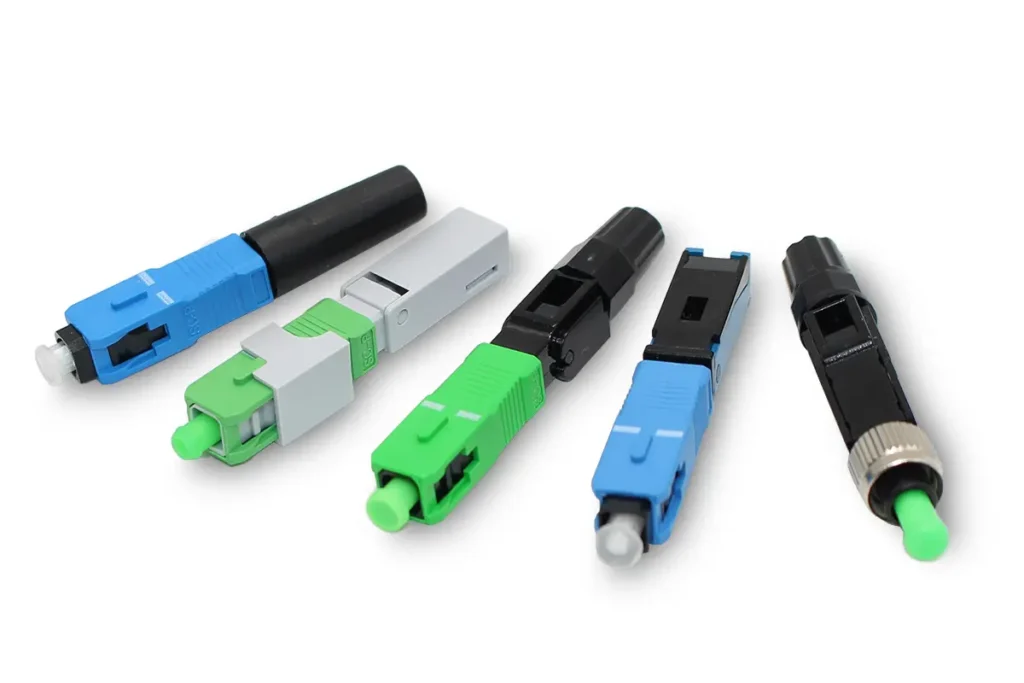
An embedded fast connector, also commonly referred to as a pre-polished fast connector, contains a factory-installed fiber stub permanently fixed inside the connector body. Fiber alignment is achieved through an internal V-groove structure combined with index-matching gel.
In this design, the optical connection occurs at a mechanical joint inside the connector rather than at the tip of the ceramic ferrule. The ferrule end-face itself is factory polished and inspected under controlled conditions, and it remains untouched during field installation.
During on-site termination, the installer only needs to prepare and cleave the field fiber, insert it into the connector, and secure it in place. Because the most critical optical interface is completed in the factory, embedded fast connectors offer high consistency and a generous margin for installation error.
What Is a Non-Embedded Fast Connector?
A non-embedded fast connector, sometimes described as a through-type design, does not contain a fixed internal fiber stub. Instead, the field fiber must pass through the entire connector body and terminate directly at the ceramic ferrule.
In this case, the cleaved fiber tip itself becomes the final optical end-face. This approach simplifies the internal structure and can reduce material cost, but it places much greater responsibility on the installer. Cleave angle, fiber length, surface quality, and cleanliness all directly affect optical performance.
As a result, non-embedded fast connectors are far more sensitive to field conditions and installation technique.
Structural Differences That Matter in the Field
Although embedded and non-embedded fast connectors may look similar from the outside, their internal structures behave very differently during real installations.
Embedded designs rely on factory-controlled alignment using a V-groove and matching gel. This configuration stabilizes fiber positioning and compensates for microscopic gaps or minor imperfections in the field cleave. Because the ferrule end-face is pre-polished, end-face quality remains consistent from one installation to another.
Non-embedded designs, by contrast, rely on direct physical contact between the field fiber and the ferrule. Any deviation in cleave angle, length accuracy, or fiber condition can compromise insertion loss and return loss. Even small errors can result in unstable optical performance or connector failure.
These structural differences explain why embedded fast connectors are generally more forgiving and predictable in large-scale deployments.
Installation Experience: Speed vs. Margin of Error
From an installer’s perspective, the key distinction between embedded and non-embedded fast connectors is not just installation speed, but margin of error.
Embedded fast connectors typically deliver a higher first-pass success rate. Because the optical end-face is factory prepared, installers only need to achieve a reasonably flat cleave. This makes embedded designs well suited for high-volume projects where installer experience may vary.
Non-embedded fast connectors require a much higher level of precision. A slightly damaged fiber tip or imperfect cleave often means the entire connector must be discarded. While skilled technicians can achieve acceptable results, the risk of rework increases significantly in less controlled environments.
Failure Rate and Lifecycle Cost Considerations
Although embedded fast connectors usually carry a slightly higher unit price, their advantages become more apparent when evaluated from a full lifecycle cost perspective.
First-pass success rate is a major factor. Embedded connectors consistently achieve higher success rates due to their factory-polished ferrules. In non-embedded connectors, any minor cleaving defect can lead to immediate failure and connector waste.
Return loss stability further separates the two designs. Embedded connectors use index-matching gel to reduce back reflection and compensate for minor imperfections at the mechanical joint. Non-embedded connectors rely on direct physical contact, making them extremely sensitive to cleave angle deviations and fiber-end damage.
Over large FTTH deployments, higher failure rates translate into increased labor costs, more site revisits, and longer troubleshooting cycles. In many cases, the apparent material cost savings of non-embedded connectors are offset—or even exceeded—by higher maintenance and rework expenses.
Equipment Dependency and Installation Conditions
Tool requirements and installation environments also differ significantly between the two designs.
Embedded fast connectors are designed with greater tolerance for field conditions. They typically require only standard fiber stripping tools, a basic cleaver, and cleaning supplies. Because the optical interface is largely protected inside the connector, embedded designs perform reliably even in dusty or outdoor environments.
Non-embedded fast connectors demand extremely high cleaving precision. Installers often need high-performance cleavers, length-control tools, and a clean, controlled workspace to achieve stable results. In challenging field conditions, maintaining this level of precision can be difficult.
Market Trends and Industry Preference
In today’s market, most commercially available fast connectors are embedded designs by default. While non-embedded connectors once held a niche position due to cost or structural simplicity, industry preferences have shifted as FTTH deployments have scaled.
Network operators have increasingly recognized that the higher failure rates and maintenance burden associated with non-embedded designs outweigh their initial cost advantages. As a result, pre-polished embedded fast connectors are now commonly specified in access network tenders and deployment standards.
Choosing a fast connector solely to save a small amount on unit price can ultimately lead to significantly higher labor and operational costs.
Practical Selection Guidelines
Choose embedded fast connectors if:
- You are deploying large-scale FTTH networks
- Installer skill levels vary across teams
- Installation takes place in outdoor or dusty environments
- Long-term reliability and consistency are critical
Choose non-embedded fast connectors if:
- You are a highly experienced technician with advanced tools
- The application is temporary or non-critical
- Installation is performed in a clean indoor environment
- Material cost control outweighs installation risk
Final Thoughts
Fast connectors continue to play an important role in modern fiber access networks, but structural design matters. Embedded and non-embedded fast connectors are not interchangeable solutions; they represent different approaches to balancing cost, installation tolerance, and long-term performance.
In large-scale FTTH deployments, embedded fast connectors have become the preferred choice due to their higher success rates, stable optical performance, and lower lifecycle cost. Non-embedded designs remain relevant in limited, controlled scenarios where skilled installers and precise tools are available.
Understanding these distinctions allows network planners and installers to make informed decisions based on real-world deployment conditions rather than specifications alone.



 English
  French
  German
  Spanish
  Arabic
  Turkish
  Japanese
  Russian