

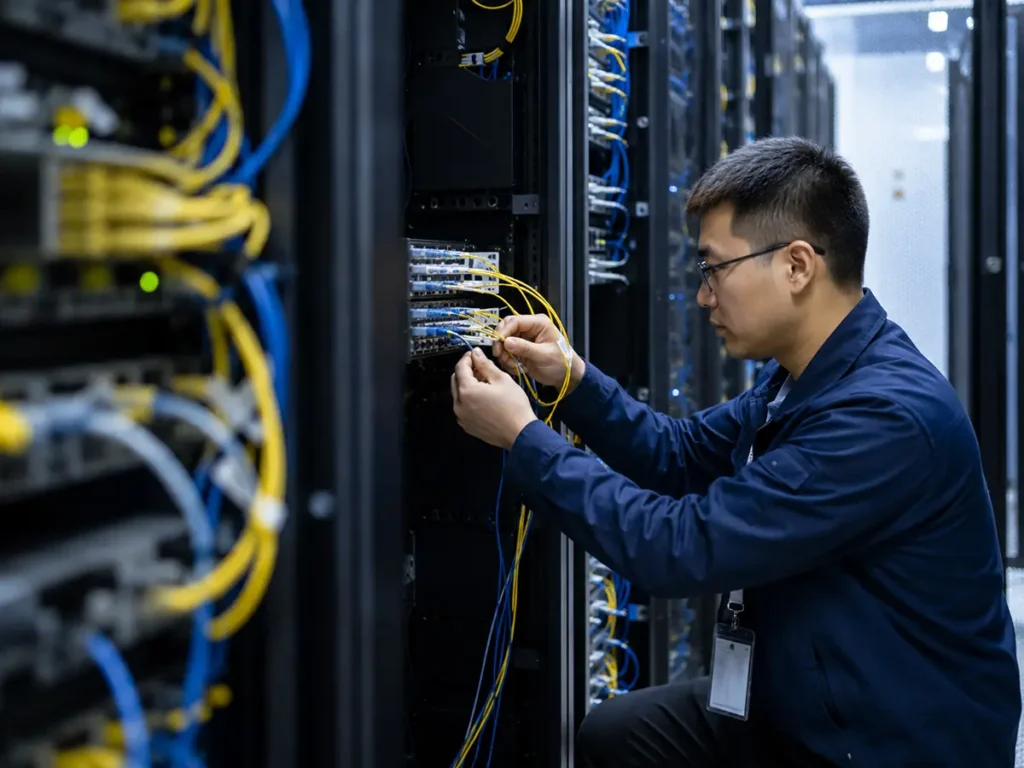
For much of the past three years, the global AI narrative has focused on GPUs. NVIDIA’s rise, the explosion of generative AI, and the unprecedented wave of hyperscale data center construction have pushed semiconductors to the center of the technology industry. But beneath the surface of this compute race, another infrastructure transformation is accelerating far more quietly.
The AI era is rapidly becoming an optical infrastructure era.
As hyperscale AI clusters expand from thousands of GPUs to tens of thousands — and eventually toward million-GPU architectures — the challenge is no longer only about compute performance. Increasingly, the bottleneck lies in how fast data can move between those systems.
That shift is fundamentally changing the role of fiber optics and optical interconnects inside modern data centers. Optical modules, fiber cabling, silicon photonics, optical switching systems, and co-packaged optics are no longer secondary technologies hidden behind servers. They are becoming foundational layers of AI infrastructure itself.
In many ways, the global optical industry is entering its largest expansion cycle since the early cloud computing era — this time driven not by telecom traffic, but by artificial intelligence at hyperscale scale.
AI Infrastructure Spending Has Entered a New Phase
Hyperscaler Capital Expenditure Is Accelerating Globally

The scale of current AI infrastructure spending is difficult to overstate.
In Q1 2026 alone, Amazon, Microsoft, Google, and Meta collectively spent approximately $131.6 billion in capital expenditures, representing year-over-year growth exceeding 70%. Combined full-year capital expenditure expectations for 2026 are now projected to surpass $710 billion globally — nearly double 2025 levels and several times larger than spending seen only two years ago.
More importantly, hyperscalers are signaling that this growth cycle is far from temporary.
Google has publicly indicated that infrastructure investment will continue rising into 2027. Microsoft has repeatedly acknowledged that AI demand remains constrained by infrastructure availability rather than customer adoption. Amazon has extended long-term procurement and infrastructure commitments through at least 2028. Meta continues expanding AI-focused data center construction across North America and Europe.
This is no longer a short-term procurement cycle. It is increasingly viewed as a multi-year infrastructure buildout comparable to previous eras of cloud expansion, broadband deployment, and hyperscale internet growth.
AI Infrastructure Is Expanding Beyond GPUs
While GPUs remain the most visible layer of the AI boom, the supporting infrastructure ecosystem surrounding those chips is growing just as aggressively.
Every next-generation AI cluster requires:
- high-density optical transceivers,
- large-scale fiber deployments,
- low-latency switching fabrics,
- optical backplanes,
- advanced packaging systems,
- and increasingly sophisticated photonic architectures.
As cluster sizes continue scaling upward, networking infrastructure is becoming one of the defining constraints of Al performance.
This shift became increasingly visible during both NVIDIA GTC 2026 and OFC 2026, wherenetworking scalability emerged as one of the central themes across the industry.
The conversation is no longer only about compute density. It is about interconnect density.
The Network Has Become the New Bottleneck
Copper Is Approaching Physical Limits
For decades, copper interconnects formed the foundation of server and networking infrastructure.
Copper remains cost-effective and highly efficient for shorter-reach applications. But AI systems are beginning to push electrical interconnect technologies toward practical physical limitations.
As data center bandwidth requirements accelerate toward 800G and 1.6T architectures, traditional electrical signaling faces mounting challenges:
- signal degradation,
- thermal density,
- power consumption,
- electromagnetic interference,
- and increasingly severe reach limitations.
These challenges become far more pronounced inside modern AI clusters, where increasing compute and interconnect density raise network power demand and facility-level heat loads at the same time. Liquid-cooled and chilled-water systems may use a brazed plate heat exchanger to transfer heat between separate cooling circuits without mixing the fluids. Thermal management does not remove copper’s signal-loss, power, or reach limitations, but it is part of the broader infrastructure required to operate increasingly dense AI systems.
Unlike traditional cloud workloads, AI training systems generate enormous east-west traffic between GPUs, memory pools, networking fabrics, and storage systems. Large language model training requires continuous synchronization across massive GPU clusters, dramatically increasing networking intensity.
At sufficient scale, networking performance increasingly determines overall AI efficiency.

Fiber Optics Replacing Copper
One of the clearest industry signals emerged on May 8, 2026, when NVIDIA CEO Jensen Huang publicly stated that copper-based technologies were approaching physical limitations for future AI infrastructure.
According to Huang, longer-reach and ultra-high-bandwidth AI environments increasingly require optical interconnect technologies rather than traditional electrical architectures.
The statement was significant because it reflected a broader transition already occurring across hyperscale infrastructure planning.
The industry has increasingly summarized this shift with a simple phrase: optics replacing copper.
While copper will remain important for certain ultra-short-reach environments, the long-term direction of AI networking is becoming increasingly optical. Fiber-based interconnects provide several structural advantages:
- higher bandwidth density,
- lower signal loss over distance,
- reduced power consumption at scale,
- lower latency characteristics,
- and significantly better scalability for future AI fabrics.
As AI clusters continue growing, optical infrastructure is no longer optional. It is becoming foundational.
AI Clusters Are Driving an Optical Connectivity Explosion
The scale of optical deployment inside next-generation AI infrastructure is expanding rapidly. A single hyperscale AI data center can require:
- millions of meters of fiber,
- tens of thousands of optical modules,
- massive quantities of MPO/MTP connectivity,
- and increasingly dense optical switching architectures.
Modern AI infrastructure increasingly resembles an optical system as much as a computing system.
Fiber is no longer limited to long-distance campus interconnects. Optical connectivity is moving deeper into the data center stack itself:
- rack-to-rack,
- board-to-board,
- and eventually package-level optical integration.
This transition is accelerating industry investment into:
- silicon photonics,
- co-packaged optics (CPO),
- optical circuit switching (OCS),
- near-packaged optics (NPO),
- and next-generation optical fabric architectures.
The AI buildout is therefore not simply increasing demand for servers. It is reshaping the entire global optical ecosystem behind those systems.
NVIDIA Is Quietly Rebuilding the Optical Supply Chain

Strategic Investments Are Expanding Beyond GPUs
Perhaps the clearest sign of this transition is NVIDIA’s increasingly aggressive involvement across the optical industry itself.
Historically, semiconductor companies focused primarily on chip design while relying on external supply chains for networking and connectivity infrastructure. But the scale of AI demand is changing that relationship.
In 2026, NVIDIA made several major strategic moves across the optical ecosystem:
- approximately $500 million tied to long-term collaboration and supply agreements involving Corning,
- roughly $2 billion strategic commitments involving Lumentum,
- another $2 billion linked to Coherent,
- and multi-billion-dollar engagement surrounding Marvell’s DSP and networking ecosystem.
While the exact structures vary, the broader strategic direction is becoming increasingly clear. NVIDIA is no longer investing only in AI chips. It is actively securing future optical capacity.
Corning’s Expansion Reflects the New AI Infrastructure Reality
One of the most important developments came from Corning. In April 2026, Corning announced a multiyear agreement with Meta supporting optical cable manufacturing expansion in North Carolina. At the same time, Corning revealed broader plans to significantly increase U.S. optical connectivity production capacity.
According to the Corning, hyperscale AI infrastructure is becoming one of the largest long-term demand drivers for optical fiber and connectivity systems.
Corning stated that:
- optical connectivity manufacturing capacity would increase by up to 10x,
- while U.S. fiber production capacity would expand by more than 50%.
The expansion reflects a growing realization across the industry, future AI infrastructure requires enormous amounts of optical connectivity.
This demand extends across multiple deployment layers:
- scale-out GPU fabrics,
- scale-up architectures,
- data center interconnect (DCI),
- optical backplanes,
- and future CPO-based systems.
The broader implication is becoming increasingly difficult to ignore. AI infrastructure growth is no longer constrained solely by semiconductor manufacturing capacity. It is increasingly constrained by how fast the global optical industry can expand alongside it.
Long-Term Supply Agreements Are Spreading Across the Industry
- optical lasers,
- DSP chips,
- CW lasers,
- fiber arrays,
- FAUs,
- precision optics,
- and high-speed transceiver manufacturing.
The Global Fiber and Photonics Expansion Cycle
The current expansion cycle is no longer limited to GPUs, switches, or optical modules alone. As AI infrastructure spending accelerates globally, pressure is spreading across the entire optical supply chain — from upstream materials and photonic components to testing equipment, automation systems, and precision manufacturing capacity.
Throughout 2026, one phrase has repeatedly surfaced across the optical industry: capacity shortages.
Across North America, China, Japan, and Southeast Asia, suppliers increasingly report that orders are arriving faster than factories can expand. In many cases, optical manufacturers describe 2026 as a year where annual order volumes were effectively reached within a single quarter. Procurement teams are traveling globally to secure production slots, while customers increasingly prioritize guaranteed delivery capacity over short-term pricing.
This reflects a fundamental imbalance: AI infrastructure demand is currently growing faster than portions of the optical industry can scale.
Optical Connectivity Manufacturing
AI infrastructure expansion is driving rapid demand for MPO connectivity, fiber assemblies, optical adapters, and high-density cabling systems.
YingFeng Communication supports global telecom and data center projects with large-scale optical connectivity manufacturing and OEM/ODM production capabilities.
The Race for Optical Components and Materials
Faraday Rotators and Optical Isolation Components Are Under Pressure
One of the earliest supply constraints emerged around Faraday rotators and optical isolation materials. As 800G and 1.6T optical modules continue ramping into hyperscale deployments, demand for higher-performance laser protection systems has increased sharply. Optical isolators play a critical role in protecting lasers from reflected light inside high-speed optical systems, making Faraday materials increasingly important across advanced transceiver architectures.
Historically, portions of this market were dominated by suppliers such as Coherent and Japan-based Granopt. But throughout 2026, tightening supply conditions and geopolitical pressures surrounding rare-earth materials have contributed to growing market constraints. At the same time, several Chinese suppliers have rapidly expanded production capacity to fill parts of the gap, particularly in the broader AI optical module supply chain.
This reflects a broader industry trend: AI infrastructure is reshaping not only demand volumes, but also the geographic structure of optical manufacturing itself.
CW Lasers, EML Chips, and Silicon Photonics Are Scaling Rapidly
Demand growth is also accelerating across:
- CW lasers,
- EML chips,
- silicon photonics components,
- DSP systems,
- and advanced optical engines.
The rapid deployment of 800G and 1.6T optical modules is driving a new wave of photonic integration, particularly around silicon photonics architectures and high-density optical interconnect systems.
Several suppliers across the industry have already disclosed significant production expansion plans. Lumentum has indicated that portions of its high-end optical component capacity are effectively reserved years into the future. Coherent has similarly acknowledged that large segments of its AI-related photonics capacity are already heavily committed through 2027 and beyond.
Meanwhile, Japanese optical manufacturers including Sumitomo Electric, Fujikura, and Furukawa Electric are also expanding production across MT ferrules, optical fiber systems, and high-density connectivity infrastructure.
Across China, multiple optical suppliers are simultaneously accelerating investment into:
- CW lasers,
- optical chips,
- fiber arrays,
- FAUs,
- optical packaging,
- and automated assembly systems.
The result is a rare moment where nearly every major region in the global optical ecosystem is expanding simultaneously.
Automation Equipment Has Become a Hidden Bottleneck
The expansion cycle is also exposing constraints in less visible parts of the manufacturing chain. As optical module production scales globally, demand has surged for:
- active alignment systems,
- automated coupling equipment,
- precision motion platforms,
- linear motors,
- testing instruments,
- and optical measurement systems.
Some equipment vendors report that individual customer orders now reach hundreds or even thousands of machines — volumes that previously represented multiple years of shipments. Lead times for certain industrial components have stretched from weeks to several months.
This highlights an important reality of the AI infrastructure boom: the scaling challenge extends far beyond semiconductors themselves.
Building the future optical industry also requires scaling the factories, automation systems, and precision manufacturing infrastructure behind it.
AI Is Reshaping the Global Fiber Industry
For much of the past decade, the optical fiber industry was often viewed as mature infrastructure. However, AI is changing that perception. As hyperscale operators build larger AI campuses, fiber density inside and between data centers is increasing dramatically. Massive GPU clusters require enormous amounts of:
- trunk fiber,
- high-density MPO connectivity,
- low-loss optical routing,
- and large-scale data center interconnect infrastructure.
This is reviving long-term investment across the broader fiber ecosystem.
Corning’s 2026 expansion plans in the United States became one of the clearest examples of this shift. The company’s decision to expand U.S. fiber manufacturing by more than 50% and increase optical connectivity production up to 10x reflects growing expectations that AI infrastructure demand will remain elevated for years.
At the same time, fiber deployment strategies are increasingly being viewed through geopolitical and supply chain security lenses.
The United States is pushing to localize portions of strategic optical infrastructure manufacturing. Japan continues strengthening its position in precision optical components and connector systems. China remains one of the world’s largest manufacturing centers for fiber connectivity and optical assembly scale.
Rather than replacing each other, these regions are becoming increasingly interconnected within the global AI optical supply chain.
The Industry Is Entering a New Optical Architecture Era
Pluggables, CPO, OCS, and NPO Are Evolving Simultaneously

While production expansion dominates much of the current discussion, the industry is simultaneously undergoing a major architectural transition.
At OFC 2026, one of the clearest themes was that future AI networking infrastructure will likely involve multiple optical architectures evolving in parallel rather than a single dominant solution.
Traditional pluggable optical modules continue improving rapidly, particularly as single-wavelength 400G technologies mature. These systems still offer flexibility, ecosystem maturity, and deployment simplicity for many hyperscale environments.
At the same time, long-term industry attention is increasingly shifting toward:
- co-packaged optics (CPO),
- near-packaged optics (NPO),
- external laser architectures,
- and optical circuit switching (OCS).
NVIDIA and Broadcom continue aggressively pushing CPO development, particularly for future ultra-large AI clusters where power efficiency and bandwidth density become increasingly critical.
Industry expectations now suggest that large-scale CPO deployments could begin accelerating between late 2027 and 2028.
Optical Circuit Switching Is Gaining Momentum
Another major shift involves optical circuit switching.
Historically, OCS was often viewed as a niche technology explored primarily by a limited number of hyperscale operators. But as AI clusters scale toward tens of thousands — and eventually hundreds of thousands — of GPUs, traditional electrical switching architectures are facing mounting power and latency challenges.
OCS allows optical paths to be reconfigured directly at the photonic layer without repeated optical-to-electrical conversion.
This creates several important advantages:
- lower latency,
- reduced power consumption,
- improved bandwidth scalability,
- and better compatibility with future ultra-large AI fabrics.
Interest in OCS accelerated significantly throughout 2026. Lumentum disclosed growing OCS-related demand, while multiple optical vendors demonstrated OCS platforms during OFC 2026 as part of broader AI infrastructure strategies.
The emergence of OCS further reinforces a broader conclusion: future AI infrastructure is becoming increasingly optical at the architectural level itself.
Capital Is Flooding Into Optical Infrastructure
Global Investment Activity Is Accelerating
The AI optical boom is also reshaping global capital markets. Throughout 2026, optical infrastructure became one of the most active technology investment categories across:
- IPO markets,
- private funding rounds,
- strategic acquisitions,
- and infrastructure expansion financing.
Companies tied to optical modules, photonics, AI networking, and precision optical manufacturing are attracting significant investor attention globally. Several major optical companies are pursuing dual-market financing structures, secondary listings, or large-scale capacity expansion initiatives to fund future growth. At the same time, mergers and acquisitions across the industry continue accelerating.
Major Global Optical Industry Events in 2026
| Date | Company | Event | Strategic Focus |
|---|---|---|---|
| March 2026 | NVIDIA + Lumentum | Multi-billion-dollar strategic supply agreement | Optical lasers and photonics capacity |
| March 2026 | NVIDIA + Coherent | Long-term photonics collaboration | AI optical component supply |
| April 2026 | Corning + Meta | Multiyear optical infrastructure agreement | Fiber and connectivity expansion |
| May 2026 | NVIDIA + Marvell ecosystem | Expanded AI networking cooperation | DSP and AI interconnect scaling |
| 2026 | Sumitomo Electric | Major MT ferrule expansion | High-density AI connectivity |
| 2026 | Fujikura | Optical fiber and connector capacity growth | AI optical infrastructure |
| 2026 | Multiple Chinese optical vendors | Expanded CW laser and optical packaging investment | AI photonics manufacturing |
The broader pattern is becoming increasingly clear: capital is flowing toward the infrastructure layer behind AI rather than toward software alone.
Bubble or the Beginning of a New Infrastructure Epoch?
As investment levels continue rising, debates around overheating and potential bubbles are also becoming more common.
Skeptics point out that AI monetization remains uneven across many areas of the market. Some investors increasingly compare current infrastructure spending to previous technology bubbles, particularly the telecom expansion cycle of the late 1990s.
But many industry leaders argue that the current cycle differs in one critical way: the demand for infrastructure is already real and visible.
AI systems are already consuming enormous amounts of compute, networking bandwidth, electrical power, and optical connectivity at scales that continue growing quarter after quarter. Unlike purely speculative infrastructure cycles, hyperscalers today are actively deploying and utilizing these systems in production environments.
That does not eliminate the possibility of localized overcapacity or periods of market volatility.
However, the broader direction appears increasingly difficult to reverse. The global AI race is now directly tied to the expansion of optical infrastructure capacity.
And behind every major AI breakthrough, an increasingly vast optical layer is quietly being built:
- fiber,
- photonics,
- optical switching,
- silicon photonics,
- and high-density interconnect systems.
GPUs may power the AI revolution. But optics will determine how far — and how fast — it can scale.