
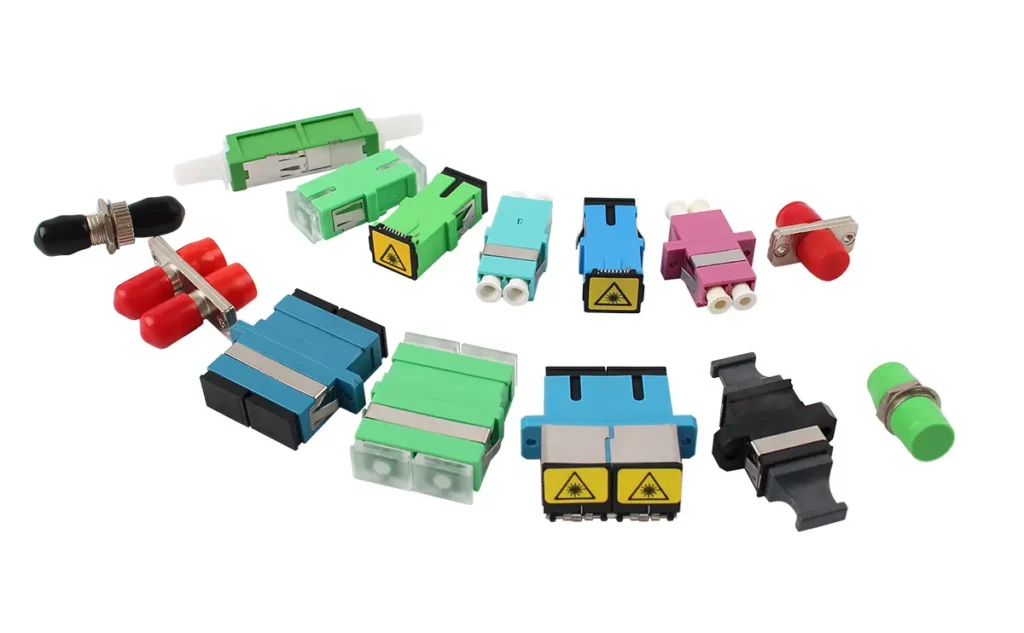
Fiber Optic Adapters: A Small Component That Connects the Entire Network
In fiber optic communication systems, adapters rarely get much attention. They do not transmit signals, amplify power, or process data. Yet in practice, they play a critical role in overall network performance. A fiber optic adapter is the interface that precisely aligns two connectors, allowing light to pass from one fiber end face to another with minimal loss.
In real-world deployments, many link issues are not caused by the fiber itself, but by poor alignment, contamination, or instability at the connection interface. This is why adapter design, tolerance, and suitability for a specific environment matter far more than their simple appearance suggests. Over time, certain adapter types have become widely adopted—not because they are perfect in every scenario, but because they work reliably across large-scale deployments.
Understanding which fiber optic adapters are most commonly used, and why, helps clarify how modern optical networks are actually built.
TABLE OF CONTENTS
Why Some Fiber Optic Adapters Became Mainstream
The market does not choose fiber optic adapters based on novelty or theoretical performance alone. Instead, mainstream adoption is driven by practical considerations. As networks grew in size and complexity, operators began to prioritize interfaces that were easy to deploy, easy to maintain, and widely supported by equipment vendors.
Several factors consistently influenced which adapters became dominant:
- Port density and space efficiency in racks and panels
- Installation tolerance and operational stability
- Long-term standardization across different systems
This is why a small number of adapter types now account for the majority of installations worldwide, while others remain limited to niche or legacy applications.
LC Fiber Optic Adapter: The Default Choice in Modern Networks
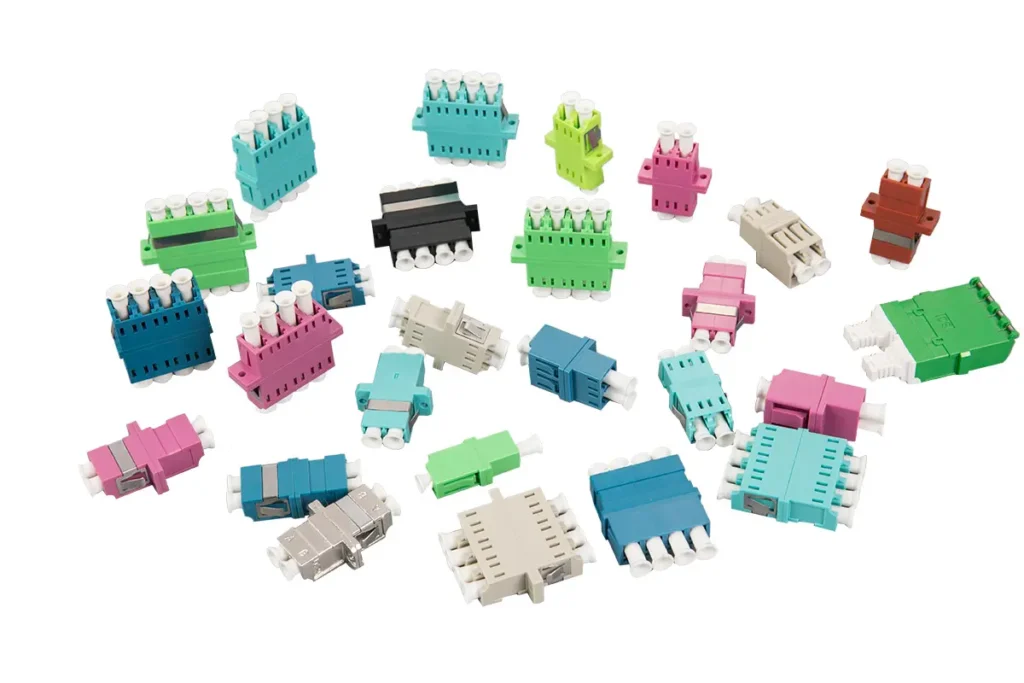
The LC fiber optic adapter is widely regarded as the default interface in today’s optical networks. Its dominance did not happen overnight, nor was it driven purely by cost. Instead, LC adapters gained widespread acceptance as network environments became increasingly dense.
With its 1.25 mm ferrule design, the LC adapter allows significantly higher port density compared to older connector types. This advantage became especially important in data centers, where rack space is limited and the number of connections continues to grow. As transceiver modules such as SFP, SFP+, and QSFP became standard, LC interfaces naturally followed.
In practice, LC adapters are most commonly found in:
- Data centers and server rooms
- High-density patch panels and ODFs
- Equipment interfaces using small-form-factor transceivers
At the same time, LC adapters are not universally ideal. Their compact size leaves less room for mechanical tolerance, making cleanliness and proper handling more important during installation. In environments where connections are frequently reworked by non-specialized technicians, this can become a consideration.
Even so, the balance between density, performance, and industry support ensures that LC adapters will remain the most widely used choice in modern optical networks for the foreseeable future.
SC Fiber Optic Adapter: Still Essential in Access and FTTH Networks
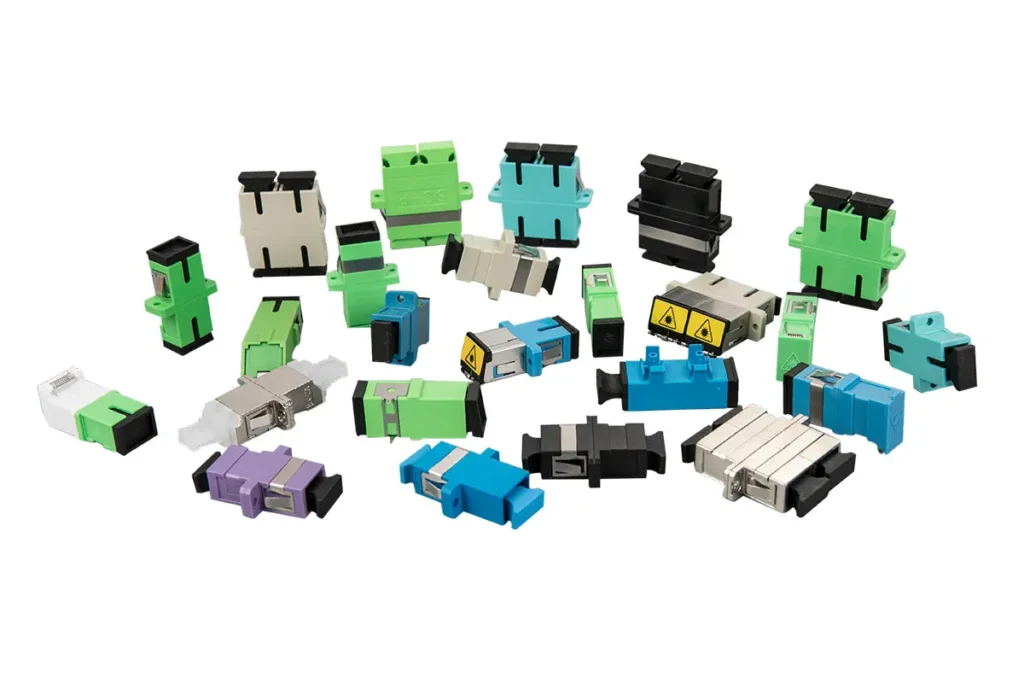
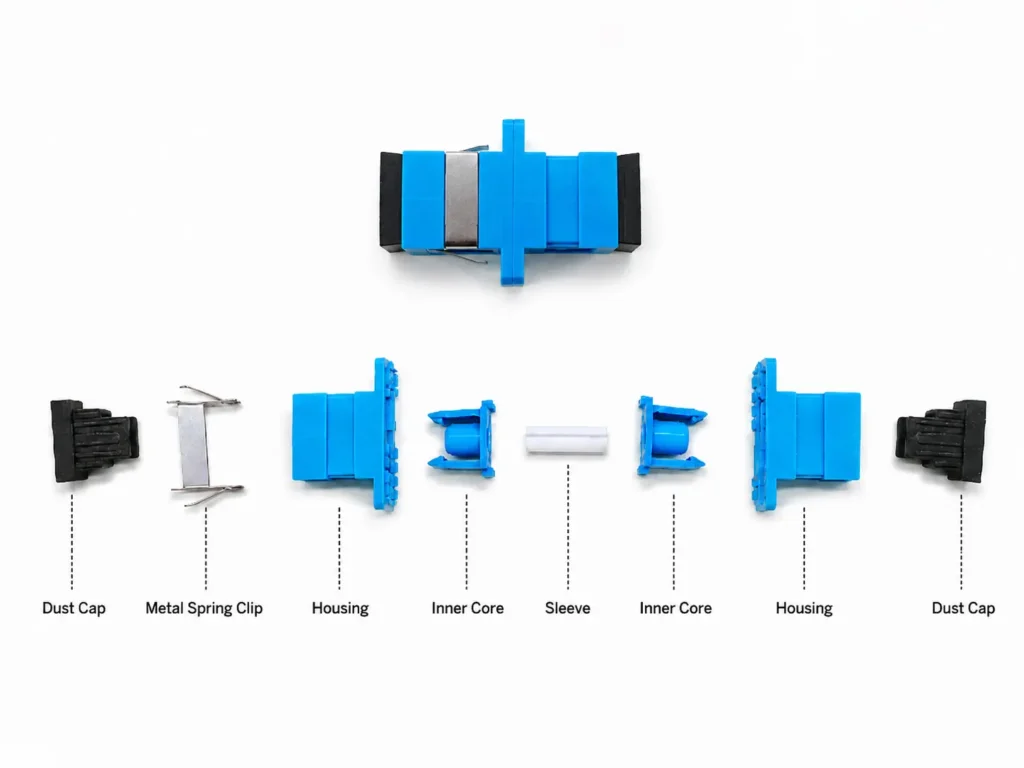
While LC dominates high-density environments, the SC fiber optic adapter continues to play a crucial role in access networks. Despite being physically larger, SC adapters are far from obsolete. Instead, they have become closely associated with reliability-focused deployments, particularly in FTTH and last-mile infrastructure.
The push-pull design of the SC interface provides a stable and forgiving connection. It is easy to install, easy to inspect, and tolerant of repeated handling. These characteristics are especially valuable in access networks, where large numbers of terminations are installed in the field rather than in controlled data center environments.
SC adapters are still commonly used in:
- FTTH distribution points
- Fiber termination boxes and wall outlets
- Central office and access-layer patch panels
In these scenarios, absolute port density is less important than consistency and long-term stability. For this reason, many operators continue to standardize on SC interfaces even as LC becomes dominant elsewhere. Rather than being replaced, SC adapters have simply found their most suitable role.
MPO Fiber Optic Adapter: Growth Driven by AI and High-Speed Transmission

MPO fiber optic adapters occupy a very different position in the market. They are not the most commonly deployed adapters overall, but they represent one of the fastest-growing segments. This growth is closely tied to changes in how data is transmitted at extremely high speeds.
As network bandwidth requirements moved beyond what serial transmission could efficiently support, parallel optics became necessary. MPO adapters, designed to align multiple fibers simultaneously, enable this shift. They are now closely associated with 400G, 800G, and emerging ultra-high-speed links.
Typical environments where MPO adapters are used include:
- Hyperscale data centers
- AI clusters and high-performance computing systems
- Spine-leaf network architectures
Outside these environments, MPO adapters are still rarely deployed. They require higher alignment precision, stricter polarity management, and more careful planning. As a result, their adoption is driven by system-level requirements rather than convenience or cost. MPO adapters are not replacing LC or SC; instead, they coexist as a specialized solution for bandwidth-intensive networks.
FC and ST Fiber Optic Adapters: Legacy Interfaces That Still Exist

FC and ST fiber optic adapters are often described as legacy interfaces, and in many ways this is accurate. Both feature metal housings and were widely used in earlier generations of optical networks.
FC adapters, with their threaded coupling mechanism, provide strong resistance to vibration and are still found in certain industrial or testing environments. ST adapters, using a bayonet-style connection, were once common in campus and enterprise networks.
Today, their continued presence is largely due to the long lifecycle of existing systems rather than new design choices. In most modern projects, these adapters are rarely specified unless compatibility with existing infrastructure is required. Their role in the market is stable but gradually diminishing.
Other Adapter Types and Hybrid Solutions
Beyond the mainstream and legacy interfaces, several other fiber optic adapter types exist for specific regions or applications. MU adapters, for example, offer a compact design similar to LC and are primarily used in parts of the Japanese market. DIN adapters appear in certain industrial and transportation systems, while E2000 adapters are known for their integrated shutter and enhanced safety features, particularly in European telecom networks. MTRJ adapters, once positioned as a compact duplex solution, have seen limited adoption in recent years.
Hybrid fiber optic adapters serve a different purpose altogether. Rather than representing a standard interface, they function as compatibility tools. By allowing two different connector types to be mated, hybrid adapters are commonly used during system upgrades or transitional phases. While they are useful in practice, they are rarely intended as permanent solutions in new network designs.
Market Trends and Practical Selection Considerations
Looking at the overall market, a clear pattern emerges. LC adapters will continue to dominate modern networks where density and scalability matter most. SC adapters remain deeply rooted in access and FTTH deployments, where reliability and ease of handling are critical. MPO adapters are expanding rapidly, driven by bandwidth demand rather than general adoption. Legacy and hybrid adapters persist mainly to support existing systems.
Choosing a fiber optic adapter is less about following trends and more about understanding where and how the network will actually be deployed. When the application environment is clearly defined, the “right” adapter choice often becomes obvious.