
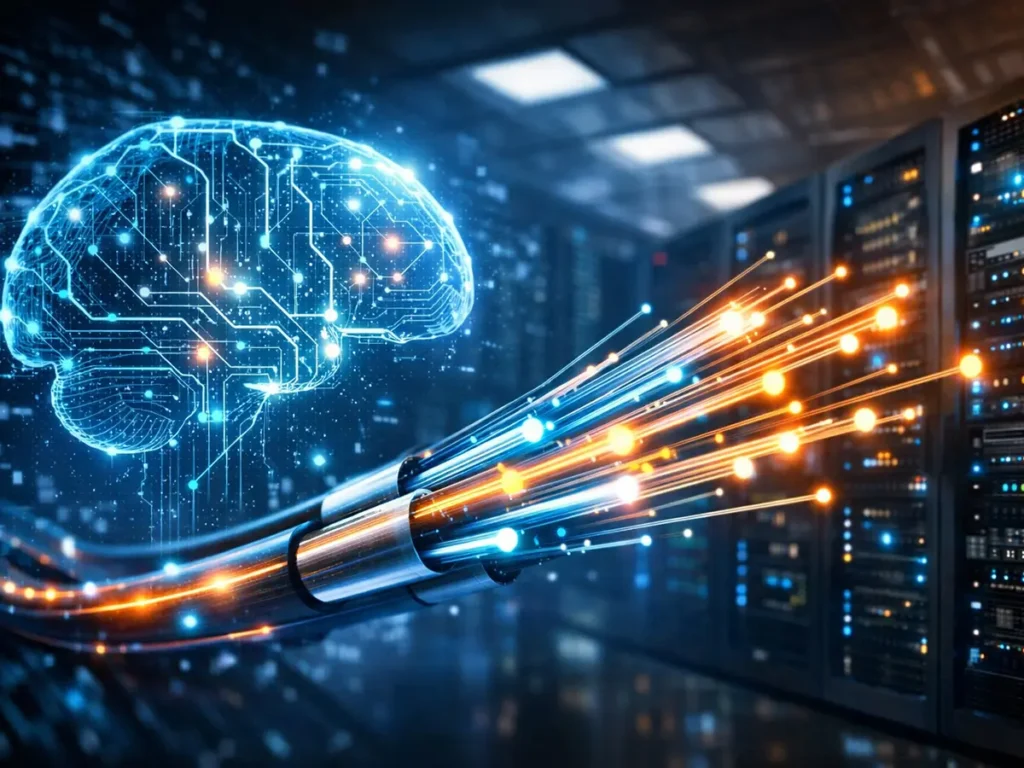
Artificial intelligence is often described through algorithms, models, and computing power. Discussions usually revolve around GPUs, parameters, and training efficiency. What is less visible—but increasingly decisive—is the physical infrastructure that allows all of this computation to function at scale. As AI systems grow larger and more distributed, data movement has become as critical as data processing itself, placing fiber optics at the center of modern AI infrastructure.
TABLE OF CONTENTS
AI Is No Longer Limited by Computation Alone
Modern AI workloads are fundamentally different from traditional computing tasks. Large language models and deep learning systems are trained across thousands of GPUs working in parallel. These models commonly contain hundreds of billions, and in some cases trillions, of parameters, requiring continuous data exchange between compute nodes.
During large-scale training, GPUs are not operating in isolation. Gradients, model updates, and intermediate results are constantly synchronized across the cluster. At this scale, even small inefficiencies in data transfer can translate into hours or days of lost training time. In practice, many AI clusters today are no longer constrained by GPU availability, but by how efficiently those GPUs can communicate with each other.
This shift has turned interconnection performance into a primary design constraint rather than a secondary networking consideration.
How Fiber Optics Moves Data: From Binary Code to Light
At the most basic level, all digital information—text, audio, images, and video—is encoded as binary data composed of 0s and 1s. AI systems operate on exactly the same principle, except at an unprecedented scale.
In fiber optic communication, this binary data initially exists as electrical signals. These signals are converted into optical signals by transceivers at the transmitting end. The data is then encoded onto light using controlled variations such as light pulses, intensity levels, or modulation patterns, which represent binary states.
Once inside the fiber, the signal travels as light. In a vacuum, light propagates at roughly 300,000 kilometers per second. Within optical fiber, the speed is reduced due to refraction, but it still reaches approximately two-thirds of that value—orders of magnitude faster than traditional electrical transmission over copper at comparable distances.
At the receiving end, the process is reversed. Optical signals are converted back into electrical form and decoded into usable data, ready for processing by servers or accelerators. This conversion happens continuously and at extremely high speeds, enabling uninterrupted data flow across large-scale systems.
Why Fiber Optics Fits the Reality of AI Infrastructure
The reason fiber optics aligns so well with AI workloads is not abstract—it is physical. Light-based transmission provides a combination of bandwidth, latency, and signal integrity that electrical interconnects struggle to maintain at scale.
As AI clusters expand, link speeds of 400G are rapidly giving way to 800G, with 1.6T optical modules already under active development. At the same time, technologies such as Co-Packaged Optics (CPO) are emerging to reduce electrical path lengths and energy loss by integrating optical interfaces closer to compute silicon.
These developments are not optional upgrades. They reflect a growing reality: optical interconnection is increasingly defining how far AI systems can scale before hitting physical and economic limits.
Fiber Optics Inside AI Data Centers
Within AI data centers, fiber optics forms the connective tissue of the entire architecture. High-speed optical links connect GPUs within servers and across racks, enabling parallel computation at scale. Switch-to-server connections rely heavily on optical interfaces to support spine-leaf network designs optimized for east-west traffic.
Storage systems also depend on optical links to ensure that massive training datasets can be accessed without becoming a bottleneck. Beyond a single facility, long-haul fiber enables geographically distributed data centers to operate as coordinated AI platforms, sharing workloads and data across regions.
Rather than serving a single role, fiber optics underpins nearly every critical data path in modern AI environments.
Fiber Optics as a Scaling Boundary
It is no longer accurate to say that AI would simply be “slower” without fiber optics. A more precise statement is that optical interconnection has become one of the physical boundaries governing how large AI systems can grow.
As clusters scale out, limitations in bandwidth density, power consumption, and signal integrity become unavoidable. Optical technologies are now central to pushing those boundaries outward, making them a core factor in the future of AI system design.
Frequently Asked Questions (FAQ)
Why is fiber optics more suitable for AI than copper-based connections?
AI workloads require extremely high bandwidth and low latency across large distances. Fiber optics can deliver higher data rates with better signal integrity and lower power loss than copper, especially at the scale required by AI clusters.
How fast do fiber optic links need to be for modern AI systems?
Current AI data centers are rapidly adopting 400G and 800G optical links, with 1.6T solutions already in development to support future model sizes and cluster densities.
What is Co-Packaged Optics (CPO), and why does it matter for AI?
CPO integrates optical interfaces closer to compute chips, reducing electrical signal paths, lowering power consumption, and improving overall system efficiency—critical benefits for large AI deployments.
Is fiber optics mainly used between data centers or inside them?
Both. Fiber optics is essential for internal data center connections (servers, switches, storage) and for long-distance links between geographically distributed AI facilities.
Will advances in AI reduce the need for fiber optics?
On the contrary. As AI models grow larger and more complex, their demand for fast, reliable data movement continues to increase, making fiber optics even more critical over time.
Conclusion
Artificial intelligence may be defined by software and algorithms, but it is sustained by physical infrastructure. As AI systems grow larger and more distributed, fiber optics has moved from a supporting role to a foundational one. In the age of artificial intelligence, fiber optics is not merely a networking technology—it is a key enabler that determines how far AI can scale, how efficiently it can operate, and how reliably it can be deployed.