

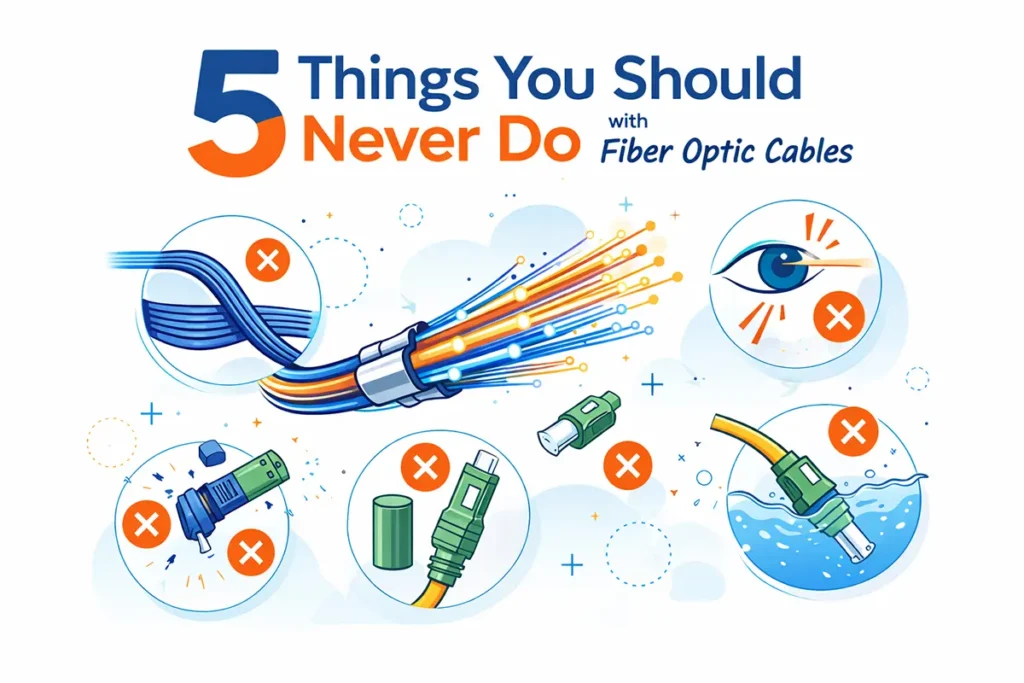
Fiber optics look quiet and harmless. No moving parts. No heat. No noise.
That’s exactly why people underestimate them.
In real networks—FTTH, enterprise cabling, data centers—most fiber failures don’t come from poor manufacturing. They come from small, everyday mistakes during installation or maintenance. Things that feel “probably fine” at the time, but quietly damage the link.
Here are five things you should never do when working with fiber optic cables—and why they matter more than most people realize.
TABLE OF CONTENTS
1. Over-bending or pulling fiber too hard
A fiber cable is not just “thin glass.”
Inside the fiber core, light travels forward through total internal reflection, bouncing at precise angles. You can think of it as a perfectly engineered highway: smooth lanes, predictable curves, no sudden turns.
When you bend fiber too tightly, that highway suddenly develops sharp corners. The light can’t follow the path anymore. It leaks out of the core. That’s micro-bending loss. Bend it further, and the fiber doesn’t just lose signal—it cracks.
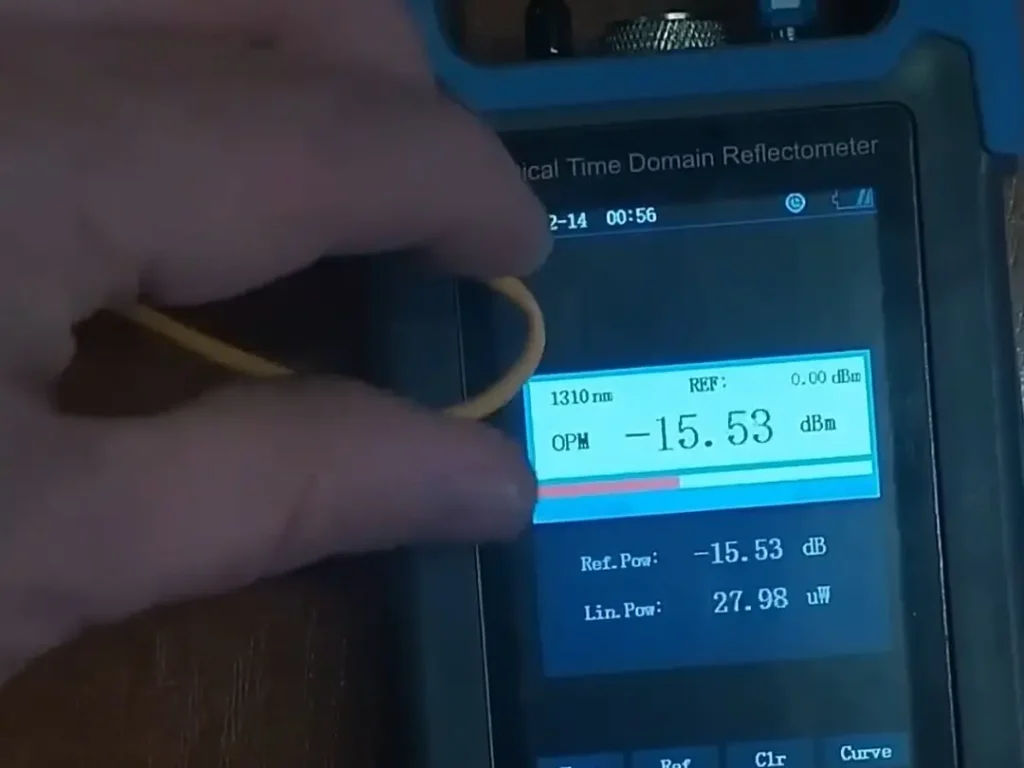
This is why bend radius rules exist.
In practice, installers often follow the 10D or 20D rule—meaning the minimum bend radius should be 10 or 20 times the cable’s outer diameter, depending on whether the cable is under tension or at rest.
Ignore this rule, and the damage may not show up immediately. The cable can look perfectly fine, but attenuation slowly increases, reflections rise, and the link becomes unstable under load.
If you want a deeper explanation, this guide breaks it down clearly:
What Is Fiber Optic Bend Radius? Complete Guide for Beginners
Minimum bend radius is not a recommendation.
It’s not even a “best practice.”
It’s physics.
2. Looking directly into a fiber end face
This sounds obvious, yet it still happens—especially during troubleshooting.
Most telecom and access networks operate at 1310nm and 1550nm wavelengths. These are infrared. You cannot see them. But they absolutely carry energy.
When someone looks directly into an active fiber, the light is focused straight onto the retina. There is no pain warning. No blinking reflex. The damage can be permanent before you even realize something is wrong.
Outdoor fiber makes this risk worse. To cover long distances and survive splitters, launch power from the central office can be much higher than people expect. Under the wrong conditions, that invisible light can even ignite flammable materials.
If you’re not 100% sure a fiber is dark, assume it’s live.
Your eyes are not test equipment.
3. Plugging and unplugging connectors casually
Fiber connectors are precision optical components, not USB plugs.
The moment you unplug a connector in open air, dust enters. Microscopic dust. The kind you can’t see, but light definitely can. Even a single particle on the end face can block part of the core, increasing insertion loss and back reflection.
This becomes especially dangerous in environments with many connections—ODFs, splitters, cabinets, patch panels. One casual unplug can turn into two problems: contamination and mis-patching.
Quick fixes feel efficient.
They often create problems that surface weeks later.
If a connector must be unplugged, clean it properly, inspect it, and cap it immediately.

4. Removing dust caps when the connector is not in use
Dust caps are not decorative.
Once the cap is off, the end face is exposed to airborne contamination. Most users don’t have inspection microscopes or proper cleaning tools. Even when they try to clean the connector, the result is often incomplete—or worse, scratched.
This doesn’t always cause a full outage. That’s what makes it dangerous. Instead, you get unstable links, intermittent packet loss, random speed drops—the kind of issues that waste hours of troubleshooting time.
If a connector is not connected, the dust cap stays on.
Simple rule. No shortcuts.
5. Letting fiber stay in water
This topic needs nuance, because not all fiber environments are the same.
For indoor, non-waterproof cables—such as standard yellow patch cords—water exposure is often destructive. These cables have no water-blocking materials. Moisture can quickly penetrate the jacket, weaken the fiber coating, and lead to rapid attenuation increase or breakage.
Outdoor cables are different.They are usually filled with gel, dry water-blocking yarns, or tapes designed to prevent longitudinal water migration. For these cables, the main risk is not brief exposure to moisture, but long-term water ingress caused by failed seals.
There are two real risks.
First, in outdoor environments, water inside a cable can freeze. Ice expands. Fiber does not forgive expansion. This alone can cause mechanical damage.
Second—and more subtle—fiber is made of silica (SiO₂). Over long periods, water and hydrogen ions can interact with the glass structure. This process can weaken the silica bonds and introduce micro-defects on the surface.
Engineers have observed that fibers subjected to prolonged water exposure can show gradually increasing attenuation over time. Not dramatic at first. Just enough to quietly degrade performance.
Maybe someone will say: “But glass cups and aquariums don’t dissolve in water.”
True—but they are thick. Fiber is not. When your entire signal depends on something thinner than a strand of hair, surface damage matters.
This degradation is rarely dramatic. It’s slow. Quiet. And expensive to trace once the cable is buried or enclosed.
Frequently Asked Questions (FAQ)
Is fiber really that fragile?
Mechanically, yes—if mishandled. But when installed correctly and protected, fiber can operate reliably for decades.
Can I clean a fiber connector myself?
Only with proper inspection and cleaning tools. Improvised cleaning often causes more harm than good.
Is short-term water exposure always dangerous?
Not necessarily. Outdoor cables are designed to handle moisture. The real risk comes from long-term water ingress and failed seals.
What causes most real-world fiber failures?
Human handling errors: tight bends, contamination, careless reconnection, and poor environmental protection.
Why these mistakes matter more than ever
As networks scale—especially in data centers and AI infrastructure—tolerance margins shrink. Higher speeds, denser connections, and longer links leave less room for “probably fine.”
Most fiber failures don’t fail loudly. They fail slowly.
And by the time users notice, the real cause is already hidden inside trays, ducts, or walls.
A Simple Rule to Remember
If you want a single rule that covers 90% of fiber mistakes, remember this:
Test before you connect.
Don’t bend it.
Don’t look at it.
Keep it capped.
Keep it dry.
Not poetic—but it works.



 English
  French
  German
  Spanish
  Arabic
  Turkish
  Japanese
  Russian
  Portuguese